BLONDIE vs. SHEENA – Grudge Match of the Bond Themes

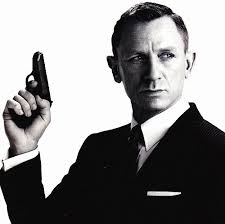
Bond 2With the release of the latest Bond, “Spectre”, a whole bunch of internet articles listed rankings of the Bond theme songs.  Sultry “Nobody Does it Better” generally wound up the #1 choice of most of these polls, followed by the classic “Goldfinger” as the #2, but then their opinions varied more greatly on the rest of the songs (Everybody seems to agree to disparage “The Man with the Golden Gun”, though).  I love those two favorites, as well as other favorites like the rock-operatic “Live and Let Die”, Adele’s stupendous “Skyfall”, and guilty pleasure “You Only Live Twice”.  And of course the undeniable original Monty Norman Orchestra instrumental.  My personal sentimental favorite is the end credit Bond Theme from “One Her Majesty’s Secret Service”: “We Have All the Time in the World”, sung by Louis Armstrong.

Louis Armstrong – We Have All the Time in the World
For - EastonToday’s blog piece is about the curious case of the two versions for “For Your Eyes Only”.  Sheena Easton’s “For Your Eyes Only”, polished to a perfect 80’s sheen, is the version that graces the movie credit sequence of “For Your Eyes Only”, with Sheena Easton being the first singer of a Bond theme to be seen as well as heard during said sequence.  But Blondie’s 1960’s spy movie flavored “For Your Eyes Only” was written first.  And I keep coming across different versions of the story about the writing and rejection of Blondie’s “For Your Eyes Only”.  Some say Blondie wrote their version in hopes of being selected by the producers.  Some say the producers commissioned Blondie to write a version, but then preferred Bill Conti and Mike Leeson’s version as sung by Sheena Easton.  But there is a third, more detailed theory.

Blondie – For Your Eyes Only

Sheena Easton – For Your Eyes Only
Continue reading

Posted in Cinema Scope, Melodies Linger On | Tagged , , , , , , , , , , , , , , , | Leave a comment

TROUBLE BUBBLES – The Songs from Childhood that Loom Large All One’s Life

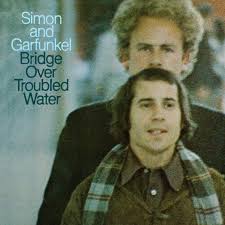
Bridge overI was three years old when Simon and Garfunkel’s “Bridge Over Troubled Water” was released and became the one of the most popular songs of its time.   One of my earliest memories is of me, small boy hardly taller than my parents’ stereo loudspeakers, dancing about the living room, singing loudly:

“Like a bridge over trouble bubbles!”

Troubled Water was perhaps a metaphor too deep for three year old me, and besides, trouble bubbles is a cool internal rhyme, right?

Bridge Over Troubled Waters (live)

I loved the song.  It loomed large in my imagination.  It wasn’t merely a popular song.  It was a monument.  One of the important consuming items in my young life, as only a Really Important Thing can be to a three or four year old.

As such it has always remained one of the defining songs of our time in my estimation.  There is something about a song, or perhaps any work of art, when it is introduced at a very young age and then makes a big impression, that can take on the power of a religious relic to a true believer.

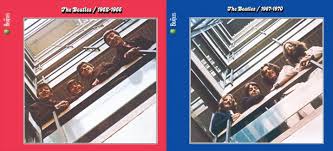
Beatles blue red“Hey Jude” is another song that effected me that way at a young age.  The whole Beatles catalog, or rather the Greatest Hits compilations known then as the Red Album and Blue Album, which my older brother David owned, loomed large for me.  The Beatles will likely remain beloved and highly critically acclaimed for as long as human culture persists, and one reason may be how accessible so many of their songs are to young children.  I noticed this as a teaching artist teaching songs to Pre-K and Kindergarten classes.  Beatles songs are gold for them.  Songs like “Yellow Submarine”, “Hello, Good-bye”, “Ob-La-Di Ob-La-Da”, “I Want to Hold Your Hand” to name just four, have the easy to learn, fun to sing, joyous qualities that captivate young children, and are so much more interesting for grown-ups to teach and sing along to than, say, “The Itsy-Bitsy Spider”.

Continue reading

Posted in Beginnings, Melodies Linger On, The Teaching Artist | Tagged , , , , , , , , , , , , , | 1 Comment

SPEAKEASY CAMPAIGN VIDEO PREVIEW – plus Audition and Facebook News!

Speakeasy Kickstarter Fundraising Campaign Video:

Above is a sneak peek at the video we created for our upcoming Kickstarter fundraising campaign for Speakeasy.  Look forward to the fundraiser being launched in a little over a week.  Meanwhile you can now already watch the video Stolis Hadjicharalambous and Henry Borriello shot and Stolis edited for us.  They did a great job!

Also, Speakeasy now also has its own Facebook page you can go to and “like.”  One more way to keep in touch with all the Speakeasy news and articles, which will be coming in faster and furiouser, or rather curious and curiouser, now that we have a reading just around the corner (Dec 7) and the full out showcase around the next (Feb/Mar 2016).

For example, we recently concluded our first round of auditions with another round slated for December.

Continue reading

Posted in Live! On Stage, The Speakeasy Chronicles | Tagged , , , , , , , , , , , , , , , | Leave a comment

FIRST GRADE OPERAS: New Similarities and Differences

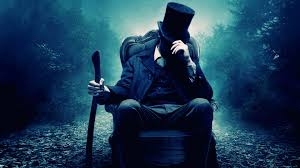
magician 3

When all three first grade classes chose “Magic” as the theme for their original operas I worried that the three pieces would all end up being too similar.  However, the three “Theme Sentences” (for 1-1: “Magic can control people’s minds”; for 1-2: “Kids teleport back in time to meet their younger selves”; for 1-3: “Magic can make money so you can buy anything you like.”) gave me hope that each class’ opera would still be distinct from its cousin down the hall on the second floor of the Brooklyn Children’s School.

magician 1

But then things got a little similar again.  As the stories – or each opera’s scenario  – began to take shape, the same premise evolved independently in each class:  there would be a magician or wizard type character to whom the other characters would go to get their needs fulfilled by magic.  Would each opera this year be uncomfortably similar after all?

Continue reading

Posted in The Teaching Artist | Tagged , , , , , , , , , , , , , , , | Leave a comment

SPEAKEASY Campaign Video Update

V7 - 1920s-harlem-gay

Stolis Hadjicharalambous has completed the final edit of the Speakeasy fundraiser campaign video.  The Kickstarter fundraising campaign will launch in about two weeks.

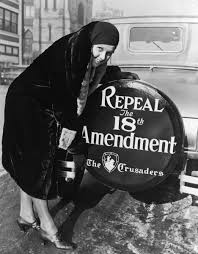
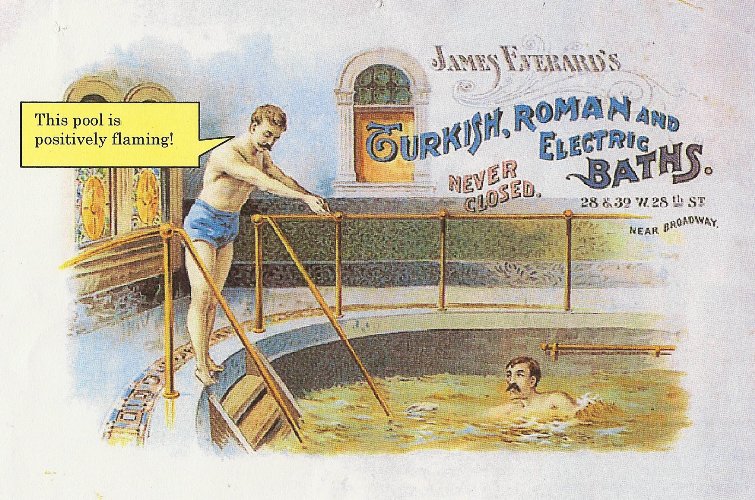
Meanwhile, here are stills of some the images and tracks of some of the music that will be featured in the video, to whet your appetite.

Flapper 4era 2

Dance into the Light

v male kisslesbians 1

V7 - Everard bath poster Continue reading

Posted in LGBTQ Alphabet Soup, The Speakeasy Chronicles | Tagged , , , , , , , , , , , , , , , | 2 Comments

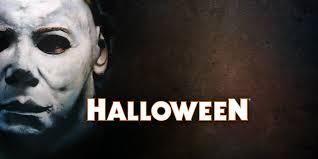
Catching HALLOWEEN around HALLOWEEN 1978 in a seedy New York theater

Halloween 1

My father insists that the movie theater or rather many of the patrons in the theater were scarier than anything that was happening on the screen.  Possibly.  I was eleven and not world-weary enough to be wary of the pot-smoking gang of guys sitting in the front seats.  That families and their young children were also sitting in the middle rows softens my impression of just how scary the patrons watching “Halloween” in that run down Upper West Side movie theater in the fall of 1978 might have been.  But my father insists to this day he was more afraid of the surroundings than the movie.

Halloween 2Yet I remember him jumping in his seat in the back row to my left more than once, as was my 16 year old brother David to my right.  I meanwhile was cowering, crouched low in my seat, knees up, chewing on my jacket in abject terror.  The theater and patrons had nothing to do with that.  It was the movie that absolutely terrorized me.

It was also one of the great movie theater experiences of my life.  A total terror filled treat.  It wouldn’t be long till I taught myself the simple if unusually metered “Halloween” theme on the piano, playing the tinkling upper notes and the booming low octaves with relish and the pedal pressed down.

Halloween Theme

I’ve heard theories that what makes a movie the scariest movie one has ever seen has less to do with the quality of the filmmaking or the scares, although it helps, than with one’s age and circumstances when one saw the film.  Most people’s scariest movie is one they first saw as a teen or tween.  Well, I was eleven, visiting my grandmother in New York City with my dad and brother, and “Halloween” was out in theaters and a big hit with audiences and critics.  The ads in the papers touted glowing reviews and the tag lines: “When were you last scared out of your wits by a movie” and “We dare you to see it”.

I was a kid who loved to watch the old Universal and Hammer horror movies on German TV.  Also, American Forces Network TV in Berlin would show a b movie “creature feature” every Friday night and I would often stay up late to indulge.  I pestered my father to take us to see “Halloween” at the neighborhood cinema near my grandmother’s house and he relented.  Permissive 1970’s parenting perhaps.  “Halloween” would prove a whole other animal than those comparatively quaint oldies and b movies I’d enjoyed on TV.

ExorcistTo this day it remains the scariest movie watching experience I have ever had.  “Halloween” is often listed as one of the scariest movies ever made, but most of those lists put “The Exorcist” at the top.  I had also wanted to see “The Exorcist” during a previous visit to New York.  But I was eight then and my parents said there is no way we would see it (not that permissive after all).  However after I was tucked to bed, my parents left me with my grandmother and saw the movie with my brother David.  Or at least that is the story which he loudly, tauntingly reveled in the next day.  I was very upset and didn’t want to believe him.  I’m still not sure whether he really did see “The Exorcist” that night.  I myself did finally see it in my twenties, and though I liked it, I didn’t find it that scary.  Extreme fantasy effects and demonic possession don’t rattle me as much as a creeping menace that modulates to a horror that is grounded in reality.

psycho“Psycho” probably would have scared me out of my mind when I first saw it, except I had already learned its secrets and had seen clips of the notorious shower and staircase scenes when I watched a televised tribute to Alfred Hitchcock before finally seeing the whole movie from beginning to end.  Only the cellar reveal was a horrific surprise for me.  Still I did enjoy playing our video of “Psycho” to a succession of innocent high school friends, watching them be scared half out of their minds.
Back to “Halloween”, New York City, 1978, in a dilapidated Upper West Side cinema that, even though it would eventually be renovated, wouldn’t survive the multiplex era.  While my father nervously smelled the odor of urine and pot in the air, I was sinking ever lower into my seat and clutching my jacket ever closer towards my clenching teeth as the movie progressed.

Continue reading

Posted in Beginnings, Cinema Scope, Melodies Linger On | Tagged , , , , , , , , , , , , , , , , , , | Leave a comment

A Halloween Treat: THE TELL-TALE HEART – A MUSICABRE and the roommate from hell who planted its seed

DIGITAL CAMERA

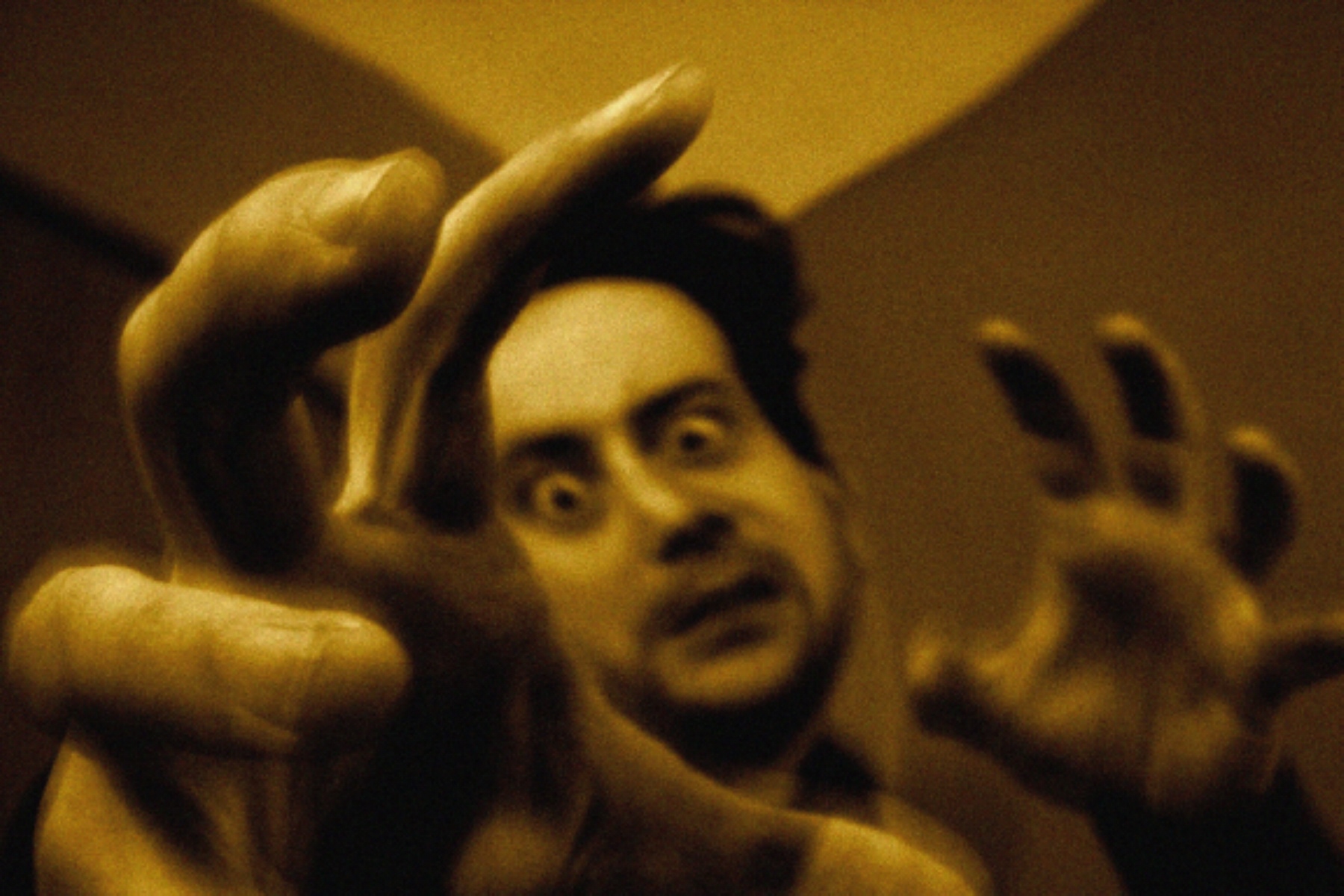
Just in time for Halloween the Tell-Tale Heart page goes live today, showcasing the audio of a live performance of my musical adaptation of Edgar Allan Poe’s “The Tell-Tale Heart”.

The Tell-Tale Heart is the ultimate bad roommate story, as it is the first person narrative of a young lodger who is spooked by the “vulture eye” of his house mate and decides “to take the life of the old man and thus rid [himself] of the eye forever”.  It all goes famously horribly wrong, what with murder and cut up body parts under the floor boards and the phantom heart beat of the victim driving the killer to hysterical confession of the crime.

The story may resonate particularly in New York City, where the economics of housing force so many to live in shares.  Among the 8 million stories of the city are likely 4 million “crazy roommate tales”, maybe not as extreme as Poe’s but harrowing enough.  It should come as no surprise then that the seed to “The Tell-Tale Heart – a musicabre” was planted by an increasingly unhinged roommate of mine 23 years ago.

Tell 39Adapting Poe’s text faithfully word for word, albeit eliding  “is” and “in” a few times or repeating key phrases and sentences for musical effect (plus at one point restating the same idea with synonyms, also for musical reasons – kudos to the sharp mind who can discover that section of lyrical invention on my part), “The Tell-Tale Heart – a musicabre” is a solo piece for a singer/actor, accompanied by three cellos.  This pocket-sized piece is somewhat of a hybrid between musical and chamber opera, I never could say which with certainty, but it is most definitely a one-act horror show, so I chose to classify it as a “musicabre”, mashing up musical and macabre into a novel term.

I wrote and performed “The Tell-Tale Heart – a musicabre” when the Metropolitan Playhouse invited me to create a piece for their inaugural American Literary Festival focused on Edgar Allan Poe, and going up in early 2006.  But I had been working with the text, or at least the first part of the text, beginning with “true – nervous – very very dreadfully nervous” up to “I was never kinder to the old man than during the whole week before I killed him”, as a stealth classical monologue I would whip out for particular acting auditions.  There weren’t many where that monologue was appropriate, but I really enjoyed doing it whenever the chance presented itself.

My escalatingly unhinged roommate of 1992 had suggested I learn “The Tell-Tale Heart”.  He sized me up and decided I was half angel, half devil, and would do very well playing a deceptively sweet psychopath.  This was when he himself was still deceptively sane and centered, a classically trained actor with a professorial demeanor.  I was subletting a windowless room in his basement apartment.  My room was barely more than a closet, but the apartment was nice, and even better, we had a backyard garden where I spent many hours during the spring and summer months right after I moved in.  Unfortunately by the onset of a cold fall, the garden was less inviting, and my professorial roommate was going alarmingly off the rails.

DIGITAL CAMERA Continue reading

Posted in Beginnings, Chamber Works, Literary Lyricism, Poe Musicabres | Tagged , , , , , , , , , , , , , , , , , , | Leave a comment

SPEAKEASY – Attack of the 30 foot Incidental Music!

SP door

So many notes… so little time…

The other day I had a meeting with Speakeasy‘s music director Jonathan Fox Powers.  One of those sessions where you make sure composer and music director are on the same page as it concerns the score, correct any notation errors that may have crept into the score and discuss where I still need to compose incidental music.

IMG_2318_2The songs have all been composed.  But there is still some music in between songs, underscoring, musical comments, little additions that still need writing.  Also, some songs need some restructuring now that the dialog is pretty much set; at least set for the reading on December 7, there will be some rewrites after that to prepare for the February showcase I’m pretty sure.  When I initially wrote a lot of the songs I knew they might be “interrupted” by dialog or other activity between verses and choruses, but I didn’t yet know exactly how that would work out in some numbers, and so those dramatic timing issues didn’t make their way into the written score of every song.  I now need to go back to those songs and make the additions necessary so they musically accommodate the added dramatic action.

So I knew I had some musical homework due in a few weeks, to be ready in time to rehearse for the December 7 reading.  But I didn’t realize just how much it would be.   After Jonathan and I were done making the to-do list, I counted 30 items.  Thirty!

(gulp)

Continue reading

Posted in The Speakeasy Chronicles | Tagged , , , , , , , , , , , , , , | Leave a comment

FIRST GRADE OPERAS: It’s MAGIC time, times three!

magic 1

It’s a whole new season of First Grade Operas at the Brooklyn Children’s School.  The three first grade classes have all begun the process of creating their own original opera, or musical, with performances set for the end of March.  You can read about last year’s First Grade Operas here and here and here.

The first order of business, after discussing what goes into making an opera (words, music, characters, scenery, costumes etc.) is the class choosing a theme for their opera.  Last year the kids in the three classes chose “Space”, “Knights” and “Under the Sea”.  We first discuss what a “theme” is, and talk about whether the theme of Cinderella may be “Love” or “Family” or “Dancing” or something else, then make a long list of “things that are important” to us, like Friendship, School, Food, Toys, Parents, Pets, Air, Pokemon, anything the children offer, to put on the list as possible theme words.

magic 3

Eventually we break up into four small groups, each of which will discuss and nominate a theme.  Then the whole class discusses and votes on the four frontrunners, and this year’s opera theme is chosen.  This is what the opera will be about.

Opera themes over the 16 years I have been doing this at the Children’s School have included Cousins, Toys, Animals, Silliness, Space Pirates, Candy, Past & Future, Graveyards, Electricity, Vampires, Dogs and Cats; Friends used to be a favorite but it hasn’t come up lately.

This year class 1-1 chose Magic.

Class 1-2 chose Magic.

And class 1-3 chose Magic.

Continue reading

Posted in The Teaching Artist | Tagged , , , , , , , , , , , , , , , , | Leave a comment

BERLIN WALL MEMORIES #2 – You Might as Well Have Told Me the Earth was Flat.

wall 1

The night the Berlin Wall came down, Nov 9, 1989, I was living in New York.  I got a phone call around 6pm that night, less than an hour in real time after East German Border guards had received the orders to let DDR citizens travel freely into the West, shortly after 11pm Central European Time.  My friend Marlies, a born Berliner now living in New York, was on the other end:

Marlies:  Danny! The wall has come down!

Me:  Yes I know, the Czechs have made the Wall obsolete.

Marlies:  No, Danny.  The Wall really has come down!  Turn on the news radio.  They’re broadcasting live from Berlin!

Let me explain my misunderstanding.  Only four of five days earlier the Czech government had declared it would no longer prevent East Germans from passing into West Germany through its borders.  With that decision the Iron Curtain had effectively been rendered obsolete.  After a summer and autumn of ever growing peaceful but insistent demonstrations at home, and ever more thousands of East Germans flooding into the West German Embassy grounds of Hungary and other East Bloc nations, eventually making their one-way voyage into the West, the Czech government’s refusal to keep East Germans from easily reaching the West via Czechoslovakia effectively neutralized the Wall’s ability to keep the citizens of the DDR from leaving.

wall 3

That decision was already pretty momentous, and that was what I first thought Marlies was referring to when she called.  Because even with the Czech government effectively making the Wall ineffective as a containing barrier, it didn’t occur to me that the DDR government, in its desperation to stem the ever growing flood of its citizens leaving the country, would completely open up the border.  But they did, and word spread quickly and within hours thousands and thousands of East Berliners were pouring into West Berlin and the night of dancing on the Wall commenced.

wall 15(It could have gone another, horrible way. Weeks earlier, Erich Honecker, then leader of the DDR, had ordered elite troops to move against the growing demonstrations. It would have been a blood bath, but cooler heads prevailed, and Honecker was replaced by his second in command Egon Krenz, who then later gave the order to open the borders.)

Back to my phone call with Marlies.  She had just heard about the Wall coming down from a friend in Berlin.  I turned on the radio and heard live reports of the celebrations, the dancing on the Wall.

I was amazed.  Like I said, even though the Wall had already become ineffective four days earlier, I still hadn’t anticipated this.  For someone who was born in West Berlin, who grew up with the Wall as a constant feature in his life, it was as if the structure of the planet had fundamentally changed.  Like some sort of a reverse Christopher Columbus.  You might as well have told me the Earth was flat.  That’s how significantly the Fall of the Wall changed my perspective on the World.

wall 10

Continue reading

Posted in Beginnings, Notes in the News | Tagged , , , , , , , , , , , , , , , , , | 6 Comments

BERLIN WALL MEMORIES #1 – Growing up 5 miles from the BRIDGE OF SPIES

bos3

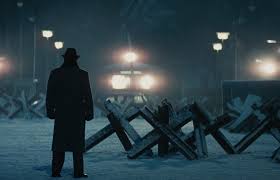
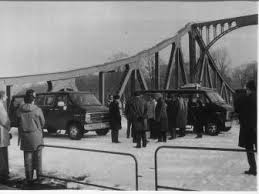
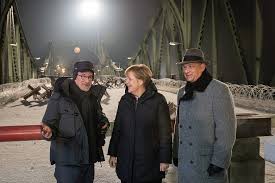
The moment I read the announcement that Steven Spielberg was preparing his next movie called “Bridge of Spies”, I knew, without having any additional morsel of information, that Die Glienicker Brücke – the Glienicke Bridge of Berlin, also known as Die Agentenbrücke, the Bridge of Spies, would figure prominently in the movie.  And although “Bridge of Spies” may function as a movie title that describes a metaphor for the “inspired by true events” story as much as the literal bridge in question, I don’t think I am spoiling anything by confirming that the climax of the movie does indeed place Tom Hanks on the literal Bridge of Spies, famous for the Cold War spy exchanges that took place there over the river separating Berlin from Potsdam, separating West from East.  Except on that location, geographically if not geopolitically speaking, the East was on the western side, and the West was on the eastern side.

bos5

I was born in Berlin five years after the events depicted in “Bridge of Spies” and lived for 19 years a mere five miles from the Glienicke Bridge, in the same Berlin district, Zehlendorf, that borders the bridge, and includes the long avenue Postdamer Chaussee, which becomes Königsstraße, which leads to Postdam, but then could not actually bring you there anymore.  All my life I knew Die Glienicker Brücke as Die Agentenbrücke people would tell tales about, although I would glance it in person only once before the Iron Curtain fell, when my class took a field trip to the nearby Glienicke Park.
The “Bridge of Spies” nickname was evidently earned during the 1950’s, when the Glienicke Bridge was used for East/West spy exchanges on numerous occasions.  Only 3 (or maybe 4 – Wikipedia accounts vary, fancy that) spy exchanges actually occurred on the bridge during the time of the Berlin Wall.  I watched one of them on television in the early 1980’s.  Other than those few East/West bartered prisoners, including the two most famous ones, Abel and Powers, dramatized in “Bridge of Spies”, no humans crossed that bridge from end to end in almost 30 years*.

bos2

Anticipating the movie “Bridge of Spies” and finally seeing it Friday afternoon stirred many memories about growing up near the titular bridge and the Berlin Wall.  The movie is a sterling example of solid grown-up Hollywood film art, and with masters like Spielberg, the Coen Brothers, Kaminski, Hanks, Rylance involved, it could hardly be otherwise.  My favorite scenes came early in the movie when episodes of ominous pursuit and evasion were played with wordless, taut suspense, reminding me of classic black and white Hitchcock masterpieces.

Continue reading

Posted in Beginnings, Cinema Scope, Notes in the News | Tagged , , , , , , , , , , , , , , , | 4 Comments

ENNOBLING TITILLATION – Company XIV’s carnal, campy, classy CINDERELLA

c7

“a baroque burlesque ballet”

That is how AMDM Productions describes the luscious presentation of “Cinderella” currently playing at the Minetta Lane Theatre.  This undeniably adult take on Charles Perrault’s Cinderella (1697) by Company XIV, which deliciously blends “opera, circus, Baroque dance, vaudeville and cabaret styling to create a whole new spin on the classic” had me completely enraptured throughout its three sexy and sensational acts of incredibly accomplished singing, dancing and acrobatics, ennobling good-natured cheesecake and beefcake sauciness.

beautifully bared buttocks

c1

bodacious balladeering belles

c9The stepsisters (Marcy Richardson & Brett Umlauf) are introduced singing the Irving Berlin chestnut “Sisters”; that’s not too unusual, but it is clever and unnerving that they are warbling perfectly accented German as “Schwestern”.  That these performers have classically trained operatic chops becomes even more abundantly clear when they sing Lourdes “Royals” in a French translation, making it sound like the Flower Duet from Lakme.

Later one of the stepsisters does an amazing twirling, upside-down-hanging pole dance twelve feet in the air while expertly singing a classical opera aria (also in French; wish I could say which aria, but the musical selections weren’t credited in the program).  Incroyable! Merveilleux!

Continue reading

Posted in LGBTQ Alphabet Soup, Live! On Stage, Melodies Linger On | Tagged , , , , , , , , , , , , , , , , , , , , , , , | Leave a comment

Speakeasy Gay Slang – FLOWERS & FLORISTS & MAE WEST, Oh my!

Mae West

Mae West

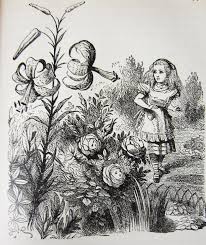
Alice flowers 2After Alice goes through the mirror in Lewis Carroll’s “Through the Looking Glass” she wanders through a mirror image fantastical version of the house she left, then discovers a garden with flowers who not only can talk but will also talk back at her with attitude.  The equivalent scene in the musical “Speakeasy” finds John Allison wandering through a labyrinth of glass and mirrors until he discovers a flower shop.  Inside are a trio of Florists, gay men working after hours sewing their dresses for the Jefferson Ball.

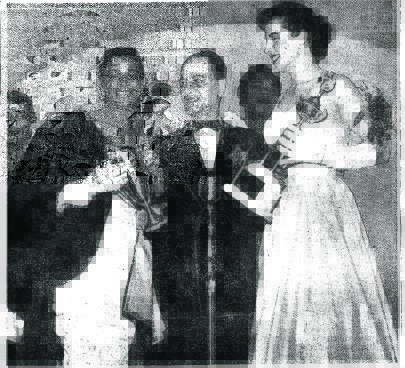
Prizewinners at the Hamilton Lodge drag ball

Prizewinners at the Hamilton Lodge drag ball

The Jefferson Ball is based on the Hamilton Lodge Ball, the largest of the drag balls that were hugely popular in the 1920’s and 1930’s. (I will go into more detail on that in a future post.)

You can get a taste of the beginning of the scene where John meets the Florists and their mentor Julian Carnation (much more on him in a future post too…) in The Speakeasy Glossary.   One big question for me writing this and other scenes in Speakeasy was trying to authentically capture the idioms of Prohibition era Queer subculture.  Non-fiction history books supplied me with many slang words, but not much actual authentic dialog as spoken by gay men and women amongst themselves, away from mainstream ears.  There are hints of 1930’s gay argot here and there in some pre-code Hollywood movies (the documentary The Celluloid Closet provides a few choice excerpts) but nothing extensive, as far as I could tell.

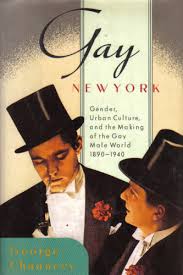
Gay New YorkThe best descriptions of the Gay repartee of the time comes in the most authoritative non-fiction book on the era, George Chauncey’s “Gay New York – Gender, Urban Culture and the Making of the Gay Male World, 1890 – 1940”, when the author describes Mae West’s play “The Drag” in detail.  Mae West brought three plays to Broadway between 1926 and 1928, “Sex”, “The Drag” and “The Pleasure Man”, which caused quite the scandal and got Ms. West in a lot of trouble with the law, as well as made her a star.

Mae West shocked and titillated contemporary audiences by putting gay male characters and dialog full of gay slang and campy repartee on stage.  Mr. Chauncey peeked my interest by quoting a few choice ripe lines in his book and promising a climax to “The Drag” that featured a “drag ball, which lasted twenty minutes and allowed thirty of its performers to put on a “show” much as they might have” at any of the actual drag ball venues of the time.

Continue reading

Posted in LGBTQ Alphabet Soup, Literary Lyricism, The Speakeasy Chronicles | Tagged , , , , , , , , , , , , , , , , , , , , | 1 Comment

WE’RE READY FOR YOUR CLOSE-UP, MR. ELDER – Video Shoot for Speakeasy Fundraising Campaign

Version 3

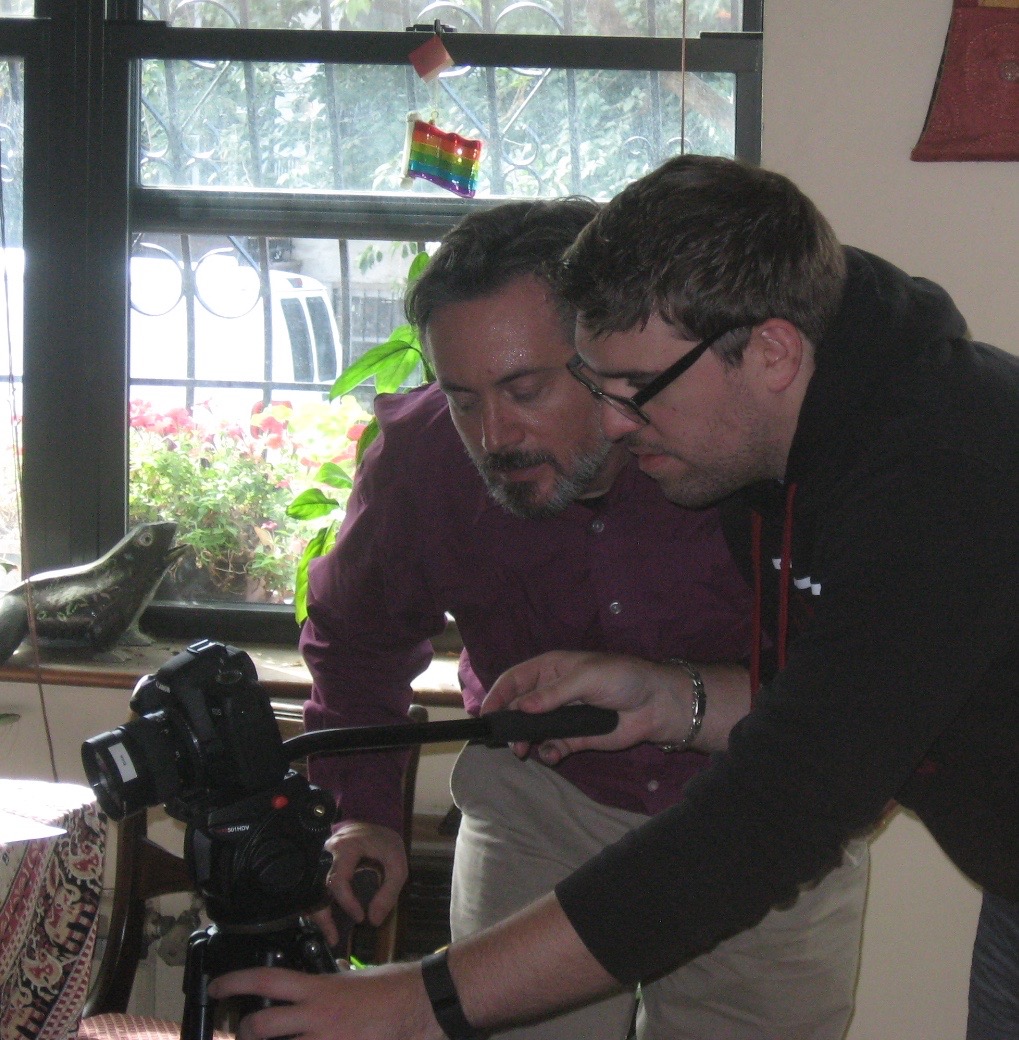
Wednesday we had a mini film crew in the house.  Henry Borriello and Stolis Hadjicharalambous (try typing that out real fast) agreed to help us out filming the promo video not required but very much encouraged if you are planning to set up a fundraising campaign on a certain kicky website.  And Speakeasy is going to require some serious fundraising to realize the four week large ensemble showcase run next February at the Theater for the New City.

Director Lissa Moira, Music Director Jonathan Fox Powers and Co-Producer (and husband o’ mine) Edward Elder joined me in imparting their views on the Speakeasy Project to the camera in what we jokingly called our “Masterpiece Theater” chair, the burgundy lounge chair Stolis chose to be the interviewee’s seat, and which we moved in front of the bookcase for best framing.

The fundraising campaign and the video accompanying it will go live in November.  Until then, here are some shots from the shoot.

Version 2

Danny and Stolis checking out the framing of the shot

Henry and Stolis

Henry and Stolis

Version 2

Here’s looking at you, kid.

“Art Directing” the part of the bookcase that’s in frame behind the chair. Each book and knick-knack was “selected”.

vs5

Jonathan Fox Powers

Jonathan Fox Powers

Ladies, he's single!

Ladies, he’s single!

Continue reading

Posted in The Speakeasy Chronicles | Tagged , , , , , , , , , , , , , , | Leave a comment

4th Grade POWER OF PROGRESS – The Immigrants

immigrants 6

Last spring the full 4th grade of the Brooklyn Children’s School presented “The Power of Progress 1840 – 1920”, a multi-media, multi-disciplinary event where different groups of children created presentations and performances on such topics as Suffragettes, Newsies, Tenement Buildings, The Great Migration, Immigrant Pastimes and Diets.

The dance teacher Sandy Stratton-Gonzales and I mentored the 4th grade Musical Players who created a mini-musical called “The Immigrants”.  Their performance began with the singing of the theme song “Power of Progress”.

Power of Progress

immigrants 1

The 4th grade musical players, a group of 13 boys and girls, composed the music for “Power of Progress” and wrote the lyrics for the chorus and part of one verse in a group effort.  The rest of the words for the verses were written one couplet at a time by the students in each section of the Power of Progress program (fondly referred to as POP).  So the Migration group wrote “Migrants fled the south to look for better jobs and freedom” and the Pastimes group wrote “Children played in empty lots and played on open roof tops”, and so on.  (The complete lyrics for “Power of Progress” are reprinted at the bottom of this article.)

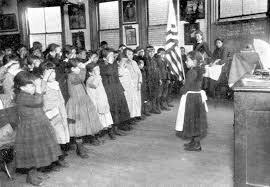
immigrants 3The setting for the play “The Immigrants” is a schoolroom of children recently immigrated to America around the turn of the century.  Each child tells a short tale of their journey, informed by research the musical players did in books, the internet, or by interviewing family members with immigrant stories.

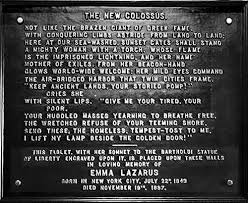
Then the children sing a hymn, based on the famous poem “The New Colossus” by Emma Lazarus, which is engraved on a plaque mounted on the Statue of Liberty.

Give Me Your Tired 1

Give me your tired, your poor

Your huddled masses yearning to breathe free

The wretched refuse of your teeming shore

Send these the homeless tempest-tost to me

I lift my lamp beside the golden door

Immigrants - Give Me Continue reading

Posted in Live! On Stage, The Teaching Artist | Tagged , , , , , , , , , , , , , , | 3 Comments

EVOCATION II – Double Stop Etude or Relationship Elegy?

Edward Elder and Danny Ashkenasi - 4/25/1998

Edward Elder and Danny Ashkenasi – 4/25/1998

There were about 200 wedding guests present when Ed and I got married (the first time) April 25, 1998.  It took at least an hour for the reception line to make its full way past us.  And with the expected good wishes and hugs there was also the occasional conversation that went something like this:

Guest: “So, your second year.  That must have been hard.”

Me: “What do you mean?”

Guest: “The music for the second duet was so sad.  Like you two got through a really difficult time that year.”

Me: “Oh no. The piece is not biographical.  I just wanted to write something with double stops for the viola.”

Guest: “Really.” (With an expression that is both skeptical and concerned.)

Me: “Yes, truly.  Ed needed to practice double stops.  We were quite happy that year.“

Ed: “Although practicing those double stops did drive me to tears…”

Moving on to the next guest, with the passing one looking unconvinced…

E 2 b Continue reading

Posted in Beginnings, Chamber Works, LGBTQ Alphabet Soup | Tagged , , , , , , , , , , , , , | 1 Comment