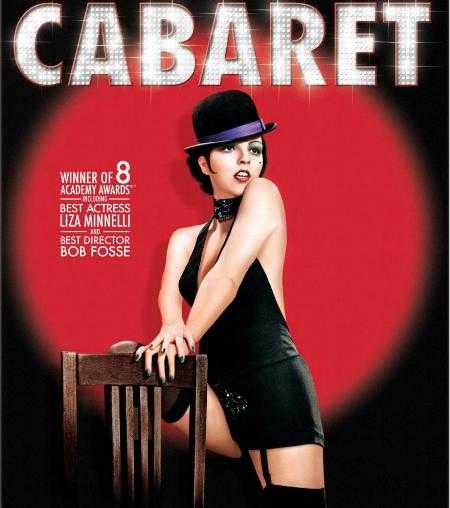
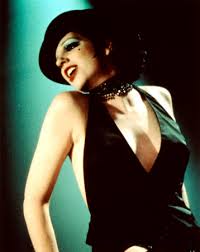
Liza Minnelli as Sally Bowles in Cabaret
When people who say they hate musicals explain why they hate musicals they usually fall back on this well-worn reason: it is unrealistic that characters just break into song and dance; this doesn’t happen in “real life”. I find this a rather eye-rollingly lazy reason to reject musicals as an art form. Do we reject comedies because in real life people generally don’t engage in hilarious dialog and pratfalls? Do we reject action films because in real life all those extreme stunts just don’t keep occurring like that? Do we reject horror films because there is just no such thing as zombies and mummies and vampires (never mind that they are a reflection of our subconscious desires just as much as a song is in a musical). If you hate jokes, fine, reject comedies. If you don’t want to watch violence, fine, reject action films (like my mother-in-law does). If you hate being scared, for heaven’s sake, avoid horror movies. And if you don’t like music, avoid musicals. But if you do like music (and really, most everybody does), it doesn’t make sense to reject all musicals just because people sing in them. People breaking into song in musicals is as much a suspend-your-disbelief integral element as all the other suspend-your-disbelief elements we accept to enjoy genres of art, or even the basic tools of the language of cinema, like editing, lighting or musical scoring. Or as one blog post I found that goes into great detail defining various musical tropes puts it: “Musicals have songs in them – just go with it.”
That said (or vented), there is at least one musical that most stringently circumvents the “characters breaking into song” trope. Cabaret is chock-full of brilliantly realized musical numbers, but all of them are performed “realistically” within the context of a performance actually happening as naturally as any other interaction between characters in the real world. If you absolutely must avoid suspending your disbelief at seeing “characters break into song” when “in real life” they wouldn’t, couldn’t ever do that, then I invite you to watch the movie adaptation of Cabaret. It also just happens to be one of the greatest musicals (or movies) ever made.
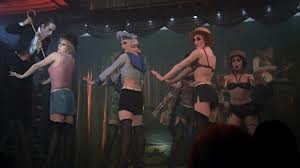
Joel Grey as the M.C. with the Kit Kat Girls
The stage version of Cabaret, a big hit on Broadway in 1966, was a traditional musical where characters would burst into song. It also included scenes in the Kit Kat Club, a seedy Weimar Berlin cabaret, where the creepy Master of Ceremonies (played by Joel Grey on stage as well as on screen), the Kit Kat Girls and Sally Bowles (played by Liza Minnelli in the movie) would perform numbers that would comment on the musical’s narrative. These numbers were therefore not suspend-your-disbelief moments of characters breaking into song unrealistically, but real life performances at the Kit Kat Club, which was as much a real setting of the musical as the boarding house where Sally resided.