A few days ago the Academy, aka the people who hand out the Oscars, revealed the list of songs from this year’s movies that are eligible to be nominated as best original song in a motion picture. There are 74 eligible songs. I have maybe heard 12 of them so far, and even fewer in the context of the movie they play in (and that is an important factor, as I will explain later), so I really don’t have much of a leg to stand on when making guesses about the eventual nominees, but…
For fun, and because I have a hunch that won’t leave me, I have what I think is a pretty good idea which song may end up being the stealth surprise nominee nobody or hardly anybody saw coming. If I am right, it would be pretty cool. It I am wrong, who cares, right? This is just a blog, not a national newspaper, or trades magazine, or anything like that. I will give you my guess at the end of this little write up, and for the sake of completion, include the full list of 74 songs thereafter.
 But really, how to guess which songs will eventually be nominated? Oscar prognosticating is a fun sport in certain corners of the internet, but this is one of the most notoriously difficult categories to predict. Every year there seem to be strange left field choices (two years ago one of those left field choices got disqualified in a bit of a scandal) or the inexplicable lack of nomination for a song everyone had expected would win.
This year a song everyone thought was the front runner didn’t even end up on the list of 74: Brian Wilson’s “One Kind of Love” from the excellent music biopic “Love and Mercy”. To understand why it was left off the list, let me quote Variety’s Kris Tapley’s rundown of the eligibility rules for Best Song candidates:
To be eligible, a song must consist of words and music, both of which are original and written specifically for the film. A clearly audible, intelligible, substantive rendition of both lyric and melody must be used in the body of the film or as the first music cue in the end credits.
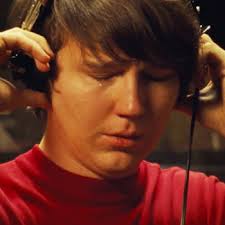
Paul Dano as Brian Wilson in “Love and Mercy”
It appears that “One Kind of Love” may have been deemed the second cue in the end credits, although, if that is the reasoning, one could argue whether that really is the case, because what may have been deemed the first cue is live footage of the real Brian Wilson singing “Love and Mercy”, and perhaps more of an epilog to the movie rather than an end credit song. But I am speculating here on the reasons for disqualification, not quoting anyone else (and I may be remembering the end credits incorrectly). The only other reason the song might be considered ineligible is if the Academy decided the song wasn’t originally written for the movie. Many popular movie songs people point to when decrying their lack of a Best Song nomination in the past were deemed ineligible for that reason, like “Maybe This Time” from Cabaret or “Come What May” from Moulin Rouge.
I wouldn’t be surprised though if “One Kind of Love” ends up winning the Golden Globe in January. It is one of their 5 nominees for best song. The Globes song nominee list always differs somewhat from the Academy Award list, but it is a good place to start speculation on the Academy choices.
The Golden Globe nominees are:
Fifty Shades of Grey – “Love Me Like You Do”
Love & Mercy – “One Kind of Love”
Furious 7 – “See You Again”
Youth – “Simple Song #3”
Spectre – “Writing’s on the Wall”
Before we speculate, let’s look at the process of how the Academy members choose their nominees. Again I quote Kris Tapley:
During the nominations process, all voting members of the Music Branch will receive a Reminder List of works submitted in the category and a DVD copy of the song clips. Members will be asked to watch the clips and then vote in the order of their preference for not more than five achievements in the category. The five achievements receiving the highest number of votes will become the nominations for final voting for the award. A maximum of two songs may be nominated from any one film.
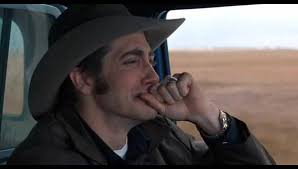
Jake Gyllenhaal listening to “A Love That Will Never Grow Old” in Brokeback Mountain. Unluckily for Oscar eligibility the scene and song excerpt didn’t run long enough for the Academy.
A very important aspect of this process is that Academy members are not merely voting on the song and its music and lyrics, but also on how it is placed in the movie, how it supports and enhances the drama of the film and/or how prominently or effectively the film showcases the song. Some great songs, like Emmylou Harris’ Golden Globe winning “A Love That Will Never Grow Old” from Brokeback Mountain for example, were ruled ineligible in the past because of the limited way they were featured in the film itself.
It is particularly because of the way the unnamed song I am thinking of is used dramatically in its movie that I believe it will stealthily slide into a nomination slot. But we shall see if I’m right after I reveal my hunch further down this post …
Continue reading →

 I plead guilty to being a bit of a Christmas Carol Grinch. OK, I used to be a BIG Christmas Carol Grinch, really loathing most carols and sometimes resorting to lip syncing rather than singing out loud when drawn into a festive sing along. This bad attitude probably stems from having been raised in a secular household blissfully devoid of Christianity. I still enjoyed all the pagan accouterments of the holiday, the decorated (Solstice) tree, the presents, a belief in Santa until I was five (OK, that may not be pagan). But being an aggressively atheistic kid, and stubborn, I didn’t enjoy singing about “Christ the Lord” or “God” or “Baby Jesus”. I admit my atheism at times was as obnoxious as the aggressive certainty of an overzealous Evangelist.
 Now, I’ve put atheism behind me, but I still consider myself “spiritually unaffiliated” and still am a little allergic to the “C” and “J” words, as well as still a bit of a snob when it comes to the whole baby in the manger kitsch factor. Nonetheless, 22 years together with Ed has welded me firmly to a family that loves singing carols together, and has taught me to temper my unfestive disdain, and join in with the music.
 And truth be told, the music to most Christmas carols is very beautiful. I still cringe a bit at the words, especially when it seems the lyrics of foreign carols have been mostly rewritten to interchangeable Christchild adoring homogeneity in English where there was a greater thematic variety in the original, and I still bristle at Beethoven’s Ode to Joy having been rewritten as a Christian Hymn (“Sacrilege, I say!”), but I’ve grown way mellower with age and will be happy to sing along with the program with all the Elders this holiday.
 It is though a bit of an irony that I of all people, this longtime carol-phobe, have found myself writing what I only in hindsight realized were three perfectly seasonally appropriate carols. They are songs from my musical “beTwixt, beTween & beTWAIN” (about which I have posted before
  “beTwixt, beTween & beTWAIN” is a musical adaptation of Mark Twain stories, in Act One short stories based in the American West, in Act Two a musical adaptation of Twain’s episodic travel memoir “The Innocents Abroad”, about the first American cruise ship journey across the Atlantic and all around the Mediterranean Sea.


 Being in the midst of rehearsals for the reading of “Speakeasy” when I saw “Carol” I couldn’t help but find the parallels to my musical. Now, I don’t want to overstate any comparisons. The obvious similarities may really be the only truly legitimate ones: both “Carol” and “Speakeasy” are about homosexual love during the more repressive eras in 20th century America (1950’s for “Carol”, 1930’s for “Speakeasy”). Other than that there are huge differences in medium (movie vs. musical theater), genre (intimate drama vs. big ensemble musical comedy) and more especially tone (serious, realistic vs. absurdist, magical realist). Not much in common there. A bit self serving perhaps to want to make comparisons between my musical theater workshop and an instant modern movie classic, just because they both depict lesbian love. Or lesbian love in repressive times.
 And yet indulge me just a little. There were moments in “Carol”, especially in the depiction of Therese, played by Rooney Mara, where I felt echoes of the character of Jane Allison from Speakeasy as well as her inspiration “Alice” from Lewis Carroll’s “Alice’s Adventures in Wonderland”.
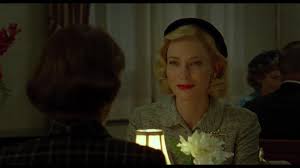 Both Therese and Jane find themselves attracted to and attracting the attentions of an unlikely, older, alluring woman who also has a very commanding personality. In “Carol” this is Cate Blanchett’s Carol, in “Speakeasy” this is Duchess Bentley. One is an upper society suburban housewife, the other an outspoken black lesbian nightclub singer. About as different perhaps as two people can be except for their lesbianism, and the first adjectives one might use to describe the two (haughty, elegant, silky for Carol; bawdy, brash, fun for Duchess) are unlikely to duplicate; yet both women similarly appeal to their younger more reticent counterpart with their commanding personality, the life force they contain in surplus, and the deceptive ease with which they appear to take their mutual attraction for granted.



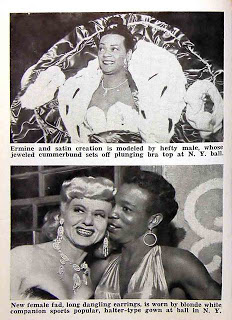
 The Jefferson Lodge Ball is closely based on the historical Hamilton Lodge Ball of Harlem. This annual ball and costume contest started in the late 1860’s and continued through the 1930’s. Drag balls were held in major cities throughout the United States by the 1920’s, but Harlem’s Hamilton Lodge Ball was the most famous, reportedly attracting up to two thousand costumed men (and women) in drag and up to three thousand spectators watching from the balconies.


 “Girls Just Want to Have Fun” is the song that put Cyndi Lauper on the scene and to this day is the song she is most identified with, even though she has had many other hit songs since, recorded dance albums, standards albums and blues albums and recently became the first woman to win a Tony for writing both music and lyrics for the hit Broadway show “Kinky Boots”.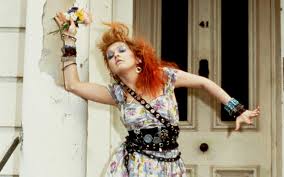

 And follow that up with Cyndi Lauper’s cover version featuring Puffy AmiYumi and lots of brass and Latin party flavor, retitled “Girls Just Wanna Have Fun”:

 Let’s move on to the cover versions by other artists, and of the many cover versions of “Girls Just Want to Have Fun”, this somber piano ballad take on the song by Gary Laswell is definitely the most popular. It is listed as a “demo” and appears to have been considered but not included in his “covers” EP. Nonetheless it has become one of his most successful recordings. He sings it in first person narrative, just like Cyndi, which would make him the girl that wants to have fun.
 When I was researching Gay Culture of the 1920’s and 1930’s in preparation for writing “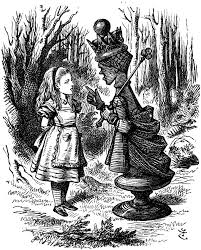
 Except I discovered, a year later after a lot more research into pre-WW2 Queer history and slowly consolidating the various characters and story lines of “Speakeasy”, that I couldn’t remember where I had read that inspirational tidbit about Julian Eltinge. For a couple panicked hours I poured through my notes and various history books, frightening myself that I may have imagined the incident and erroneously built a whole character and plot development around a fiction I only believed was history.
 Maybe that is because his sexuality is in question and thus so is his place in Queer history. Julian Eltinge was by all accounts incredibly good at portraying women on stage. Believable. Entertaining. He performed in Vaudeville, Broadway, London’s West End and in Silent Movies and became very wealthy. However, unlike Julian Carnation in “Speakeasy”, Julian Eltinge, officially was straight. Although believed to be homosexual by many of his peers in the theater, Eltinge aggressively asserted his heterosexuality with extended engagements to women (he would ultimately never marry) and (likely staged) bar fights (methinks the lady maybe doth protest too much?). His personal life is shrouded in innuendo and speculation.
 The bestselling Author Rebecca Cantrell has posted an interview with me about Speakeasy on her blog. In it I reveal some tidbits about Speakeasy and a song demo that had not yet found their way to Notes from a Composer.



 Notes from a Composer