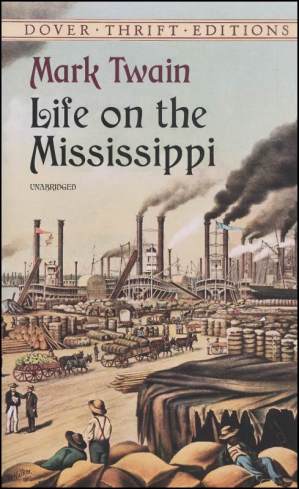
I recently created the TWAIN page, where you can read about stories and listen to musical excerpts from my Mark Twain musical comedy beTwixt, beTween & beTWAIN. Below I will reproduce a complete scene from the musical, the mini-adaptation of a crucial section from Twain’s autobiographical Life on the Mississippi.
This segment deals with Twain growing up on the banks of the Mississippi river, dreaming about becoming a steamboat pilot. His dream will come true, but not without perilous and humorous challenges. Eventually youthful ambition and wonder grows into wistful adult wisdom.
The main songs from this section, Let the River Flow, Mississippi Song and Sunset in the River, can be heard in edited versions on the TWAIN page, but here I will include complete recordings and a complete libretto of the Life on the Mississippi section of beTwixt, beTween and beTWAIN. You can also listen to jazz singer Jacqui Sutton’s take on Mississippi Song (and another song from the same musical) here.
And now, without further ado…
LIFE ON THE MISSISSIPPI
Story: Mark Twain Music, Lyrics and Adaptation: Danny Ashkenasi
DOWN TO THE RIVER AND FAR FAR AWAY
Down to the River/Let the River Flow
SOLO:
Once in Missouri, south of St. Louis
There lived a future grand troubadour
He didn’t know yet what peels of laughter
What tales and stories
He had in store
He was a young man longing to sail the
Grand Mississippi
Some lucky day
One day he’ll tell the story of going
Down to the river and far far away
LET THE RIVER FLOW
ALL:
Let the river flow
See the waters deepen downstream
Let the Mississippi grow
Into your dreams
Take the riverboat
From St. Louis to New Orleans
On the mighty river float
Into your dreams
NARRATOR:
When I was a boy, there was but one permanent ambition among my comrades in our village on the west bank of the Mississippi River. That was to be a steamboatman.
BOY:
We had transient ambitions: when a circus came and went, it left us all burning to become clowns;
ANOTHER BOY:
Now and then we hoped that if we were good, God would permit us to be pirates.
NARRATOR:
These ambitions faded out, but the ambition to be a steamboatman always remained.
ALL:
Let the river flow
From St. Louis to New Orleans
Let the Mississippi grow
Into your dreams
NARRATOR:
Boy after boy managed to get on the river.
BOY:
The doctor’s son became a bar-keeper on a boat.
ANOTHER BOY:
The minister’s son became an engineer.
NARRATOR:
But pilot was the grandest position of all. Two months of a pilot’s wages would pay a preacher’s salary for a year. I had comforting daydreams of a future when I should be a great and honored riverboat pilot.
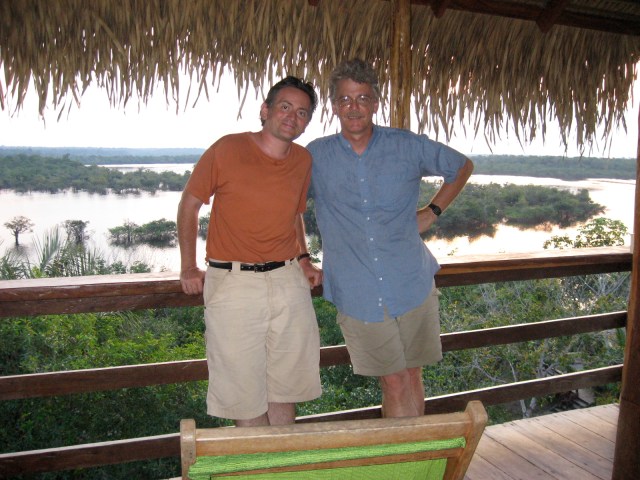
Today that handsome fellow pictured above, who also just happens to be my sainted husband, Edward Elder, turns 57. And, as has become tradition in our 23 years plus together, one of the birthday presents he receives from me today is a duet I composed for viola and piano. Ed plays the viola, I play the piano. And the duets I write for each new birthday are called Evocations. I have already shared posts about Evocation I and Evocation II on Notes from a Composer. Today I will skip ahead a couple decades and share the newest duet, Evocation XXIII.
You may remark that Evocation XXIII is shorter than Evocations I and II. True, it is even much more shorter than some of the early Evocations (oh, like V and X) which took on epic proportions. There is a practical as well as aesthetic reason for the briefness of Evocation XXIII, in fact the briefness of almost all the recently composed Evocations. For one, they are called Evocations, which linguistically and aesthetically connotes a hint of something, a suggestion, a brief reverie, not a lengthy meditation or exhaustive discourse (That’s what Sonatas or Rhapsodies are for, right?).
And for another, well, just practically, once you have over 20 viola/piano duets to choose from, it becomes more and more likely that each single one is going to get played less and less over the years. Therefore it is helpful that each new addition to the ever thickening “book” may be quickly learned and swiftly performed, so that Ed and I can better enjoy the playing of it as well as its equally easily breezy* siblings. (Not to harp on poor Evocations V & X, but they are not only epically long but also require a lot of practice for us to get halfway decently right; and thus haven’t been played in over ten years…).
Anyway, enough talk, on to the music. Here is the computer program’s rendition of Evocation XXIII. Ed and I will be playing it ourselves too later this morning, using actual instruments.
Celebrities, Politicos, Soccer-Moms and Babies gettin’ their Alexander on!
Exploring the intermittently sublime sub-sub-sub genre of singing along to Hamilton while riding in a car!
Above is the famous Late Late Show Carpool Karaoke starring James Corden and Lin-Manuel Miranda famously lip-syncing to sections of the cast recording of the musical Hamilton, and then being joined by Broadway stalwarts Audra MacDonald, Jesse Tyler Ferguson and Jane Krakowski. After over 11 million views I think it is safe to call this a “viral hit” and also safe to assume that if you have found this blog, you most likely have already watched this video at least once.
But have you seen the following video, the “lip-syncing” family doing their own take on Hamilton while in the family van “on their way to the mountains”? It is adorable enough while the two older brothers assay Aaron Burr and Alexander Hamilton respectively, but “just you wait” until other family members start joining in. I’ll say no more except enjoy:
Which led me to do a little research on videos showing lip-syncing / singing of Hamilton in cars. Any more gems like the above?
It’s been a while since I’ve built a new permanent page on Notes from a Composer. See the black banner border above? Where you can access the following pages, or skip to the following content:
Well, in addition to the resume related pages and the pages devoted to three specific music theater pieces (Speakeasy, The Tell-Tale Heart – a musicabre, and The Song of Job 9:11), there is now a seventh permanent page devoted to the Mark Twain musical comedy beTwixt, beTween & beTWAIN. To keep things simple, the page is designated TWAIN.
beTwixt, beTween & beTWAIN adapts several of Mark Twain’s best loved short stories as well as excerpts from Life on the Mississippi and The Innocents Abroad. The TWAIN page includes crisp synopses of the various sections of the show, excerpts from the songs (recorded live), plus links to diverse Notes from a Composer articles that involve beTwixt, beTween & beTWAIN.
Here’s a little example, from Act One, with music:
Sunday, June 26, was Pride Day in New York City. Close to 2 million people watched hundreds of thousands of marchers within about 485 contingents (groups and floats) make their way down 5th avenue, 8th Street and Christopher street, from Midtown to Greenwich Village.
My favorite Quaker, Ed
Some years Ed and I watch the parade go by, some years Ed and I join the Quaker contingent (Ed is a Capital Q Quaker, to the manor born, and I as his husband am called a Friend of a Friend, as in I’m the significant other of a member of the Religious Society of Friends).
The Quakers are considered the first religious community to support the modern Gay Rights movement, having offered sanctuary and refreshments during the Stonewall Riots of 1969 and having marched in the very first Gay Pride Parade the following year.
Me, 7 years ago, watching the parade go by
When you march in the parade, you only get to see a small fraction of all the other groups marching. However you do get to celebrate with all the many colorful, diverse, happy people up and down Fifth avenue and over to Christopher Street. This photo diary shares that experience.
Oh, and of course there will “Pride” themed musical accompaniment, because that’s what I do around here…
Love and Pride – King
Gathering at 41st Street before being led into the Parade line-up
My shirt shows half the Yin/Yang symbol. (It makes more sense when Ed wears the shirt with the other half)
Happy Pride Day, everybody. Today is the Last Sunday in June, when New York City commemorates the birth of the modern Gay Rights Movement and the 1969 Stonewall riots with our Pride Parade and Festivities. Ed and I will be marching with the Quakers.
Today’s Pride Day, June 26, also falls on the year anniversary of the Supreme Court decision affirming marriage equality. So to celebrate Pride Day and last year’s same-sex marriage ruling, I will repost:
Ed and I got married in 1998. And again in 2011. Then our marriage got federally augmented in 2013. And now finally in 2015 the state of our union will be fully recognized in every state of the Union. It’s been a long time coming but our day has come.
Let’s start the celebration with the original recording of “Our Day Will Come” by Ruby and the Romantics.
Today, June 26, 2015, in fact just minutes before I posted this piece, the Supreme Court ruled that the United States Constitution guarantees a nationwide right to Same-Sex Marriage.
This Sunday’s Gay Pride marches will be especially festive. It has been a long time coming, for the LGBTQ community and for the nation as a whole. It has been a long day coming for Ed and me too. During our now 22 years together the nature of our relationship has grown and changed, but not nearly as much as the legal nature of our marriage.
Ed and I met April 25, 1993 in the back of a greyhound bus returning to New York from the large March for Gay Rights that had just taken place in Washington D.C. It was my first LGBT march, after having just attended the First National Bisexual Convention. The greyhound bus only had one seat left in the back when I got on, the seat next to Ed. Neither Ed nor I are the gregarious type likely to chat up strangers on a bus, but today we both made a conscious exception, each thinking it might be nice to meet someone. For the next 4½ hours we sat side by side getting to know each other. It was only after we got off the bus that I got a good look at Ed’s face from the front (rather than a ¾ profile) and noticed his height (six foot one) and broad shoulders.
After a year of dating Ed and I came to the mutual understanding that the anxiety of losing the other was now equal to the anxiety of facing a whole life time together, and that with every following day the former would grow and the latter would fade. In other words we were in love! After four years of toggling between a Chelsea and an Upper West Side studio apartment (our two bedroom unit connected by a 50 block hallway and the C subway line) we finally moved in together in Brooklyn and set the date for our marriage ceremony: April 25, 1998, the fifth anniversary of our meeting on that greyhound bus.
Let’s celebrate that day with Karen Carpenter’s smooth rendition of “Our Day Will Come” (and ignore the awkward radio announcer that mars the end of this track from the concept album “Now and Then”).
Our Quaker Marriage Certificate
Our marriage would be a Quaker wedding ceremony augmented with musical framing and performances, as Quakerism is Ed’s religion and Music is mine. Friends of ours at the last minute arranged for us to mutually break a wine glass under a white napkin as a gesture towards my Jewish background (if not Faith). Everyone who attended signed the Marriage Certificate, as is Quaker custom. This wedding was not legally binding. There was no legally recognized same-sex marriage anywhere in the USA at that time. The only legal document available to us from our government was a New York City Domestic Partnership Certificate, which only had any real legal bearing if one of us was a city civil servant, and even then it didn’t grant much legal protection. But it was something at least.
In our hearts though, legal recognition or no, April 25, 1998 is the year Ed and I got married. It just took our country a long time to catch up to that reality.
The following contains details of the movie Swiss Army Man, starring Paul Dano and Daniel Radcliffe, as well as of the Harry Potter series which many will consider spoilers.
As well as ghastly many references to bodily emissions, which may spoil much too.
So, apparently the corpse of Harry Potter washed up on a beach. I was stunned and dismayed to see this, since last I’d heard Harry Potter was alive and well, 37 years old, and bringing his two eldest children to the Hogwarts Express on platform 9 3/4 in Kings Cross. The Potter corpse on the beach looked to be in his mid to late twenties. Granted, I didn’t know much about what Harry had been up to between defeating the Dark Lord two months shy of his 18th birthday and the trip to the train station 19 years later. Maybe there was a beach side adventure in his twenties? But he couldn’t be actually dead on the beach like Dobby? Not if he will start a family and drop the kids off at school a decade later? After all, even in the magical world, as J. K. Rowling has confirmed many times, dead is dead. Or?
Harry and dead Dobby on the beach
There was only one witness present at the beaching of Harry Potter’s apparently dead body. Unfortunately this was not a wizard who would recognize a hero from his world, but a ship-wrecked muggle named Hank, who did not know the Chosen One from Adam, and proceeded to calling him Manny. He first regarded Harry as a mere lifeless body, albeit one still exuding some gaseous fumes. Eventually these farts revealed themselves to be a particular potent expression of Harry Potter’s signature magic spell: Expelliarmus!
Hank and dead Harry on the beach
You see, it was soon apparent to a connoisseur of the Wizarding World that Harry was not dead, but suffering from a devilishly potent and only very-slowly-wearing-off spell of Petrificus Totalus. Now Hank thought he was going crazy, imagining himself hallucinating a dead body becoming partly reanimated, when he was simply witnessing Harry’s snailpaced unfreezing from the body binding curse. Eventually Harry was moving his eyes, then speaking haltingly and shifting his facial expressions.
Harry’s Expelliarmus spells were being emitted backside and reoccurring unbidden and unceasing much like Ron’s self-inflicted slug-spewing during his second year at Howarts. Unfortunately Hermione wasn’t around to counteract the effect of the gas with a sound- and odor-inhibiting Muffliato spell. Harry’s corpse started shooting across the shallow surf as if charged by something I’d call Propellus Gastrointestinicus. Hallucinating or not, Hank took advantage of Harry’s redirected and explosively magnified Expelliarmus spells to jet-sky on Harry’s back to the main land.
It would not just be the Expelliarmus spell that would become useful if bodily redirected by the effect of the stubborn Petrificus Totalus curse. The Aguamenti spell would slake Hank’s thirst with water gushing in torrents out of Harry’s mouth. The Confrigo spell would protect Hank from a bear with a flamethrower effect (out the backside again, natch), so powerfully, in fact, I feared Fiendfyre might have been unleashed once more, just as in the doomed Room of Requirement during the legendary battle of Hogwarts. At another point I was sure Nagini, Voldemort’s horrific snake, had made its way into Harry’s pants, but it was just his penis incorporating the Point Me spell (AKA the Four-Point spell, and now rechristened the Erecto spell in my mind) to lead Hank back to life saving civilization. Hank even exhorted Harry to have “happy thoughts”, but sadly, Harry was not able to produce a Patronus in his Petrificusly frozen state. Possibly because Harry had no memory of who he was or his former life. Had an unreformed Deatheater obliviated his memories before administrating the body-bind curse and dumping him on the beach? If only J. K. Rowling would confirm if any of this is canon!
OK, I’m feeling a little silly and in the mood for a puzzle.
I just posted this tweet:
“I finished a composition la la la la
Part of a cycle 23 years (& counting) in the making la la la la
?? (Clues are in my blog la la la la)”
In other words, you can guess the title of this mystery musical composition I just completed; the information leading to the answer is suggested by the tweet and discoverable somewhere within my blog.
Anyone should be able to guess the title with just a little detective work within “Notes from a Composer”, and I will make digital downloads demo recordings from one my musicals available to the first 10 people who email me the correct answer at admin@ashkenasi.net. (Please put “Composition Title” in subject heading)
The Broadway community has gathered together to produce a charity single to honor the victims of the Orlando massacre. They have given the Bacharach/David classic “What the World Needs Now is Love” the “We are the World” treatment, and the result is absolutely lovely.
Watch the video below, but be sure to purchase and download the song at the Broadway for Orlando website too (Itunes will carry it as well in a few days). 100% of the proceeds go to benefit the LGBT Community Center of Orlando.
You’ll probably easily spot universally recognizable Whoopie Goldberg, Rosie O’Donnell, and Rosie Perez as well as Broadway legends Bernadette Peters, Audra MacDonald, Chita Rivera and Lin-Manuel Miranda. And look, there’s husband and wife team Mathew Broderick and Sarah Jessica Parker! And Joel Grey! Sean Hayes! Carole King! Gloria Estefan! and…
Oh, here’s a copy of the list of participants from the website:
Last June I posted an impressed and irreverent report of of “Snow White and the Seven Hos“, a Disney parody musical benefit for SCA (Sexual Compulsives Anonymous). SCA supports gay and bisexual men with sex addiction issues. Every year they create an original parody musical that chases the original material through a fun house of camp sensibilities and naughty lyrics. It’s all a big wacky adult hullabaloo that never looses its sense of fun, while still incorporating a sincere message about overcoming sex (and drug) addiction. The creators and performers of each year’s show are members of SCA. If you are going to catch just one “amateur theatrical” per year, make it the SCA benefit.
This year’s benefit is called “Wicked Addicted”, and so it looks like Broadway Juggernaut “Wicked” is getting the SCA treatment this year. Just how wickedly will the salacious parodists of SCA rewrite the lyrics to “Popular” or “Defying Gravity”? Just how much more camp and crude will the green-hued and blond-curled divas of Oz be when essayed by Friends of Dorothy in drag? What scary new meanings shall be applied to the term “flying monkey?”
The actor Rob McClure (currently performing in Something Rotten) just posted the following anecdote about Hamilton on his Facebook page. It’s going viral, as they say nowadays. Read it to see why:
“Hamilton deserved every Tony.
Here’s one of the reasons why…..
Last night, thru a series of weird events, I ended up getting a car service back to Philly (home). My driver was a mid 30’s guy from the Bronx. SUPER SWEET. He was asking me all about being an actor. He said all he knows about Broadway is that he’s dropped a few clients off at shows. He mentioned Hamilton and I asked what he knew about it.
Somehow… THIS MAN KNEW NOTHING. Like. ZERO.
I explained and he seemed intrigued so I asked if he wanted to hear the album for the 100 minutes drive remaining. I put it on.
To no one’s surprise, the musical Hamilton dominated the Tony awards show tonight, winning a near record 11 Tonys (after racking up a record breaking 16 nominations).
But beyond the electric charge and grace not only exhibited by Hamilton, but by all the showcased musicals tonight as well as James Corden’s happy hosting, the most poignant moments for me were the many deeply moving gestures to the horrible events in Orlando this morning, beginning with a sincere preamble by Corden, and including Lin-Manuel Miranda’s heartbreaking sonnet to love in the face of violence as well as Frank Langella’s deeply felt eloquence during their respective acceptance speeches.
Congratulations to all involved in tonight’s celebration of a pretty spectacular season on Broadway. And in honor of Hamilton, I will repost my response to Hamilton on Notes from a Composer the day after I attended it last August:
It’s June, rose blooming season. So let’s enjoy some beautiful roses, and since we can’t enjoy their visual splendor accompanied by their sweet smells, we’ll enjoy their sweet sounds in the forms of favorite “Rose” songs from the last hundred years. And right off the bat I concede that my bastardization of the famous Shakespeare quote “a rose by any other name would smell as sweet” (Romeo and Juliet, Act 2, Scene 2) in this post’s title mangles the original beyond logical comprehension.
The Rose – Bette Midler
Can’t not start this rose themed medley without “The Rose”, which is arguably The Rose Song above all. It already sounded like a classic when it came out in 1979. I remember hearing it sung again and again at my high school’s musical auditions, music concerts and talent shows. There were those who would cattily slack the song’s lyrical conclusion (“Just remember in the winter – Far beneath the bitter snows – Lies the seed that with the sun’s love – In the spring becomes the rose”) by asserting that roses are cultivated by making cuttings, and are not grown from seeds. That became a common refrain of ridicule against the song among my high school peers. But of course in the wild, before mankind got their grubby cultivating hands on them, roses propagated by growing from seeds just like any other plant. Silly teenagers!
La Vie en Rose – Edith Piaf
I’m sure there are those who would rank La Vie en Rose above The Rose as the #1 Rose song of the last hundred years. And I agree La Vie en Rose has a stronger claim on evergreen status than any other tune listed here. The problem with the song, for the sake of this article, is that the “rose” in La Vie in Rose more likely refers to the color pink than the flower. That doesn’t disqualify it from this countdown, but explains why Bette Midler gets pride of place before Edith Piaf. But only barely.
Most of these rose pics were taken in the Brooklyn Botanical Garden, which boasts one of the largest collections of roses in North America.
A Rose by any Name – Blondie (featuring Beth Ditto)
Speaking of pride, June is not only rose blooming season but also Pride Month. So to celebrate LGBTQ Pride, take in Blondie’s Deborah Harry dueting with the self-described “fat, feminist lesbian from Arkansas” Beth Ditto:
If you’re a boy or if you’re a girl
I love you just the same
Wherever you go, all over the world
A rose by any name
I wouldn’t be surprised if this post is the first you ever hear of Blondie’s “A Rose by any Name” which of course neatly ties in to the featured Shakespeare quote as well as Queer Pride.
The next two Rose titled pop songs, for better or for worse, have been ubiquitous in popular culture, with every likelihood of sticking around in the public musical tapestry for years to come.
June is Pride Month. So I thought I should make my first post of the month a post that deals heavily with LGBTQ issues. And although my many posts related to my musical Speakeasy almost invariably deal with LGBTQ issues, I choose to repost a more personal post on male bisexuality I originally published last September, and which is one of the more widely read articles to have appeared on Notes from a Composer:
The director of “Speakeasy”, Lissa Moira, and I were conducting another one of our weekly meetings pouring over the script and discussing staging and production issues, when I mused aloud that in many ways “Speakeasy” is an expression of my bisexuality.
“You are bisexual?” Lissa asked.
“I thought you knew”, I responded, dumbfounded.
How could Lissa, who has known me for years, not be aware of that fact about myself? It is not something I try to keep secret. And she’s known me for decades. But that is the problem with bisexuality. It is so easy to keep hidden, even if there is no intention to hide it. Society may not assume someone is heterosexual as categorically as society used to, but monosexuality – hetero or homosexuality – is nowadays still the default assumption.
Or is it? Just these past weeks have seen a slew of studies showing that the upcoming generation of young adults are much more comfortable with sexual fluidity and placing themselves on the bisexual spectrum than older generations (see here and here and here). Charles Blow has written profound editorials about bisexuality in the New York Times. Entertainment websites keep posting lists of celebrity bisexuals (like this one or this one).
Except, those lists of celebrity bisexuals usually feature three women for every one male or must resort to listing men long deceased to beef up the ratio. Out bisexual males are still very rare in our culture. Even Alan Cumming (pictured above), who so deliciously professed erotic desire for men and women not once but three times while hosting the Tony Awards this year has not embraced the “bisexual” label (as far as I can tell) but is more likely to use the word “pansexual” if he allows any label to define him. And that is his prerogative. Labels are limiting. But the bisexual label seems particularly maligned and avoided, especially for men, at least until now. Perhaps with the millennial generation apparently showing so much more acceptance of sexual fluidity and bisexuality than their elders, this might finally change.
But there is still so far to go. There are still so few works of art about bisexuals, especially bisexual men. I applaud the recent explosion of movies and TV shows centering on or featuring transgender stories. And gay and lesbian characters have been incorporated into mainstream entertainment for some time now (not that we have arrived yet anywhere near full narrative integration). But bisexual characters? Especially bisexual male characters? I have to go back to the 1970s and Sunday Bloody Sunday and Cabaret (pictured above) to find well drawn bisexual male characters. Torch Song Trilogy had one too but also gave sympathetic voice to a lot of biphobic prejudices. Yet that is over 30 years ago. What about in film, TV and Theater nowadays? Crickets.
Well, maybe not as much for bi women (Piper, the lead in Orange is the New Black, is surely bisexual, even though in the first two seasons no one appears to have used that term in reference to her). But what about bi men in movies, TV or theater? Where are they? Plenty of gay men to be found, and of course straight men still dominate our culture like nobody’s business. But bisexual men? Nada. Invisible. Don’t mention it.
There may be hope. That pansexual orgy scene in episode six of the first season of Sense8 (pictured above) surely had me shouting “Hallelujah”! But the fact remains that the characters’ sexual fluidity was achieved through involuntary mind-melding – in their own space each character individually still seems to identify as hetero- or homosexual (at least by the end of Season 1).
The tenor Douglas McDonnell sang two songs from Speakeasy at last weekend’s Lower East Side festival at the Theater for the New City: “Dance into the Light” and “All You Are”. Unfortunately technical difficulties got in the way of recording “All You Are”, but Douglas’ rendition of “Dance into the Light” can be heard below. Jonathan Fox Powers provided the accompaniment: