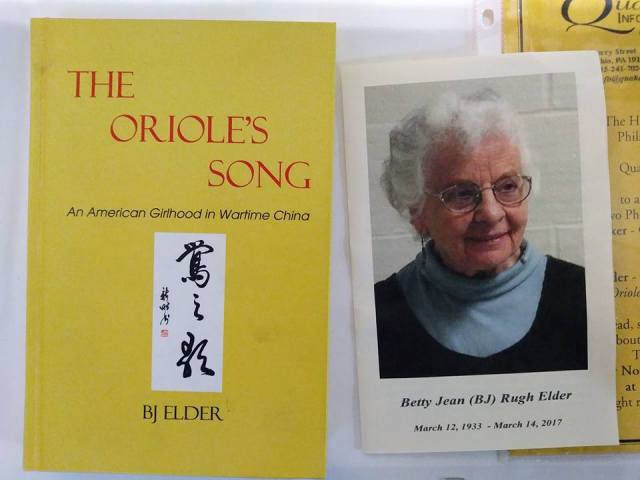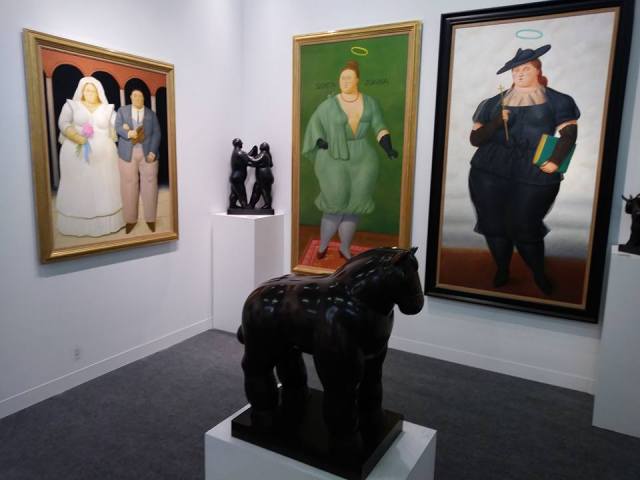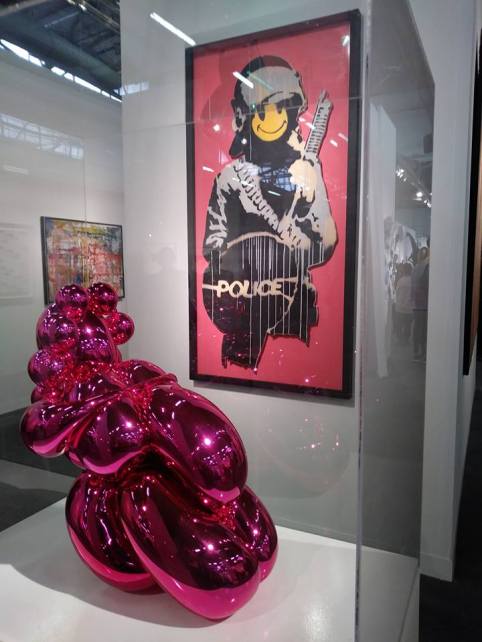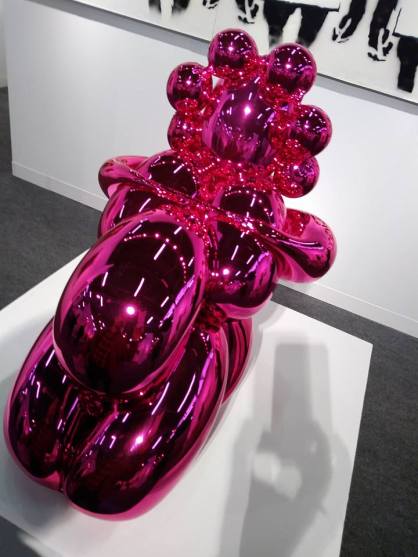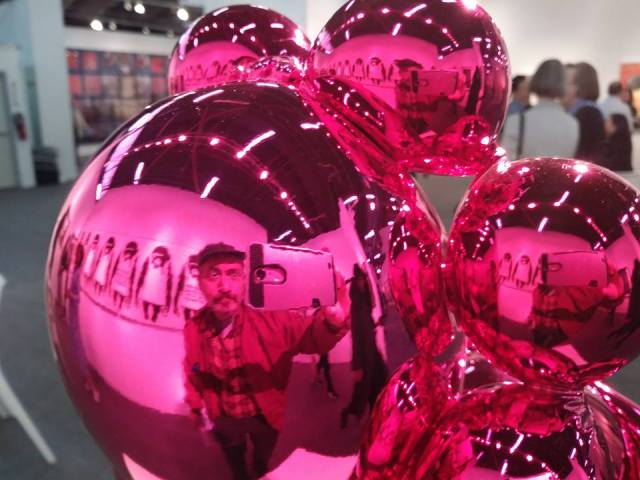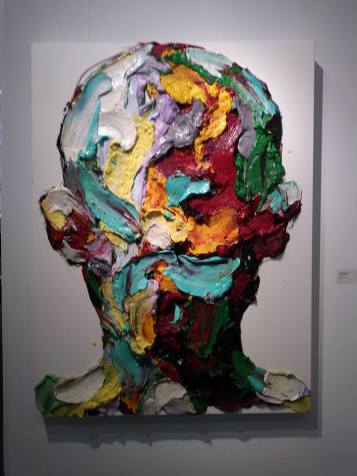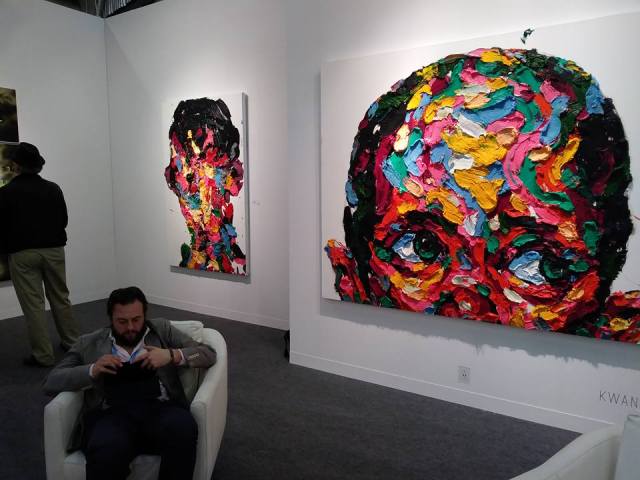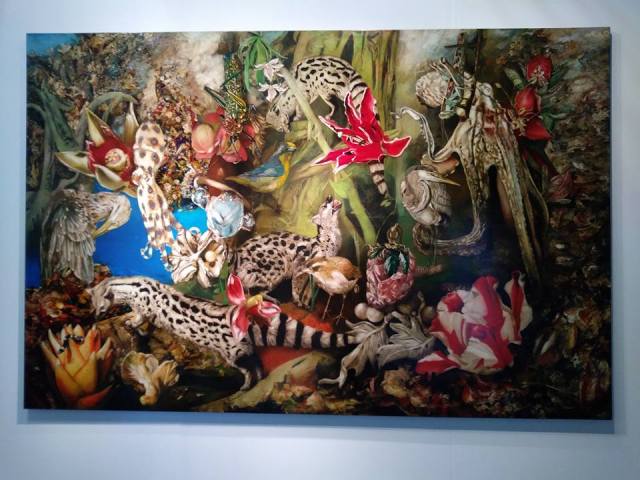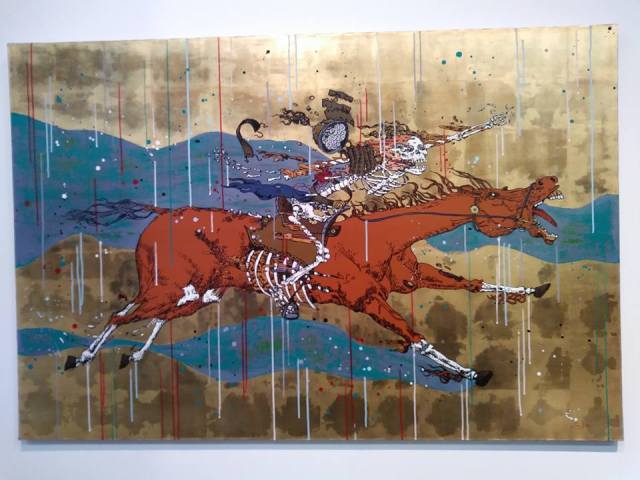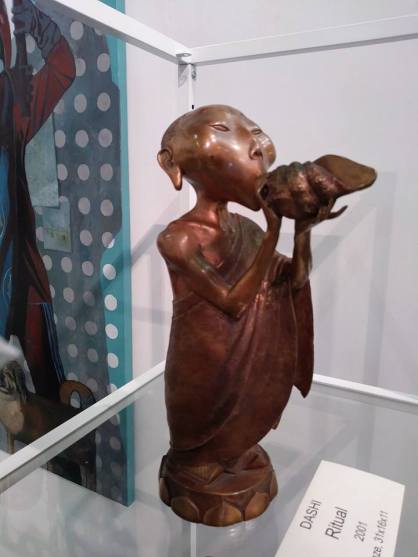
Another year, another visit to the ART NY expo. Here are pictures of some of the works that intrigued me this year (last year’s can be seen here).
Some famous names are included here among the up and comers, like Picasso, Banksy, Warhol, Lichtenstein, Hirst, Koons, and Botero (above, and again further down).
“You are like a circus-horse. As soon as you hear the music, you start dancing.”
That’s the loving joke my father used to make about my mother, most likely in German amongst their Berlin friends, since “Zirkuspferd” (circus-horse) is a word in the German idiom, a more glamorous, theatrical alternative to the mundane, desultory “workhorse”.
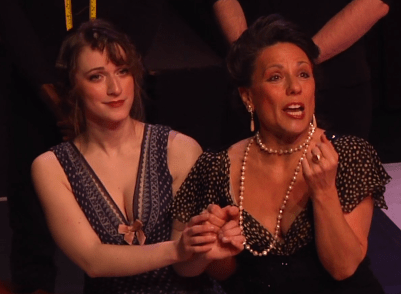
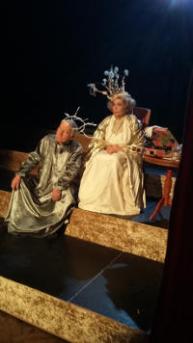
Well, my mother is “dancing” again. The “80 year old Grande Dame of Opera”, as the Berliner Zeitung referred to her, is playing hooky from retirement in the Opera Lab Berlin production of Mauricio Kagel’s “Staatstheater”, which caused such a fuss during its 1971 Hamburg world premiere that the composer required police protection.
Here is Opera Lab Berlin’s promotional video of their production, directed by Michael Höppner, and concluding its run in Berlin today:
Opera Lab Berlin’s website says “Kagel set Staatstheater with the concept of musical theater itself, its conditions and possibilities. This is typical of Kagel’s black-humored, partly grotesque, partly absurd approach but it also leaves room for interpretations and even new conceptualisations of the piece. The only formal requirement is that it must be no longer than 100 minutes duration.”
My mother would tell me details of the rehearsal process that would confuse and intrigue me. I first gathered that the opera was about retired opera singers in an old folks home haunted or even driven mad by their memories. But as that may be how the action begins, the opera itself becomes something far larger, absurdist, elusive, even audience-participatory. It sounds to me like the love child of Eugène Ionesco and John Cage … joining an orgy with the Blue Man Group.
It’s peek cherry blossom blooming season this weekend at the Brooklyn Botanic Garden (bbg.org).
This weekend the BBG is hosting the Sakura Matsuri festival, offering over 60 events and performances that celebrate traditional and contemporary Japanese culture. The picture below shows the set up the Friday before. Every year the BBG hosts a festival to coincide with peek cherry blossom season. Not every year does peek blossoming coincide with the long pre-ordained festival dates. The BBG can choose the most likely weekend, but weather fluctuations have in the past brought on peek cherry blossom blooms up to week away from the festival date. This year’s timing would work out perfectly.
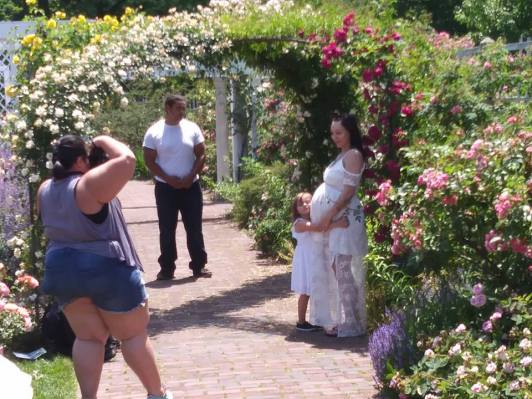
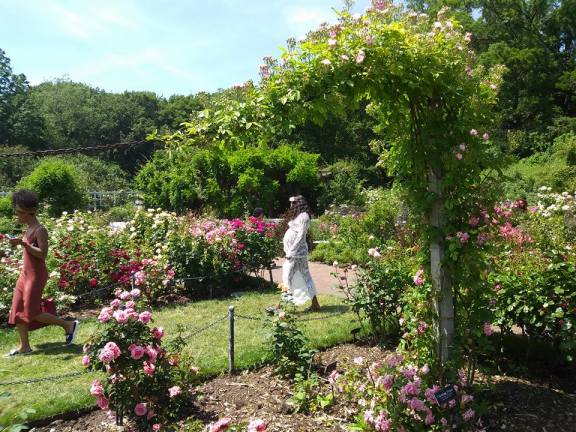
It’s not just the cherry blossoms currently blossoming in the BBG, although they are of course the big event this weekend. I’ll share some pretty pictures from around the gardens before continuing cherry blossom overkill.
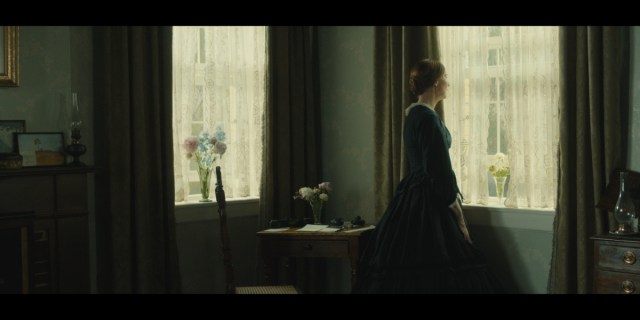
Cynthia Nixon as Emily Dickinson in “A Quiet Passion”
Arthur:
But I’m alone
(Patsy: oh no you’re not!)
So all alone
(Patsy: I’m here you twat!)
All by myself I’m all alone
I’m All Alone (from “Spamalot”) – Tim Curry and Michael McGrath
What do Monty Python and Emily Dickinson have in common? Nothing, probably, except that they both employ the English language. Perhaps a Monty Python sketch may have parodied the Belle of Amherst, but surely a serious biopic about her would not reference Monty Python, would it? And yet…
We were watching “A Quiet Passion”, Terence Davies’ exquisitely crafted movie about Emily Dickinson, luminously embodied by Cynthia Nixon in one of her most compelling, multi-layered performances. The movie is both a traditional biopic and a willfully original work in that it dutifully follows a life span from youth through adulthood to death, but rather than constructing traditional dramatic arcs to illustrate Dickinson’s life, it skips fleetingly yet deeply from moment to moment, each rendered as short and dense scenes of outward simplicity and inner richness, in what I imagine is a conscious effort to have the cinematic dramaturgy mirror the shape and effect of Emily Dickinson’s own poetry, which is often heard recited, clear and elusive all at once.
It’s a movie likely to divide audiences. I was engrossed throughout. Ed felt like he was “watching wallpaper”. Which may explain why his mind was free to catch the Monty Python moment. During a scene late in the movie when Dickinson is feeling bereft and wandering the rooms of her home alone, somber piano music is playing in the soundtrack. Ed leaned toward me and whispered “Spamalot”. I thought “What?” and listened closely to the doleful piano melody. Yes, it did sound like “I’m All Alone”, King Arthur’s comically pathetic ballad from Act Two of the Monty Python musical “Spamalot”. But surely that was just a matter of one melody coincidentally sharing a few notes with another melody, much like “Memory” from “Cats” shares similarities with Ravel’s “Bolero” or “West Side Story’s” “I Have a Love” echoes Wagner’s “Götterdämmerung”, to name just two famous examples. I lightly boxed Ed’s arm in a comic rebuke for making such a silly connection while watching a sorrowful moment in this film, and mentally reminded myself to check the music credits at the end of the movie to find out what 19th century piano piece Terence Davies really did employ, and which must have a melody that would over a hundred years later be coincidentally mirrored in a Monty Python tune.
After seeing the current revival of “Sunday in the Park with George” and enjoying another live performance of its seminal song about “the art of making art”, I found myself remembering the many different versions of “Putting it Together” we’ve seen over the years, and how Stephen Sondheim was compelled to rewrite its lyrics, depending on whether the art being made was visual, or audio, or cinema, or theater.
In the original musical, Act Two’s modern day George sings “Putting it Together” during a reception after the unveiling of his latest high tech art installation. The video above shows Mandy Patinkin as George wrestling with balancing the art while securing the funding, juggling personal integrity and p. r. compromise. When “Sunday in the Park with George” first came out, songs like “Sunday” and “Everybody Loves Louie” and the title song got the most attention. But then Barbra Streisand decided she wanted to open what would become one of her most successful and celebrated records, “The Broadway Album”, with “Putting it Together”. Except she felt she needed the lyrics to reflect the artistic struggles she experiences as a recording artist. Which would necessitate some targeted rewriting of lyrics.
Would Sondheim agree to changing “Putting it Together”?
Now where George exclaimed “lasers are expensive”, Barbra laments “vinyl is expensive”. And where initially the art of making art is putting it together
Bit by bit-
Link by link-
Drink by drink-
Mink by mink-
now Barbra is putting it together bit by bit
Beat by beat, part by part
Sheet by sheet, chart by chart track by track
Reel by reel
By stack, snit by snit
By meal, shout by shout
By deal, spat by spat
Shpiel by shpiel
So the genie was now out of the bottle. If Sondheim would help rewrite “Putting it Together” for Streisand, surely he would do it again for the Academy Awards. And so, in 1996 we get the art of making movie art in the “Putting it Together” opening number of the 66th Academy Awards, sung by none other than Bernadette Peters, Dot/Marie in the original Broadway production of “Sunday in the Park with George”.
Here we’re putting it together with writing and lighting and carpenters and stage hands and “statistical magicians to enhance it and of course the money to finance it”, plus “signing up a cast to make it thrilling if you can negotiate the billing”, among other movie specific lyrical nuggets. Whereas Sondheim made only some incidental adjustments to the lyrics for Streisand, here only the first third of the number still use lyrics from the original stage version, the rest is a slew of new cinema centric rhymes.
Just as in “The Broadway Album” version, the changes in the song are not just about lyrics. The structure of the song, or rather musical number, is revised to suit the medium and the needs of this particular performance. In the original Broadway version the song is constantly interrupted by dialog and musical asides pertaining to the plot; in the Academy Awards performance clips and snippets of movie dialog are inserted, and the song sections are reorganized to suit the framework of an Oscars opening number.
The Streisand recording, although it does include some incidental dialog, is the most streamlined version of “Putting it Together”. That, combined with the huge success of “The Broadway Album”, explains why it is now the most well known version of the song. And why now “Putting it Together” is the most well known song from “Sunday in the Park with George” (even becoming an ad jingle for Xerox).
So, “Putting it Together” has chronicled the art of making visual art, albums, movies. What about the art of making theater, singing on stage, as Patinkin and company were when first introducing “Putting it Together” to the world?
When you see a theater production of a piece you know well and love well, after having seen wonderful and celebrated productions of the piece many times before, including the original Broadway production, and watched the dvd of that production and listened to the cd of its original soundtrack countless times… and then find yourself weeping often and for long stretches during the performance, more than ever before, it’s not just love of the piece and accumulated history with it that is so moving; something really special is happening at that moment on that stage with that performance and these performers. Such it was for me at Saturday’s matinee of “Sunday in the Park with George”.
Ed and I treated ourselves to the revival of “Sunday in the Park with George” concluding its limited Broadway run this weekend and starring movie star Jake Gyllenhaal and Broadway darling Annaleigh Ashford in dual roles as the painter George Seurat and his great-grandson, also called George, and as Seurat’s mistress/model Dot and her granddaughter Marie. (Robert Sean Leonard, no slouch as movie star or Broadway lead himself, shows up in a supporting role, his playbill bio dispensing with credits and simply stating “After I saw the original production of this musical I went directly to Colony records, purchased the tape, and then wore it out on my Walkman. I am deeply honored to be here.”)
Jake Gyllenhaal as George Seurat
The theater world reacted with happy surprise to discover how well Jake Gyllenhaal could sing the immensely challenging role of George during a concert performance last October (Annaleigh Ashford’s vocal bona fides and suitability for the role of Dot/Marie had already been fully established in Broadway musicals like “Kinky Boots”, just listen to her hilarious, powerhouse rendition of “The History of Wrong Guys” below*). A limited Broadway revival run was quickly arranged for February through April. In advance of performances, Jake Gyllenhaal posted the following rehearsal video with this message:
“This is what happens when Riva Marker (the badass president of NineStories) and I invite Cary Joji Fukunaga to rehearsals for our new Broadway musical. Check out this video we made!”
The experience of the live performance in the Hudson Theater Saturday combined with consideration of the “rehearsal video” above leads me to wonder whether a movie version of “Sunday in the Park with George” starring Jake Gyllenhaal may be in our future. This may all just be conjecture and wishful thinking on my part, but let me explain why the particular qualities of this revival convinced me that a wonderful movie version with these leads could be made of this idiosyncratic musical, and why the mere fact of the “rehearsal video” suggests to me Jake Gyllenhaal may be actively working to make that movie a reality.
Congress … yuck! A distasteful subject! Quite literally even, according to Mark Twain.
Every year Congress gives us more reasons to loathe it. This year perhaps more than ever. Thinking ill and making fun of Congress is a sport that goes back to the beginning of the republic. Mark Twain, if anyone, is probably America’s foremost critic and satirist of Congress.
“It could probably be shown by facts and figures that there is no distinctly native American criminal class except Congress.”
“It is by the goodness of God that in our country we have those three unspeakably precious things: freedom of speech, freedom of conscience, and the prudence never to practice either of them.”
These are just two quotes from Twain about Congress specifically and The American Way in general. There are many more like that and quite a few of them made their way into my Mark Twain musical “beTwixt, beTween & beTWAIN“, which also features the following excerpt in which Twain’s distaste of Congress is quite literally, in more ways than one, hilariously mixed up with no less unappetizing a subject than cannibalism.
By the way, that percussive sound you’ll hear during the reprise “In December on a Train” at the end is the singers gleefully clinking knives and forks in rhythm.
Enjoy, or, I should say, bon appetit:
CANNIBALISM IN THE CARS
JOURNEY THROUGH AMERICA
ALL:
Riding on a train in South Dakota
On a journey through America
On a long long trip to Indiana
Wide stretched the plain and sky cut by the horizon
MAN:
There I sat beside a politician
Once a congressman of able skill
That fellow did regale me with quite a tale
Of a scale bigger than whale
That would never fail to thrill
IN DECEMBER ON A TRAIN
CONGRESSMAN(with others):
In December on a train
Riding through the endless plain
Men that numbered twenty-two
Passengers and crew
Not one lady, no children too
Suddenly the skies grew dark
Lightning flashing like a spark
Then the snow began to fall
In a vicious squall
Covering the plains, tracks and all
All around the train the snow was falling, ever falling
Wind was blowing, snow banks growing
Train was stalling, train was slowing
Snow came to the window top
Till finally and fatally we reached a creaking stop
Fifty miles from any town
With no help around
And the snow was still coming down
We all shoveled snow in vain
Stoked the engine of the train
But we stayed helplessly stuck
Without any luck
In a high and wide snowy muck
We had wood to keep us warm
Through the days of endless storm
But there was no food to eat
Not a scrap of meat
Not even a lone grain of wheat
So for days on end we’d wait for succor without supper
Eating nothing, lots of nothing
Getting hungry, oh so hungry
Somewhat angry, but more hungry
After four, then five, then six, then seven days of pain
It was clear that we all knew
What the twenty-two
Gentlemen must do on that train
GENTLEMAN #1:
Gentlemen – it cannot be delayed longer! We must determine which of us shall die to furnish food for the rest!
Saturday night we attended the Lesbian & Gay Big Apple Corps Symphonic Band performing a concert at Symphony Space titled “Once Upon A Time … The Soundtrack to Our Story”, with music referencing and inspired by the history of the Gay Rights movement as well as individual stories presented first hand via representatives from The Generations Project. It was a moving, festive, musically rousing affair.
The Lesbian & Gay Big Apple Corps Marching Band
The Lesbian & Gay Big Apple Corps is best known for their marching band, always a highlight at every year’s Pride March as well as many other public events. While the marching band is very reminiscent of your typical All American marching band, except that it is far more fabulous, the Symphonic Band has a repertoire that, while including typical marching band arrangements of popular tunes, also embraces classically symphonic music.
The Symphonic Band, conducted by symphonic director Henco Espag, is as large if not larger-than-your-typical symphony orchestra, but instead of a string section – which usually takes up the majority of individual players in a classical orchestra – here there are more woodwinds, more brass and more percussion. Specifically piccolos, flutes (over a dozen), oboes, english horns, bassoons; clarinets (about 20 “regular” clarinets, and then additionally:) E flat clarinets, alto clarinets, bass clarinets, contrabass clarinets; soprano saxophones, alto saxophones, tenor saxophones, baritone saxophones; trumpets (over a dozen), plus heaps of french horns, trombones, bass trombone (just the one), euphoniums, tubas, and finally nine percussionists and one guitar/electric bass player. Around 120 players.
So at their best it can make for a very rich and dynamic sound. And we got that aplenty Saturday.
Kyle Post
Our affable Master of Ceremonies was Kyle Post, who announced he had just come from playing a six foot drag queen in a Broadway matinee performance of Kinky Boots. Kyle is also credited with being a “life coach who helps artists and creatives live out their dreams with wild authenticity”.
Kyle Post in Kinky Boots
He gave a short preamble setting the scene for the Pre-Stonewall Gay Rights movement, and then the band played a “Hair” medley of Aquarius and “Let the Sunshine In”, after which Kyle announced he wished he’d been prepared to respond by returning to the microphone in nothing but a loin cloth and long haired wig.
The capacity audience surely would not have minded.
The epochal event of the Stonewall Riots was represented musically by a dramatic rendition of Gustav Holst’s “Mars: The Bringer of War” from The Planets. I can only provide a traditional recording of the original arrangement, but imagine all string parts substituted by flutes and woodwinds, with extra heaps of added brass, all playing to the hilt, and you will get a sense of what I considered the highlight of an evening which had many.
Mars: The Bringer of War – Gustav Holst (The Planets)
Alicia Hall Moran
Gay Life in the 1970’s was represented by “Amaparito Roca” (Jaime Texidor) and “Music for Lovers” (Bart Howard), with guest singer Alicia Hall Moran (who replaced Audra MacDonald in the Porgy and Bess tour; one could hear a clear similarity in vocal timbre).
The AIDS crisis occasioned the playing of Wataru Hokoyama’s “Echoes of Memories”, which allows me to share one of two rehearsal videos of pieces from the night’s program the Lesbian & Bay Big Apple Corps has posted on their YouTube channel. The performance on Saturday was even richer, crisper and more moving.
The first act closed with a joyous rendition of “It’s Raining Men” (Paul Jabara and Paul Schaeffer, yes, the Paul Schaeffer of Late Night fame). Alas, the arrangement was more serviceable than wildly exuberant. What would it have been like if “It’s Raining Men” had been arranged and performed on the level of Holst’s “Mars: The Bringer of War”? There’d have been another riot. A riot of fabulosity!
So for the nostalgic fun of, I’ll include recordings of the original Weather Girls singing “It’s Raining Men” (unfortunately missing my favorite part “I feel stormy weather moving in – In the thunder don’t you lose your head – Rip off the roof and stay in bed”) and the 1998 “Sequel” featuring original Weather Girl Martha Walsh and none other than RuPaul adding some extra sass as well as including my favorite section:
It’s Raining Men – The Weather Girls
It’s Raining Men … The Sequel – Martha Walsh featuring RuPaul
Another year and another group of Pre-K students are learning “We’re Singing” AKA Mr. Danny’s Most Sung Song – this would be the third yearly installment in what is evidently and unexpectedly turning into a continuing series (the first two installments are both copied below).
And so the new-to-school 4 year olds, after learning to sing and perform how “we clap our hands together” and then “we tap our feet together”, were invited to come up with their class’ own third and fourth sung and performed action.
Pre-K 1 went the traditional route:
We stomp our legs together – stomp stomp stomp – stomp stomp stomp (everybody stomps their legs)
We nod our heads together – nod nod nod – nod nod nod (everybody nods their heads)
Looking at the list of popularly chosen activities over the many years I have been teaching this song (see below), stomping our legs comes up as an oft chosen option, and nodding our heads is well represented by the even more popular shaking of heads. So far so good and usual.
Pre-K 2 had other ideas.
When “clap our hands” and “tap our feet” were duly taught and practiced and I opened the floor for additional alternatives, the first suggestion was “gallop”. Gallop? We had to ascertain what galloping was and who was most likely to gallop. That would be a horse. But did it use its hands or legs? It occurred to me that the answer to that question may not be as obvious, scientifically speaking, as my initially mentally jumped to conclusion. Still, we decided we’d opt for the legs, since we have already availed ourselves of our hands for clapping. Then came the tricky assignment of figuring out how we would uniformly mimic galloping with our own legs while still managing to stay in place and sing the song together in our “circle spots”. Finally we mastered singing and performing:
We gallop our legs together – gallop gallop gallop – gallop gallop gallop
After that I asked with a certain amount of bemused anticipation what our final thing we would do together should be.
My mother told me today that my parents’ neighbor and friend Conrad has succumbed to the cancer he’d been battling for several years. Last year he and his wife Ulrike were so taken by my father’s tree internment at the south side of the American Red Oak at Stahnsdorf cemetery that they asked my mother if she approved of them selecting one of the other sides of the same tree for their family grave. My mother liked the idea.
They were neighbors in life. They will be neighbors in death.
My father, Abraham Ashkenasi, died on this date last year. Above is the last picture I took of him, the last day I saw him in person.
It was February 16, 2016. Two days earlier my mother called me to say my father was in the hospital and the doctor said there was a 50/50 chance he would not survive the night. I was about to leave for a production meeting ahead of the tech rehearsals for the workshop production of my musical “Speakeasy“. Instead I purchased a plane ticket, worked out with my director how the show would manage without me during tech week, and flew from New York to Berlin, not knowing whether my father would still be alive when the plane touched down at Tegel airport the following morning.
My mother picked me up and told me Dad had made it though the night, but his situation was precarious. His doctor considered him a dying man. He would give no time estimates, but his attitude suggested days, rather than weeks or months.
In January Dad seemed well enough to plan a trip to New York. He and Mom were going to come to New York in March to see the final performances of “Speakeasy”. But early February there was a change and they announced his condition didn’t allow him to fly after all; so they cancelled their trip. I realized then that the assumptions I had made of my father surely still having several good years with us may need adjusting, and I planned an April trip to Berlin, during the school Spring break when I wouldn’t be teaching in New York. But even that adjustment was woefully optimistic. The February 14 phone call from my mother came as a considerable shock. None of us expected my father’s condition to deteriorate so dramatically so quickly.
The timing could hardly have been more awfully “inconvenient”. I could only carve two and a half days in Berlin before I had to return to the production of my musical. I knew I was very likely seeing my father for the last time, and I think he knew it too, but it wasn’t openly discussed.
I still don’t think I have the words, or yet wish to find the words, to describe what this circumstance felt like. I knew I was at a loss for many words then and there; and because of that, and the accompanying sense of helplessness, a certain need to document, to do something, I took some pictures with my phone. Of us the family, and of Dad in his hospital bed. Most of the shots of him are not ones I would wish to share, but the final shot, the one above, of Dad napping and Mom looking on, is one that radiated a calm that seemed comforting.
After I took that picture, without much thought I turned the phone onto myself to document what I felt was etched into my face.
(Note 9/30/2018 – added some steamy shadowy shots I took yesterday of the lovers – see below)
The photo above is one of my personal favorites I have taken during my random photo taking walks around New York City. It is of the Bailey Fountain in Grand Army Plaza in Brooklyn.
The reason I am posting this today is because when it is Spring the Bailey fountain will start gushing water again periodically. It remains resolutely dry and still in the winter. Spring has officially begun, but it is still resolutely wintery cold in Brooklyn today. Freezing cold, with blustery winds. Perhaps posting this picture will help Spring hurry along. I’ve joked that this year winter has come in like a lamb and is leaving like a lion, because it was so mild in January and February but snow storms and cold alternated discombobulatingly with warm spells in March.
I’m ready for a real Spring now. For warm weather to allow the Bailey Fountain to splash the Lovers of Grand Army Plaza with sexy condensation.
This weekend the Disney live-action remake of the 1991 Disney animation classic “Beauty and the Beast” made a big splash with audiences, critics, and, especially, the box office. I saw it Friday and was completely enchanted. The movie smartly recreates in live action all that is beloved about the original, with eye-poppingly baroque visual effects, good writing and fine acting, while adding just enough winning new material and occasionally cleverly tweaking the familiar beats too.
The one tweak that got my attention so much I decided to write about it here comes in the new rendition of the title song “Beauty and the Beast”. Emma Thompson steps out of the formidable shadow of the beloved Angela Lansbury to essay her own lovely vocals as Mrs. Potts, the singing teapot. But unlike Angela Lansbury, Emma Thompson finds herself having to smoothly glide through some tricky rhythmic obstacles. Listen and hear for yourself:
Beauty and the Beast – Emma Thompson (music: Alan Mencken; lyrics: Howard Ashman)
At the 1:01 mark this “Beauty and the Beast” turns into a waltz, in 3/4 time, something that didn’t happen in the original.
In the original we see Belle and Beast dancing a waltz while Angela Lansbury sings about the tale as old as time, but the music nonetheless remains steadfast in common time, 1 2 3 4, 1 2 3 4… and the melody continues the rhythmic pattern set forth at the beginning of the song and followed through to the end, a phrase of four eighth notes followed by a longer note (Tale as old as time — Beauty and the Beast — da da da da daah — etc.)
It appears that for the remake the decision was made that when Belle and Beast start dancing their famous waltz the music should join them in 3/4 time; and so it now does, subtly but definitely at the 1:01 minute mark in the recording, staying in 3/4 until the 2:34 minute mark. But how does that change the melody of the song? Is it rhythmically rewritten to accommodate the new time signature? Nope.
Emma Thompson keeps singing the song as if she was singing regular phrases of 4 eighth notes starting on a downbeat and followed by a long final note on the next downbeat. If anything, she holds onto that steady 4 note phrase more rhythmically evenly now than she does during the first minute, where she sings those phrases more freely. In holding on to the steady 4 while underneath her the orchestra is playing a constant 3, Emma Thompson is proving herself the master of a very tricky tuplet.
It’s a Snow Day here in the Northeast. New York City is basically shut down and everyone is staying inside. What was projected to be a nasty blizzard for the city has been downgraded to an unpleasant mix of snow, sleet, rain, wind and cold, but other areas in the Northeast are being hit much harder.
So while we wile away the day indoors with hot cocoa and books and Netflix, how about some Snow Songs? (And since this is also 3/14 AKA Pi day, I’ll throw in a bonus Pi song too).
Let’s start with two songs actually called “Snow”, both from movie soundtracks:
Snow – Gustavo Santaolalla – Brokeback Mountain
An idyllic, relaxed take on snow. Not the snow storm but the cool calm snow blanketed mountain landscape afterwards. And Jake and Heath keeping warm by the fire, and keeping warm under the blankets too…
Gustavo Santaolalla received an Academy Award for his twangy, subtly soaring score for Brokeback Mountain.
Snow – Abel Korzeniowski – A Single Man
Abel Korzeniowski should have received an Academy Award for his aching string score for A Single Man, but alas he wasn’t even nominated. This track, Snow, in contrast to Santaolalla’s calm Snow, is agitated and ominous, in keeping with the snow framed nightmare vision of the deadly accident it accompanies.
Quick, let’s move on to a prettier, happier musical take on snow; snowflakes waltzing, to be specific:
I have been following the HBO’s A-level mystery soap “Big Little Lies” and have been transfixed by the title credit music. It begins with a haunting hummed falsetto motif that, after a few repeats, becomes the accompaniment to a plaintive, raspily sung soul melody.
A little internet research informed me this cool music was excerpted from Michael Kiwanuka’s “Cold Little Heart”. On Itunes there were two versions one could download. The 9:57 album cut (from Kiwanuka’s “Love & Hate”). Or a 3:30 minute radio edit.
Ten minutes seemed like too much of a good thing, especially when I only knew I loved the minute I heard during the “Big Little Lies” credit sequence. So I opted for the radio edit:
Cold Little Heart – Michael Kiwanuka – Radio Edit (3:30 minutes)
Which starts with that haunting intro. And after a quick verse chorus verse chorus go around there is a quick fade out, just as the music hints at an intriguing coda. A coda that plays over Big Little Lies’ title credits, but is not included in the radio edit.
It sounded truncated. I was curious what else, in addition to the title credit coda, was missing. I decided to plunk down an additional $1.29 for the ten minute album cut.
It’s a three course meal. With plenty of salad and appetizers before the main course, and a tasty dessert after:
“I just hope the weird pandemonium doesn’t overshadow the fact that a $1.5 million independent film by a black director about black, gay, poor people was named Best Picture. The process to get there was very weird, but it’s an amazing thing.”
Ava DuVarnay
Someone on Facebook off-handedly commented that surprise (in so many ways) Best Picture Oscar winner “Moonlight” was “a little too Oscar baity”. And I took the bait, by incredulously commenting that, if anything, “Moonlight” may be the least Oscar baity film ever to win. LGBTQ protagonists/love story? African-American cast? Micro-budget indie? Films with just one of these criteria struggled to just get nominated, but never won. And sometimes even when they were so highly acclaimed they could not be ignored, they still somehow got slighted, see “Carol” last year with 6 nominations but none for director or picture, or “Selma” the year before with a picture nom but then just one more, for song. (And then there’s the homophobic backlash that bedeviled the most acclaimed movie of its year, “Brokeback Mountain”…)
And what does “Oscar Bait” even mean? It’s a lazy term that used to be applied to big historical epics or British prestige pics or anything Harvey Weinstein releases, or as of late any movie that celebrates Hollywood and Actors (Best Picture winners “The Artist”, “Argo”, “Birdman”, and 14 time nominee and 6 time winner “La La Land”). Or that snarky moniker is simply directed at any film that appears to have been produced with Academy Awards hopes in mind.
Tarell Alvin McCraney (who wrote the play “In the Moonlight Black Boys Look Blue” & Barry Jenkins, who adapted the script and directed “Moonlight”