Ed and I originally saw “Kinky Boots” when it was still in previews. We had treated each other with reciprocal Broadway tickets for Xmas, because we had high hopes for a Harvey Fierstein / Cyndi Lauper musical collaboration. The performance ended with the audience in ecstatic jubilation, echoed by the critics after opening night, and four years later “Kinky Boots” is still going strong on Broadway.
Broadway tickets being rather expensive, even half price at the TKTS booth, Ed and I are not likely to see any show more than once, no matter how much we like it. But then Jake Shears, the lead singer of my fave pop band “Scissor Sisters” took over the lead role of Charlie Price, and his tenure at “Kinky Boots” would overlap for 4 weeks with “Whose Line Is It Anyway” improv comedy performer extraordinaire Wayne Brady playing the other lead role Lola. Two of our favorite idiosyncratic talents starring together in one of our favorite shows. Four years after our first joyous visit, we decided we would treat ourselves again. Half price tickets at the TKTS booth. Still had to pluck down 9 Harriet Tubmans (currently still Andrew Jacksons), but we took the splurge.
One delicious irony of the current casting is that the flamboyant gay guy is playing the straight guy and the straight guy is playing the drag queen.
Phantom Thread – Psycho – Cloud Atlas – Platoon – Lorenzo’s Oil – Harry Potter and the Goblet of Fire – American Crime Story: Versace – The Club – Schindler’s List – Jesus Christ Superstar – Moonlight – Jackie – Under the Skin – A Single Man – The Red Violin – Nosferatu
Johnny Greenwood’s score for P. T. Anderson’s “Phantom Thread” may win the Oscar this Sunday (although most Oscar pundits peg it as runner up to Alexandre Desplat’s lovely waltzes for “The Shape of Water”). It is my favorite movie score of the year, deftly evoking both unabashed romanticism and prickly modernism reminiscent of mid 20th century music. (A great part of “Phantom Thread’s” extraordinary achievement resides in how every element of the film, story, cinematography, acting etc. feels unusual as well as rooted in the era it takes place, as if this original love story could have been made in the 1950s, minus a few cuss words.)
Greenwood’s lush score favors strings, in a small chamber configuration and full string orchestra, joined by harp, percussion, piano and celeste. Some of the more overtly romantic tracks feature the piano prominently, but the first time the main theme is played, it is the string orchestra on its own, sighing away in the upper registers, in close harmonies and polyphonic echoes of the main motif:
Phantom Thread – Phantom Thread I – Johnny Greenwood
The Phantom Thread theme is played four times in the score, each time in a musical and instrumental variation; a piano/violin duet, an extravagantly double-stopped solo violin version, and another, more stately, heavy version for the string orchestra, accompanied by timpani:
Phantom Thread – Phantom Thread III – Johnny Greenwood
It is however the first version that struck me the most, and reignited an ongoing fascination I have with what I call the “sighing strings of cinema”, movie score pieces that exclusively utilize string orchestra in gorgeously heart-tugging, soul-stirring ways. There is a purity as well as a richness of tones in a string orchestra, and a variety of expression, even when limiting the parameters to what one may call “sighing strings”. Turns out there are a quite a few accomplished examples of that extremely particular subset of movie music, so I will try to keep my examples limited to the pure variety exemplified by Phantom Thread I and not the “impure” accompanied-by-one-or-more-non-string-instruments options as exemplified by Phantom Thread III … except for one or two can’t-help-myself exceptions.
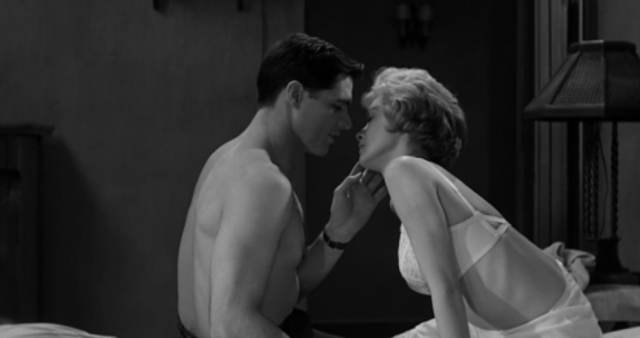
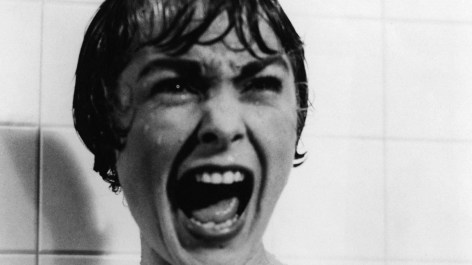
John Gavin and Janet Leigh in “Psycho”, both well worth sighing about
My fascination with string orchestra music begins with one of the all time great scores ever composed for a movie, Bernard Herrman’s music for Alfred Hitchcock’s “Psycho”. One of the great composers of classic Hollywood (“Vertigo”, “North by Northwest”, also for Hitchcock) who also defines the modern era with his score for “Taxi Driver”, Herrmann chose to match Hitchcock’s stark black and white aesthetics with the stripped down palette of the string orchestra. Everybody knows “Psycho’s” most famous musical cue of the shrieking string glissandos that nerve janglingly accent the knife slashes of each murder – arguably the most famous musical cue in all of movie history, but Herrmann’s complete score for “Psycho” deserves recognition as one of the most accomplished scores for string orchestra in the 20th century, inside and outside the cinema.
Beyond the screaming shower strokes, Herrmann’s “Psycho” music masterfully sustains an overall mood of unnerving tension through jagged, propulsive syncopation, in its main title “Pursuit” theme, as well as eerie motifs that rise and fall up and down scales, long held notes of foreboding, and nagging pizzicatos. Yet there are also themes of intense longing and melancholy, which may be less remembered aspects of the score but which are in part the most beautifully haunting tracks, and great examples for this post’s sighing strings. So while most of us may recall the strings of “Psycho” as messengers of horror and unease, I’d like you to also take in the sweet sorrow in the theme of the heroine, doomed because of a mistake she will make out of love:
Psycho – Marion and Sam – Bernard Herrmann
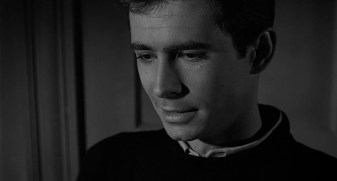
Deep yearning is also the root of this next piece, but it reflects the longing in Norman Bates’ twisted soul, as he tells Marion perhaps a little too much about life with his mother, and finds himself a little too much attracted to Marion.
Psycho – The Madhouse – Bernard Herrmann
Both these tracks exemplify the emotional, yearning, sighing strings that are as much a part of Hermann’s “Psycho” score as those murderous harpy string slashes.
But, fine, I’ll throw in those for kicks too. It’d be silly to leave them out of any discussion of “Psycho”, I suppose:
Psycho – The Murder – Bernard Herrmann
Alrighty then…
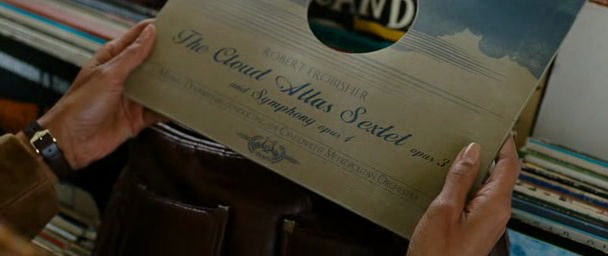
My second most favorite cinematic string orchestra piece comes from “Cloud Atlas”. It is the Cloud Atlas Sextet arranged for string orchestra. In the storie(s) of “Cloud Atlas” the sextet is composed by one of the time-hopping movie’s 1930’s era characters; it’s music that, though forgotten in its own time, will resonate in a variety of ways in future ages to come. This concert version is discovered by another character in the the 1970s on one of only six vinyl copies believed to remain of that recording:
Cloud Atlas – The Cloud Atlas Sextet for Orchestra – Tow Tykwer, Johnny Klimek, Reinhold Heil, Gene Prisker
I love this theme and this arrangement. How it sighs and pulls and enraptures. It sounds perfectly like what a classical composer in the 1930s might have composed for string orchestra, which is of course exactly what it is supposed to be, not a soundtrack cue in a movie.
And speaking of classical music from the 1930’s, one can’t discuss the sighing strings of cinema without this most famously cinematically incorporated string orchestra piece from the classical concert repertoire:
A few months ago I was conducting a third grade choir class in a Tribeca school, when an alarm sounded.
“Lockdown”, one of the two classroom teachers in the room with me and 25 third graders announced.
Swiftly, and calmly, the children congregated in a group sitting on the floor in a blind spot corner of the room, not visible from the door. One teacher took a key out of the classroom’s call box and locked the door from the inside. She also taped blank sheets of paper over the door’s window. Then she joined the rest of us in the blind spot.
I sat still in a chair. In decades of being a teaching artist all over the New York metropolitan area, I had been part of numerous fire alarms, all of them drills. But this was my first lockdown alarm. And whereas in a fire alarm one calmly lines up the students and walks with them down the hallways and stairways out of the school, onto the street, and at least a block away from the building, in this case the procedure was to collectively cower quietly and out of sight in a hidden corner of a locked room.
I assumed this was just a drill. But I didn’t know. I thought about asking the teachers if they knew a drill was planned for today. Sometimes school administrations give advance warning of drills, sometimes they surprise the community to test the response.
But I decided just asking the question could cause anxiety. I felt my role was to be calm and collected and look unworried. My ignorance and inexperience would go unaddressed.
The children looked remarkably calm and patient. The teachers looked calm and serious. There was also a quality of discomfort under their professional demeanor that may have come from feeling anxious or angry.
I first thought how odd it was that such a lockdown drill was taking place in a New York City school. Wasn’t this exercise an overreaction? And the kind of thing that would be undertaken in the heartland of the country, not here in cosmopolitan NYC? Then I remembered that Sandy Hook Elementary School is only 30 or so miles away.
I assumed that, of course, this is a drill. Still I found myself listening carefully to any sounds out in the hallway. I wanted the ongoing silence to confirm my assumption.
Thoughts of Sandy Hook stayed with me. I felt a rising panic in my guts. In all my experience of fire drills, including many that were unscheduled and might have been for real incidents, I had been calm and untroubled.
But now I felt a bubbling up of terror in my stomach. Rising tremors of wordless fear. I had to work to get the feeling under control, not allow myself to show the anxiety that wanted to paint itself on my face, not allow the tears pressing behind my eyes to emerge.
There was no way I was going to indulge in panic in front of the children. I suppressed the fear, and with outward calm waited out in silence on my chair away from the classroom door, while the teachers sat quietly on their chairs, and the children sat quietly in a crowd on the floor.
Longtime visitors to my site will have noticed that I love sharing photos, under the “Two-fisted Touristing” rubric, of scenic vistas from around the world or places and events in New York City. And sometimes I share images that just capture my eye, that give me a visual joy, things thrilling to capture and share in a frame of pixels. I often find myself drawn to images of light play, its illuminations, its refractions, its shadows, its contrasts.
Hi, it’s me, being swathed in the light entering the home
Today I share a bunch of shots that all fall under the theme of “Light Enters the Home”. Pictures I have taken this day or the other over the course of several months, when a shaft or spill of light shone into our home in a way that caught my attention and made me reach for the cell phone and click.
Maybe because we live in a ground floor apartment that doesn’t exactly get bathed in vast amounts of light any time of the day or the year, I am especially intrigued by the subtle particularities and dramatic flourishes natural light sometimes makes in our rooms. Whatever the reason, I noticed that I had liked enough of these light-in-home pictures I made over the last year to collect them in a blog post.
And to make the whole endeavor more musical, I will, as is becoming a bit of a “thing” here on Notes from a Composer, include a musical guessing game: a collection of “Light” titled music tracks to identify, plus added musical trivia queries. Track titles and artist names can be gleaned from the tags at the bottom of the post. Enjoy!
Which “cutting” band asked Ian McKellen to thrill like Vincent Price in this song?
Sun tea visibly soaking in the sun rays on the window sill planters:
Which classic cinema comedian composed the music for his movies, including this “lighted” one?
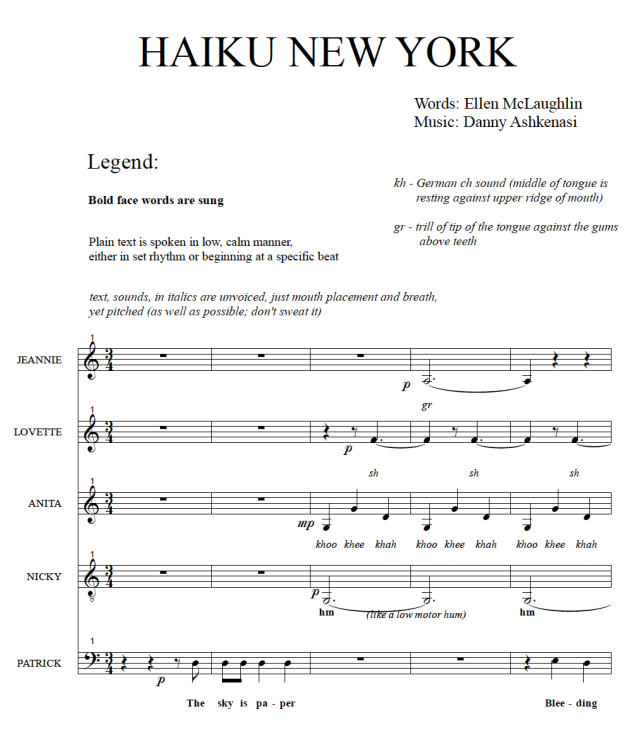
This series of nine haikus were written by Ellen McLaughlin and set to music by me in 2001 at a Composer/Librettist workshop. With all the hateful dehumanizing rhetoric swirling around questions of immigration these days, I feel compelled to share these words, how they evoke with rich humanizing specificity one immigrant’s experience.
Ellen McLaughlin in “Angels in America”
Ellen McLaughlin is the acclaimed writer of plays like “Infinity’s House”, “The Trojan Women” and “Helen”. She also, incidentally, iconically, played the Angel in the original Broadway production of “Angels in America”. She was one of five writers thrown together with five singers and five composers, of which I was one, for two weeks during a very intensive workshop hosted by New Dramatists. Every two days each writer was paired up with a different composer to collaborate on a specific assignment for a new music theater collaboration. By the end of the workshop 26 pieces would be written and performed by all involved (It should have been “just” 25, but I ended up composing two pieces for the 5th assignment – which is another story altogether).
Ellen and I were paired up for the fourth assignment. For this collaboration each writer and composer were given individually fashioned instructions. Ellen was required to write her text in haiku structures. It was solely her idea to write a piece from the perspective of an immigrant entering New York harbor. Within less than a day, she sent me the text. At first read I knew it was perfect. I emailed Ellen that I loved it and set to work (making ours perhaps the simplest exchange between collaborators for the whole workshop). I had a day to set it to music.
My instructions had been to not repeat any musical ideas; I was to compose a thoroughly through-composed piece, no verse or chorus structure, no motifs that are restated. After having already written three pieces firmly residing in musical theater and song structure traditions, I was eager to embrace the assignment’s direction. I also chose to add additional challenges for myself by experimenting with a cappella and using spoken text and vocal “sound effects” as musical materials.
The richly voiced baritone Patrick Mellen was assigned as our lead singer for this assignment, but for the first time we were given the option to include as many of the other four singers as we wished (and every composer did enthusiastically write for all five). It was my first chance at that stage to compose for the soprano Jeannie Im, who told us during first day introductions how much she enjoyed singing stratospheric coloratura. Ellen’s evocation of circling seagulls gave me the perfect opportunity to indulge Jeannie.
In the end, I wound up finding a bit of a loophole around the “don’t repeat yourself” stricture the workshop instructors had imposed. The final haiku echoes the musical phrases of the first haiku, but in reverse order. The end is a near aural mirror image of the beginning. Rather than being taken as a bit of a cheat on my part, the instructors appreciated the musical gesture.
Sometimes I am asked, in applications for grants or music competitions for example, to write about myself. It is a certain special torture to have to act as your own greatest champion in writing (or in person), but that is what is often required of any artist, or perhaps even most of us, in many fields of work, in order to be given opportunities, to “get ahead”. What follows are excerpts from one such required essay I have written, leaving out some of the biographical nitty gritty and focusing on some essentials.
Here is a bit of how this composer sees/hears themself:
I am an American composer/writer/actor born and raised in Berlin, Germany, living in Brooklyn, NY. I’ve composed “pop” songs and “art” songs and chamber works for various instrumental combinations; yet my main body of work as composer/writer lies in music theater in all its variety: musical comedy and drama, opera, oratorio, experimental, children’s theater, original stories, adaptations of classic texts and writers, as the sole author/composer and working with collaborators.
My greatest strength is melody. Drawing in as well as surprising the listener. Creating musical phrases that caress and prick, soothe and confound, that are smart and visceral, moving emotionally and intellectually, but mostly do what music does best, exist in the ineffable.
Today our nation commemorates Martin Luther King Jr. Day.
The message and significance of Martin Luther King Jr. and what he represents for the aspirations of our country and the world weigh more heavily, sadly, today, than they have for a very long time.
This Thursday a choir of third graders in Manhattan will quote from Martin Luther King Jr.’s “I Have a Dream” speech during the conclusion of their chorus performance.
I was brought into their school to direct the third grade chorus on short notice in late October when the original chorus director left unexpectedly. When I was told the performance was scheduled for this coming week, I immediately suggested that for the concert’s finale the children could sing U2’s paean to Martin Luther King Jr. “Pride (In the Name of Love)” while also quoting lines from the iconic “I Have a Dream” speech.
Pride (in the Name of Love) – U2
U2’s lyrics about the oppressed and those who would stand up to oppression throughout history, as well as the third verse that pointedly references Martin Luther King Jr.’s assassination, will be sung in full by the children. The hummed phrases will be repeated and sung as accompaniment to excerpts from “I Have a Dream”. Each of the four individual third grade classes will quote in unison one of the four most well remembered sentences from the speech. After the final full throated refrain of “Pride”, the concert will end with the word “love” held in extended harmony.
One of Ed’s Christmas gifts to me was three puzzles made out of photos he had taken. This was for one of our traditional “little” gifts we give each other, and Ed boasted of a Groupon offer that allowed him to avail himself of this otherwise expensive service at a 95% discount. 95% discount? Looks to me like we were the lucky beneficiaries of a Groupon typo.
The first puzzle I worked on would be the one of the two of us, taken this summer at the Brooklyn Botanic Garden.
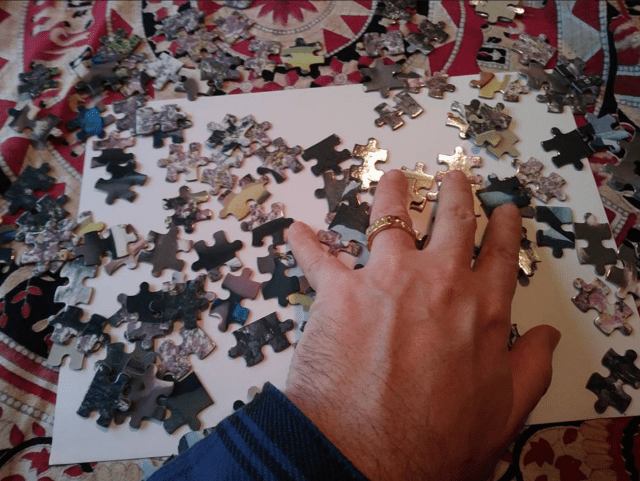
The puzzles arrive in their completed state. So I had to break up the puzzle into its 120 pieces. Kind of scary what that does to Ed and me in this picture…
120 piece puzzles are not that hard to do, and it wouldn’t take me long. But there would be a few subtle difficulties that kept things interesting. In particular the fact that the puzzle pieces themselves are quite similarly shaped, so if they also look very similar there is a danger of fitting them together incorrectly.
It’s a Puzzlement, musically, as well…
As usual here, try to guess title, singer, source of the songs – or discover these tidbits in the tags at the bottom of the post…
Is it a matter of narcissism or merely the fact that those pieces are just the easiest to locate that I’m putting my face together first?
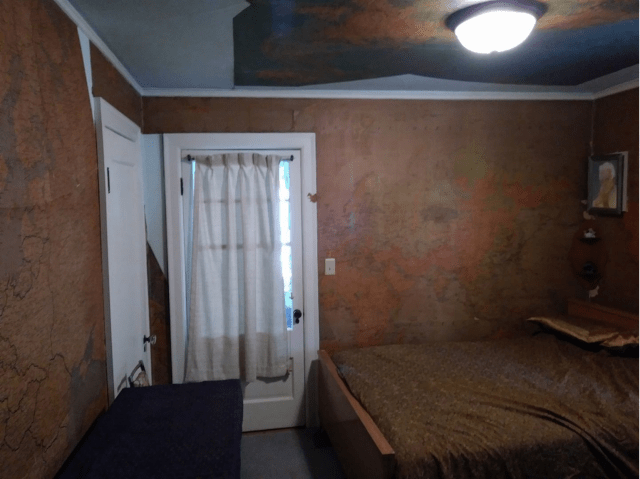
On the second floor of a hundred year old house near Vilas Park in Madison, Wisconsin, is a guest bedroom known as the Map Room.
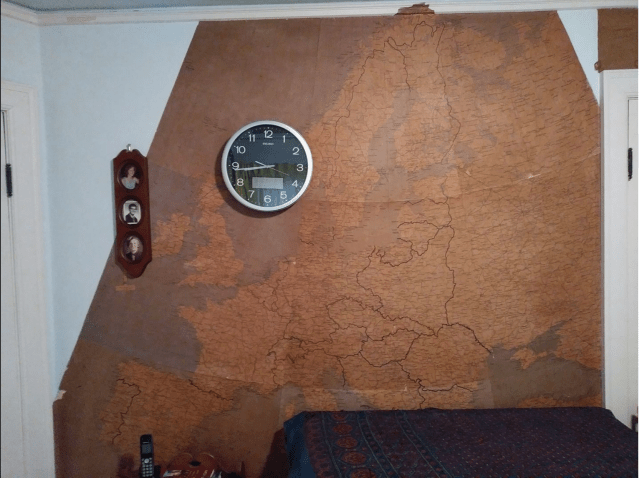
Three of its four walls have been wall papered by huge maps of the world.
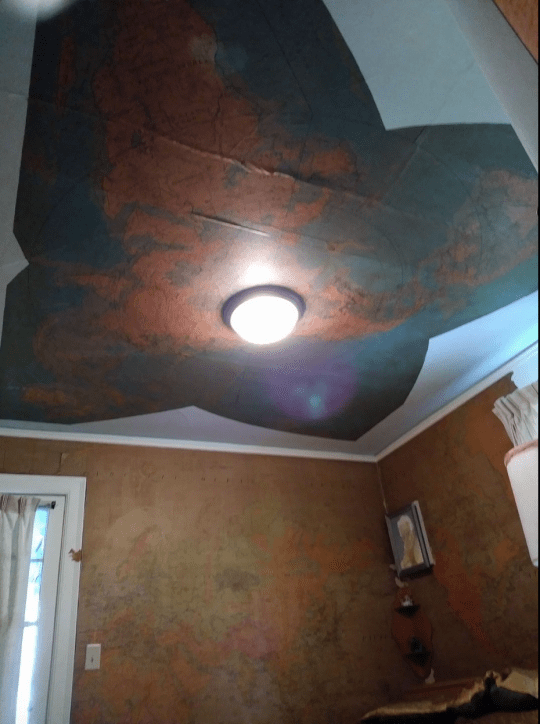
The ceiling too is a map of the world as seen from above the “top” of the globe.
The light fixture cleverly doubles as the North Pole ice cap.
Another whimsical touch is this outline of Iceland wrapped around a door frame.
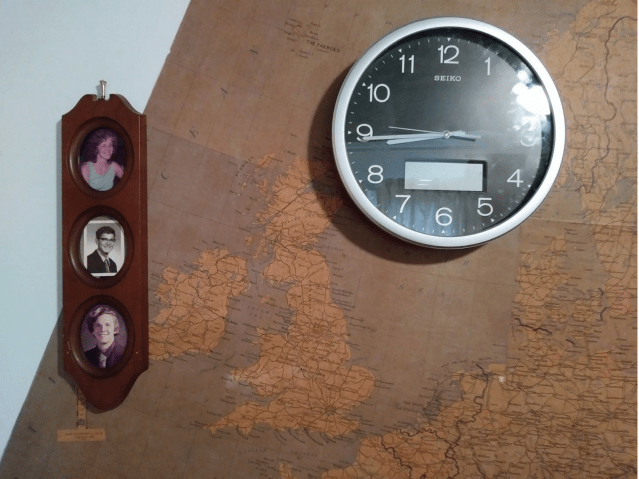
The map appears to be from the 1930s. Germany’s borders here are from between the two World Wars.
The family that refers to this bedroom as the “Map Room” has lived here since the early 1960s. These pictures below to the left are from the now adult children when they were still teenagers (one of the three is now a grandparent). That’s my husband Ed Elder at the bottom, when his hair was still red and before he grew his mustache.
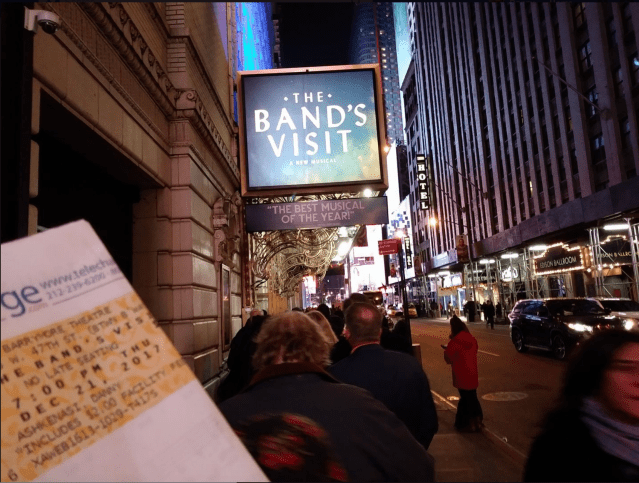
This post is not really about “The Band’s Visit”, the marvelously unlikely new Broadway musical hit show, enchanting critics and sold out houses.
This is about you, the sad selfish woman sitting diagonally behind me.
You see, about halfway through the performance, you apparently realized that this exquisite exceptional piece of theater was not to your liking.
You sighed.
And sighed again.
Right in the middle of the female lead’s yearning solo number “Omar Sharif”.
And these weren’t sighs of empathetic appreciation.
No, these were sighs of morose malignancy.
The sighs of a bored tactless adolescent during an endless church sermon given in Latin.
Soon to be followed by a contemptuously muttered “Jesus Christ!”
After the sixth or seventh impatient utterance I turned around to face you with my finger demonstratively lifted to my lips.
That shut you up. For a while at least.
Perhaps until that moment your sotto voce peevishness may have been an unconscious reflex, or believed to be so sotto voce that it couldn’t possibly have been heard by anyone in the immediate vicinity.
But after that moment there could have been no doubt that your egregious exhalations were poisoning the atmosphere for others.
And though my silent admonishment silenced you temporarily, alas, it didn’t silence you for good, because about twenty minutes later you were back at it.
Sour sigh.
Harrumphing seat shifting.
Truculent tut.
I thought to myself, do I turn around yet again with my finger to my lips, perhaps with extra fire in my eyes? Do I give you a good lecture on audience etiquette after the final curtain call? Do I grab you by the collar on our way out and toss you over the balcony into the emptied orchestra seats below?
“You should compose a piece for the family to play at Christmas”, my husband Ed said to me a few weeks ago (actually it was November 10, I have documented evidence, I’ll get to that later, not that it really matters).
Well, it may not have been those very words, more like words to that effect. The “should” may have been a “could” or a “how about”. The “should” may be what my brain did to myself.
Ed may just have been thinking about something fun for the family to do together in the holiday spirit, in addition to the traditional caroling sing-a-longs and 1000 piece puzzles. Or he may have also been thinking about the fact that the last piece I composed was the viola piano duet for his birthday, and the last piece before that was the previous year’s piano viola duet. It might not be such a bad idea to compose something, anything, again.
What kind of piece would I write for the family that we would be able to play together, or even get the family to get together and play together? I furrowed my brow and started asking Ed all sorts of logistical questions possibly designed to derail this idea before it set root, but in actuality painting myself in a corner in which I would answer the questions myself and the conclusion would be foregone.
Would this piece just be for the usual instrumentalists in the family, or would it attempt to rope in everyone? The latter solution would be more logistically complex, but surely more inclusive and fun.
My mother will be joining us in Wisconsin for the holidays. My mother is an opera singer – retired officially but just when she thinks she’s out they pull her back in. Ed’s mother is also an experienced enthusiastic soprano. Hmmm…
Ed and I were at a play when he raised the question. Before we were back in the subway on the way home I had scribbled some notes for a seasonally angelic, perhaps corny, but still pretty vocal theme for sopranos. There they are in the page from that day’s NYTimes, because I always take along the Saturday crossword puzzle for Ed and me to do together on the subway.
A simple tune with plenty of internal repetition for easy instant sight singing (chord modulations in the accompaniment will add extra variety). In traditionally kitschy but still pretty parallel thirds; what the Germans like to call “Schweineterzen” – pig’s thirds – not sure why exactly “pig” but I like the comical way the phrase denotes harmonies that are generically fatty and juicy and common and popular and, let’s face it, just plain good. And relatively easy to sing instantly.
Hot Mess – Torch Song – Call Me By Your Name – Cabaret – Speakeasy
By a quirk of timing I wound up seeing two days in a row the two stage plays currently playing in New York (Off Broadway) that deal at any length with male bisexuality. And as I wrack my brain about all the gay themed plays I’ve seen in New York over the past 30 odd years (and I have seen very many) it is possible I have just seen the only two Broadway or Off Broadway plays that deal with male bisexuality at any length with any depth. And this has made me feel conflicted and peevish; and so here I am writing yetonemore blog piece on bisexuality, specifically male bisexuality on stage and screen.
“Hot Mess”, currently in previews, is the “labor of love, and completely true story” Dan Rothenberg co-wrote with his wife Colleen Crabtree. Now performed by a cast of three, the comedy romance about a bisexual man not telling the woman he is dating about his history of sleeping with men was originally performed by Dan and Colleen as a two person show called “Regretosexual” in LA. (That bit of info about the writers being husband and wife now probably gives away the ending, doesn’t it? High time I forewarn that particular spoilers will abound for all plays and movies I discuss here today.)
The playwrights’ bios already clued me into the strong likelihood that a message of love and acceptance and inclusivity would conclude this charming play very much designed for a mainstream audience. But the original title also telegraphed ambivalence or worse about the lead character Max’s homosexual history. And so it was. I experienced much of the first 3/4 of the play feeling mildly aggrieved while the hero keeps postponing telling his girlfriend about his gay experiences, revealing a conflicted uncomfortableness with his sexual past. This culminates in a brutal freezing out of a friend and former fuck buddy when he accidentally runs into him while on a date with the girlfriend. The worst stereotypes about bisexual male secrecy, inconstancy, and untrustworthiness were looking to be fully justified, thank you very much.
“Hot Mess” to be continued, but let me skip on over to the next day watching the excellent production of “Torch Song”, reviving an edited version of Harvey Fierstein’s classic 1981 play “Torch Song Trilogy”. I’d not seen the original production but I do know the movie version. The depiction of Ed, who leaves the Harvey Fierstein stand-in Arnold for a woman (before returning to him in Act 3), to some extent plays very neatly to 1970s/1980s gay male stereotypes about bisexual men really just being gay men who aren’t honest with themselves. Ed may be somewhat more forthcoming about his sexual history with both Arnold and his future wife Laurel than Max is during most of “Hot Mess”, but that doesn’t make Ed’s true feelings easy to pin down since he seems so slippery about them even to himself. And then the play stacks the sexual deck against Ed’s heterosexuality so much – Ed comes to orgasm with Laurel only when he kisses her neck and thinks of Arnold; Ed almost acts on fantasies of suicide because he is so fearful of coming out; Ed ‘s desire for a family and pleasing his parents are more forcefully stated reasons to marry Laurel than his love for her – that he comes across more like a deeply conflicted, self-deluding homosexual than a true bisexual. But then again, wasn’t (or isn’t that still?) the belief of most gay men of that era (and still?) – there is no such thing as truly bisexual men? Just gay men not being honest with themselves?
By the intermission I was fuming with indignant rage. Why must Ed’s bisexuality be so vilified, to the point of being denied as even being real? Where are the plays that affirm and celebrate and go to the ramparts for male bisexuality in the brilliant way “Torch Song Trilogy” did for male homosexuality in its day*? It’s 2017 and I can not think of any play since 1982 that even deals at length with male bisexuality except for the one I just happened to see the day before.
Notes from the “BiView: Bisexual Representation in Media Panel” at NewFest2017
Eliel Cruz, Denairii Grace, Taylor Behnke, Alexandra Bolles
David J. Cork
October 21st I attended the panel discussion on Bisexuality in the Media, the first of its kind at a NewFest/Outfest film festival. Moderated by bisexual activist and journalist Eliel Cruz, the panel was filled out by writer/singer Denarii Grace, filmmaker David J. Cork, GLAAD Digital Director Taylor Behnke and GLAAD Associate Director of Campaigns, Alexandra Bolles. I managed to take that snapshot above of 4/5 of the panel as they posed for the official NewFest photographer in front of the festival’s rainbow lit scrim. They jokingly called me a paparazzi. What follows are some of the highlights of the panel discussion, based on my notes:
During the opening remarks Denarii Grace described bisexual as being both a personal and political label, seeing queer as a political label. “When I first came out I thought of a world of men and women. Now I understand that my attraction is a lot more fluid, more nuanced.” Alexandra Bolles also embraced “queer” as a political label, adding “I really like the word bisexual, because for a long time I ran away from it and now I am really excited to own it.” David J. Cork likes the alliteration in black and bi, saying “Bisexual means to me both a sexual and emotional attraction to men and women.” Taylor Behnke on embracing the word bisexual: “It took me a while to accept that label because I grew into that through experiences with people over time.”
Eliel Cruz raised the question if there is even a need for labels: “I find that people who are monosexuals push for a world where labels aren’t necessary.” Which had David reminiscing about another festival where “everybody identified as queer or fluid or pansexual or ominisexual…” but apparently not bisexual (I can relate). Denarii then started discussion on the label/hashtag “biplus” as a term many in the community use to identity themselves, and which established itself as the most favored idiom on the panel, a term that can incorporate fluid gender identity in oneself as well as in those one is attracted to. As Denarii related, “I am concerned about splintering, because of the label wars. But labels are important. All labels, feminine, disabled, fat, cisgender… Many speak to how we identify to others and how we see ourselves and our bodies, and help us find our community.”
Regarding the necessity of labels, Alexandra said “short answer: yes. Long answer: sometimes. The needs of the bi community can’t be met if we aren’t counted.” Taylor added “I accept the decision not to use any label – but they are helpful. It’s a pretty common experience within the biplus community that it takes a while for people to figure themselves out.”
Features: 100 Men – My Wonderful West Berlin – A Womb of Their Own
Shorts: Bayard and Me – Umbrella – DES!RE – The Son I Never Had – Resist – House of JXN
“We have gay people. Hey, Gay People, come out!” – Kathy Najimy
I heard Kathy Najimy utter that quip about 15 times at NewFest, NYC. It’s a clip from the movie “Dating My Mother” that had been edited with other clips into the NewFest 2017 preamble short that played before every screening at the LGBTQ movie festival. By my third screening I started mouthing along with Kathy. I can still hear her say it in my head, weeks later. Such are the side effects of film festival overconsumption. The movies may differ widely from screening to screening. The promos ahead of them are always the same, the same, the same, the same…
The benefits this year however of festival deep diving were enjoying films that were consistently worthy, good and excellent, long and short form, many of which I already discussed here, here and here. Now it’s time for the documentaries. I caught up with lots of rich gay history and fascinating transgender complexities.
Three very different docs successfully blended the Gay Micro with the Gay Macro, by which I mean (get your head out of the gutter) that deeply personal, specific slice of life details were illuminatingly integrated into narratives that comprehensively spanned decades of gay history. In 100 Men director Paul Oremland lists and tracks down a hundred men he had sex with over the last 40 years of his adult life. Everything from random hook ups to longterm relationships. This is initially as cheekily irreverent and titillatingly provocative as one might expect, but through Oremland’s journeys through New Zealand, The United States, England and Poland, interviews with and remembrances of a variety of people and experiences, covering decades of gay sexual, social, and political revolutions and struggles, “100 Men” becomes an invaluable document of modern gay male experience. As well as a stealth love story.
Similarly, Jochen Hick’s My Wonderful West Berlin covers 40 years of gay history in the historically uniquely situated city of West-Berlin, the liberal Western oasis that was surrounded by the walls of the Iron Curtain; a place like no other in its time (and my childhood home during much of the time Hick’s covers). Many individuals’ personal narratives regularly enrich the complex broader picture of the quiet 1950s, the clandestine 1960s, the revolutionary 1970s, and the devastating 1980s that marked gay life in the divided city, which before German Unification was like a unicorn among the cities of the world: a geopolitical all-time original, a beacon, an outlier, a refuge, a renegade, a subsidized experiment; an unusual condition that contributed greatly to its uniquely evolving queer culture. I was too young at the time to take part in any significant way in any of the varied gay history Hick’s excavates. Still I was deeply drawn by nostalgia to the movie’s depiction of my childhood hometown, brought back in such vivid detail. And many of the film’s featured seminal LGBTQ personalities and locations and events – the Pariser Bar, queer film director Rosa von Praunheim, the Deutsche Oper, intersex Drag Star Romy Haag, gay movie classic “Taxi zum Klo”, the squatters movement, to name a few – made an impression on me too even as just a child mostly consciously unaware of his own burgeoning bisexuality.
The third example of the gay micro/macro history doc I saw is the short Bayard & Me, which lovingly recounts Walter Naegle’s love story with the civil rights leader Bayard Rustin. Personal touches are threaded with illuminating historical details, like how Rustin’s Quaker background helped inform the non-violent civil disobedience tactics espoused by Martin Luther King, or how the couple pioneered gay adult adoption as a way to ensure the younger Naegle would be able to inherit and continue to live in Rustin’s apartment in a time long before gay marriage was considered even a distant possibility. When the short concluded during the middle of the “Boys Shorts” compilation screening in which it played, the audience rose in the still darkened theater for a standing ovation .
I took a Swoon Dive this weekend. I read André Aciman’s “Call Me By Your Name” while playing Sam Smith on endless shuffle. It was almost irresponsibly intoxicating.
Say It First – Sam Smith
I first heard about the Gay Romance “Call Me By Your Name” when the film version premiered at Sundance last January. The early rapturous reviews of the movie (starring Timothée Chalomet and Armie Hammer, directed by Italian sensualist Luca Guadagnino, screenplay by “Room with a View” / “Maurice” / “Howard’s End” legend James Ivory) poured into the Internet movie sites I habitually read. I looked up from my laptop to my husband Ed and said “Guess what we will be seeing at the movies in about 11 months…”. A romantic, sexually frank gay love story with that cast and that pedigree in writing and directing? Even without the glowing advance word, it would be a must see. But 11 long months, that is how long I would have to wait until I could expect to see “Call Me By Your Name” released in the local theaters.
Lately that long wait has become its own kind of exquisite torture as more reports from the fall film festivals and the U.K. release of the movie attest to its embrace by a wide audience (not “just” the gay male cinema crowd) as a cinematic masterpiece, a sensual experience, a paean to love. Last weekend, even though my chance to finally see “Call Me By Your Name” was only three or four weeks away, I couldn’t bare it any longer and I took myself to the Park Slope Community Book Store to treat myself to the book. Initially I hadn’t yet wanted to read the book before seeing the movie, as it was the movie version that had been calling to me all these months; so I’d thought to myself, see the movie first, and then later, maybe read the book that inspired it. (Later, maybe…sigh; if you’ve read the book you understand the reference. I can only wonder how prominently those words figure in the film; probably not as weightily as in the book.) But like an impatient overstimulated teenager (much like the story’s protagonist, as I would soon find out) I just couldn’t wait any longer, and if I couldn’t have the movie yet, I would take the book.
Lay Me Down – Sam Smith
I wished to read it all from start to finish, with no interruptions, just as one would engage with a movie. But that would not be practical, as reading the book would take me many many more hours than watching the movie. Still, experiencing it parceled out over three days, with interruptions like social engagements and spending time with my husband, and sleeping, was more concentrated and quicker than the relatively slow reader I am usually can manage.
And as Sam Smith’s new album finally came out last week I decided that his songs of deep melismatic male longing would be the perfect aural accompaniment to this homophile literary couch cocooning. It’s not just that Smith is openly gay, many pop singers are (and I have many of their albums), his songs are so richly drenched in romantic and sexual longing, his voice so shamefully shamelessly expressive of yearning, oscillating between emotional (and vocal) highs and lows, and his personal experience so redolent of the passions and callowness of a young gay man’s experience of longing, heartache, “drama”, I intuited it would fit rather neatly with the burgeoning male sexual desire of “Call Me By Your Name”. I would be all too right.


 Broadway tickets being rather expensive, even half price at the TKTS booth, Ed and I are not likely to see any show more than once, no matter how much we like it. But then Jake Shears, the lead singer of my fave pop band “Scissor Sisters” took over the lead role of Charlie Price, and his tenure at “Kinky Boots” would overlap for 4 weeks with “Whose Line Is It Anyway” improv comedy performer extraordinaire Wayne Brady playing the other lead role Lola. Two of our favorite idiosyncratic talents starring together in one of our favorite shows. Four years after our first joyous visit, we decided we would treat ourselves again. Half price tickets at the TKTS booth. Still had to pluck down 9 Harriet Tubmans (currently still Andrew Jacksons), but we took the splurge.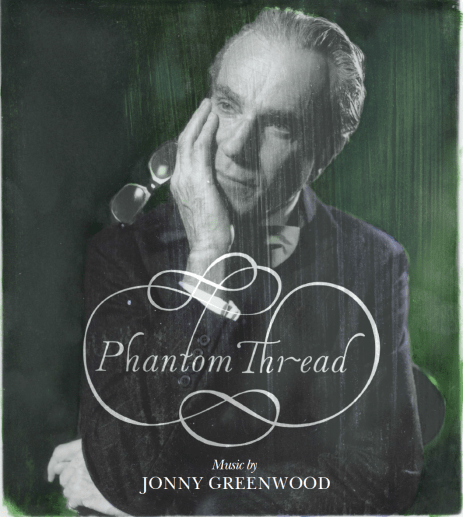


















 Ed may just have been thinking about something fun for the family to do together in the holiday spirit, in addition to the traditional caroling sing-a-longs and 1000 piece puzzles. Or he may have also been thinking about the fact that the last piece I composed was the
 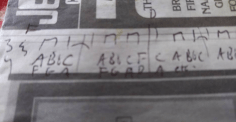 Ed and I were at a play when he raised the question. Before we were back in the subway on the way home I had scribbled some notes for a seasonally angelic, perhaps corny, but still pretty vocal theme for sopranos. There they are in the page from that day’s NYTimes, because I always take along the Saturday crossword puzzle for Ed and me to do together on the subway.
 A simple tune with plenty of internal repetition for easy instant sight singing (chord modulations in the accompaniment will add extra variety). In traditionally kitschy but still pretty parallel thirds; what the Germans like to call “Schweineterzen” – pig’s thirds – not sure why exactly “pig” but I like the comical way the phrase denotes harmonies that are generically fatty and juicy and common and popular and, let’s face it, just plain good. And relatively easy to sing instantly.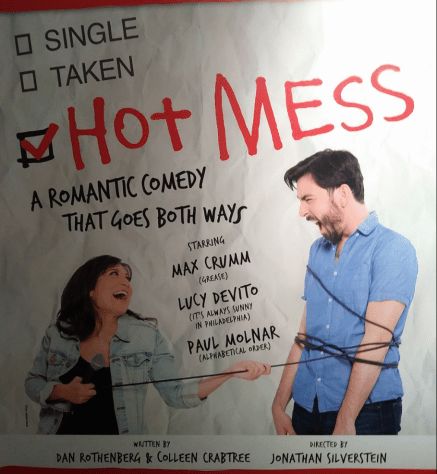
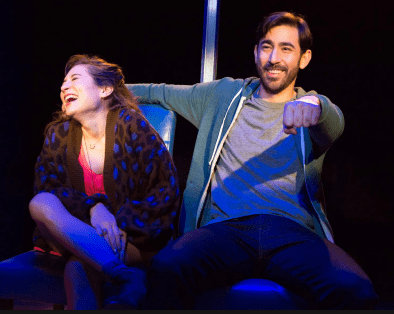 The playwrights’ bios already clued me into the strong likelihood that a message of love and acceptance and inclusivity would conclude this charming play very much designed for a mainstream audience. But the original title also telegraphed ambivalence or worse about the lead character Max’s homosexual history. And so it was. I experienced much of the first 3/4 of the play feeling mildly aggrieved while the hero keeps postponing telling his girlfriend about his gay experiences, revealing a conflicted uncomfortableness with his sexual past. This culminates in a brutal freezing out of a friend and former fuck buddy when he accidentally runs into him while on a date with the girlfriend. The worst stereotypes about bisexual male secrecy, inconstancy, and untrustworthiness were looking to be fully justified, thank you very much.
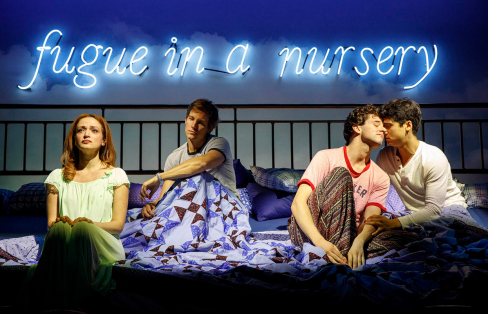 Ed may be somewhat more forthcoming about his sexual history with both Arnold and his future wife Laurel than Max is during most of “Hot Mess”, but that doesn’t make Ed’s true feelings easy to pin down since he seems so slippery about them even to himself. And then the play stacks the sexual deck against Ed’s heterosexuality so much – Ed comes to orgasm with Laurel only when he kisses her neck and thinks of Arnold; Ed almost acts on fantasies of suicide because he is so fearful of coming out; Ed ‘s desire for a family and pleasing his parents are more forcefully stated reasons to marry Laurel than his love for her – that he comes across more like a deeply conflicted, self-deluding homosexual than a true bisexual. But then again, wasn’t (or isn’t that still?) the belief of most gay men of that era (and still?) – there is no such thing as truly bisexual men? Just gay men not being honest with themselves?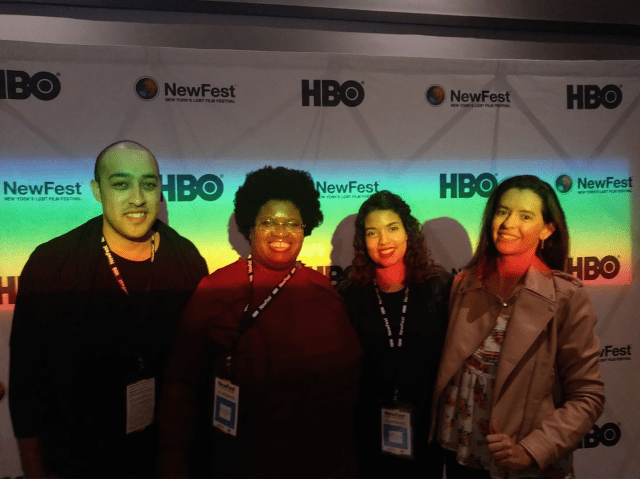

 Eliel Cruz raised the question if there is even a need for labels: “I find that people who are monosexuals push for a world where labels aren’t necessary.” Which had David reminiscing about another festival where “everybody identified as queer or fluid or pansexual or ominisexual…” but apparently not bisexual (
 Regarding the necessity of labels, Alexandra said “short answer: yes. Long answer: sometimes. The needs of the bi community can’t be met if we aren’t counted.” Taylor added “I accept the decision not to use any label – but they are helpful. It’s a pretty common experience within the biplus community that it takes a while for people to figure themselves out.”
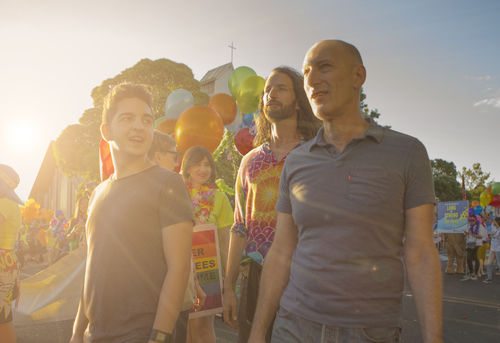 Three very different docs successfully blended the Gay Micro with the Gay Macro, by which I mean (get your head out of the gutter) that deeply personal, specific slice of life details were illuminatingly integrated into narratives that comprehensively spanned decades of gay history. In 100 Men director Paul Oremland lists and tracks down a hundred men he had sex with over the last 40 years of his adult life. Everything from random hook ups to longterm relationships. This is initially as cheekily irreverent and titillatingly provocative as one might expect, but through Oremland’s journeys through New Zealand, The United States, England and Poland, interviews with and remembrances of a variety of people and experiences, covering decades of gay sexual, social, and political revolutions and struggles, “100 Men” becomes an invaluable document of modern gay male experience. As well as a stealth love story.
 Similarly, Jochen Hick’s My Wonderful West Berlin covers 40 years of gay history in the historically uniquely situated city of West-Berlin, the liberal Western oasis that was surrounded by the walls of the Iron Curtain; a place like no other in its time (and my childhood home during much of the time Hick’s covers). Many individuals’ personal narratives regularly enrich the complex broader picture of the quiet 1950s, the clandestine 1960s, the revolutionary 1970s, and the devastating 1980s that marked gay life in the divided city, which before German Unification was like a unicorn among the cities of the world: a geopolitical all-time original, a beacon, an outlier, a refuge, a renegade, a subsidized experiment; an unusual condition that contributed greatly to its uniquely evolving queer culture. I was too young at the time to take part in any significant way in any of the varied gay history Hick’s excavates. Still I was deeply drawn by nostalgia to the movie’s depiction of my childhood hometown, brought back in such vivid detail. And many of the film’s featured seminal LGBTQ personalities and locations and events – the Pariser Bar, queer film director Rosa von Praunheim, the Deutsche Oper, intersex Drag Star Romy Haag, gay movie classic “Taxi zum Klo”, the squatters movement, to name a few – made an impression on me too even as just a child mostly consciously unaware of his own burgeoning bisexuality.
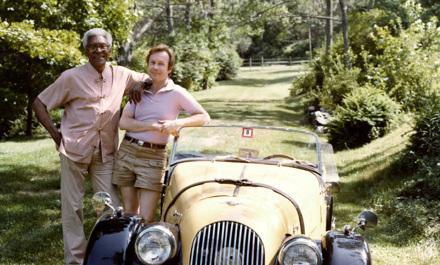 The third example of the gay micro/macro history doc I saw is the short Bayard & Me, which lovingly recounts Walter Naegle’s love story with the civil rights leader Bayard Rustin. Personal touches are threaded with illuminating historical details, like how Rustin’s Quaker background helped inform the non-violent civil disobedience tactics espoused by Martin Luther King, or how the couple pioneered gay adult adoption as a way to ensure the younger Naegle would be able to inherit and continue to live in Rustin’s apartment in a time long before gay marriage was considered even a distant possibility. When the short concluded during the middle of the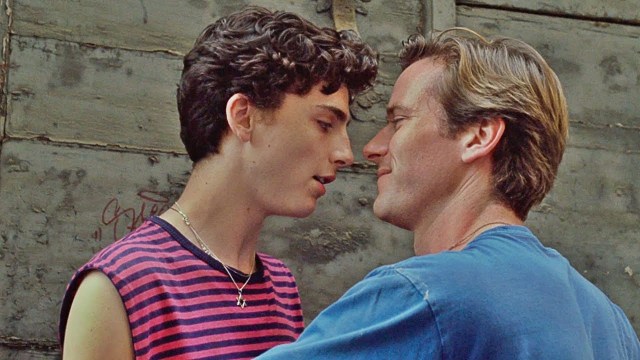
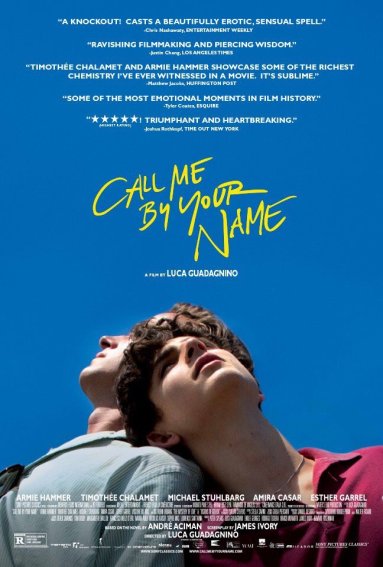 I first heard about the Gay Romance “Call Me By Your Name” when the film version premiered at Sundance last January. The early rapturous reviews of the movie (starring Timothée Chalomet and Armie Hammer, directed by Italian sensualist Luca Guadagnino, screenplay by “Room with a View” / “Maurice” / “Howard’s End” legend James Ivory) poured into the Internet movie sites I habitually read. I looked up from my laptop to my husband Ed and said “Guess what we will be seeing at the movies in about 11 months…”. A romantic, sexually frank gay love story with that cast and that pedigree in writing and directing? Even without the glowing advance word, it would be a must see. But 11 long months, that is how long I would have to wait until I could expect to see “Call Me By Your Name” released in the local theaters.
 I wished to read it all from start to finish, with no interruptions, just as one would engage with a movie. But that would not be practical, as reading the book would take me many many more hours than watching the movie. Still, experiencing it parceled out over three days, with interruptions like social engagements and spending time with my husband, and sleeping, was more concentrated and quicker than the relatively slow reader I am usually can manage.


 Notes from a Composer