






“The Pit and the the Pendudulum – a musicabre”, my (intake of breath) musical short film Edgar Allan Poe classic horror story adaptation officially concluded its one-and-a half year festival run late last year. However, and this is a nice surprise, I got a request from the Triborough Film Festival for permission to screen it again at a special event April 26 (7:30pm at Studio 3636 in Queens). Happy to report I’ll be there too for a Q&A.
Last year “The Pit and the Pendulum – a musicabre” was nominated for 6 awards at the Triborough Film Festival, and won three.
In total the film won 69 IMDb recognized awards and 38 additional nominations.
For more info on the event and to make a reservation click here.

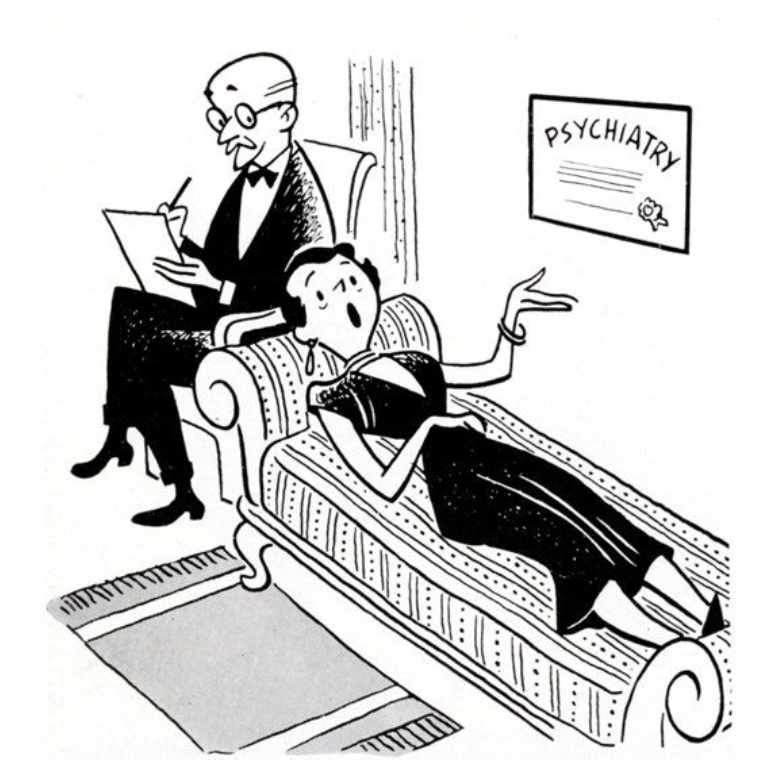
At the beginning of Section XII of the little night opera “Beyond” AKA “Jenseits”, written for my mother Catherine Gayer (catch up on previous installments via the opera’s main page), the 1st Angel takes on the persona of the 4th man in the limbo-straddling opera singer’s life-in-review: her Therapist.
The main piano accompaniment figure, usually heard moving chromatically in severe octaves, is now transformed into a jaunty, jazzy syncopation. The Therapist is a blowhard played for comic effect, but that doesn’t mean he is wrong when he complains that the Woman spends her therapy sessions avoiding the real issues in her life, instead speaking of daily banalities. The Therapist’s prompts may evoke potent images or memories in the Woman, but she keeps those to herself, and considers the Therapist a “pseudo-expert”, a “bullshit-artist”.
It doesn’t help that he falls asleep in the middle of her session.

Other than making the Woman an opera singer, librettist and family friend Helga Krauss is not telling my mother’s or our family’s story in the scenes she writes. That said, a few incidentals are taken from life. For example, my mother really does put bowls of beer out in the garden in order to keep slugs and snails away from her greens. Attracted by the beer odor the slime-trailing invaders drown in pools of ale and the lettuce is spared.
The end of the therapy session ushers in Section XIII, a scene with Husband and Son, played by the 1st and 2nd Angel respectively. Halloween is celebrated in a game of blind man’s bluff that in all its playfulness nonetheless exposes fissures in the family’s domesticity.
Variations of the son’s lullaby are played above a jingly version of the Husband’s metronomic accompaniment.
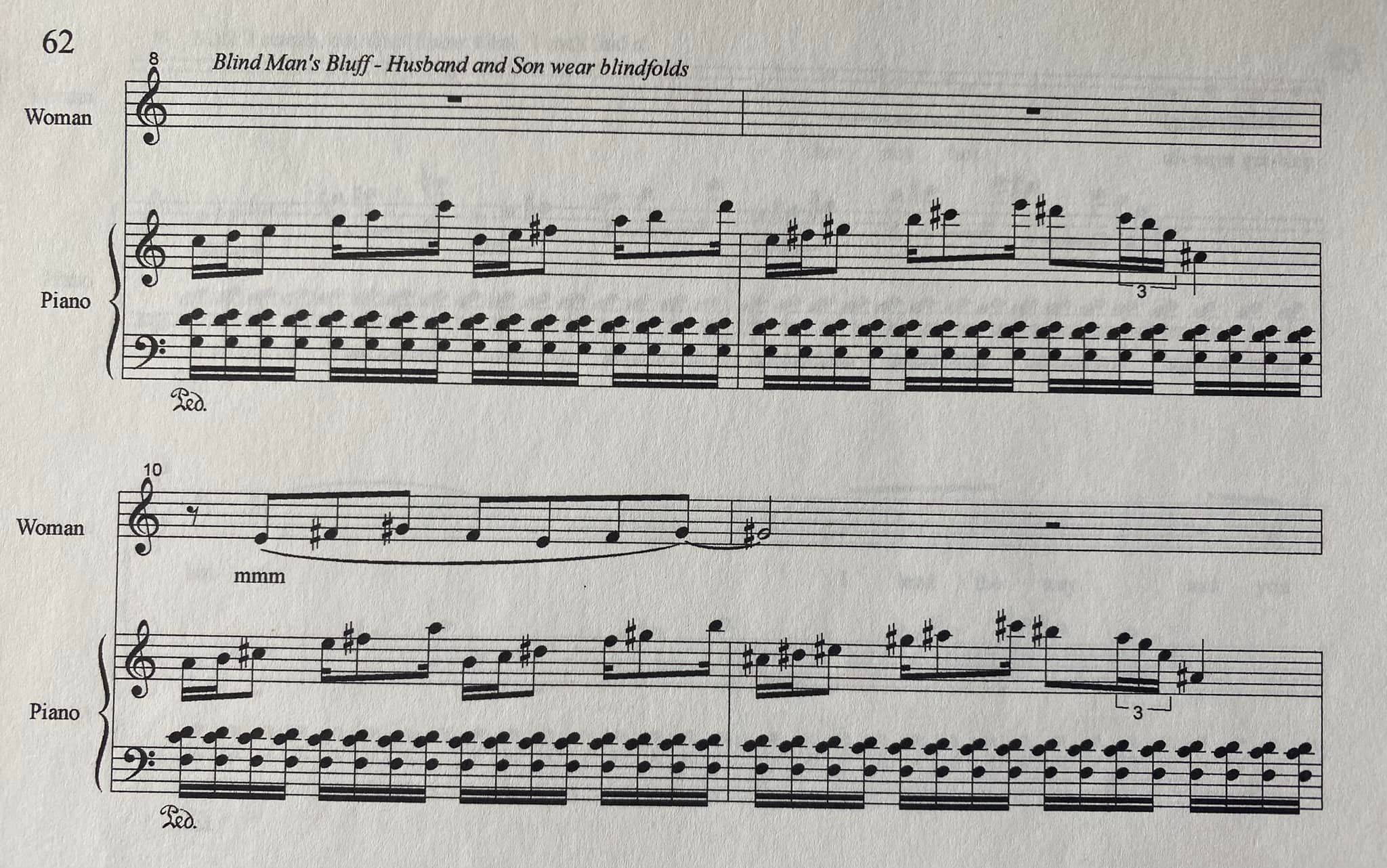
Finally the lullaby theme becomes a chiming fanfare as the Woman celebrates the “Holy Trinity” of her family.
Nonetheless the Woman still feels that longing first intoned in Section XI, “die Sehnsucht” in the German text, that unceasing sense of not feeling fulfilled.

German Language Studio Recording
English Language Live Concert Recording
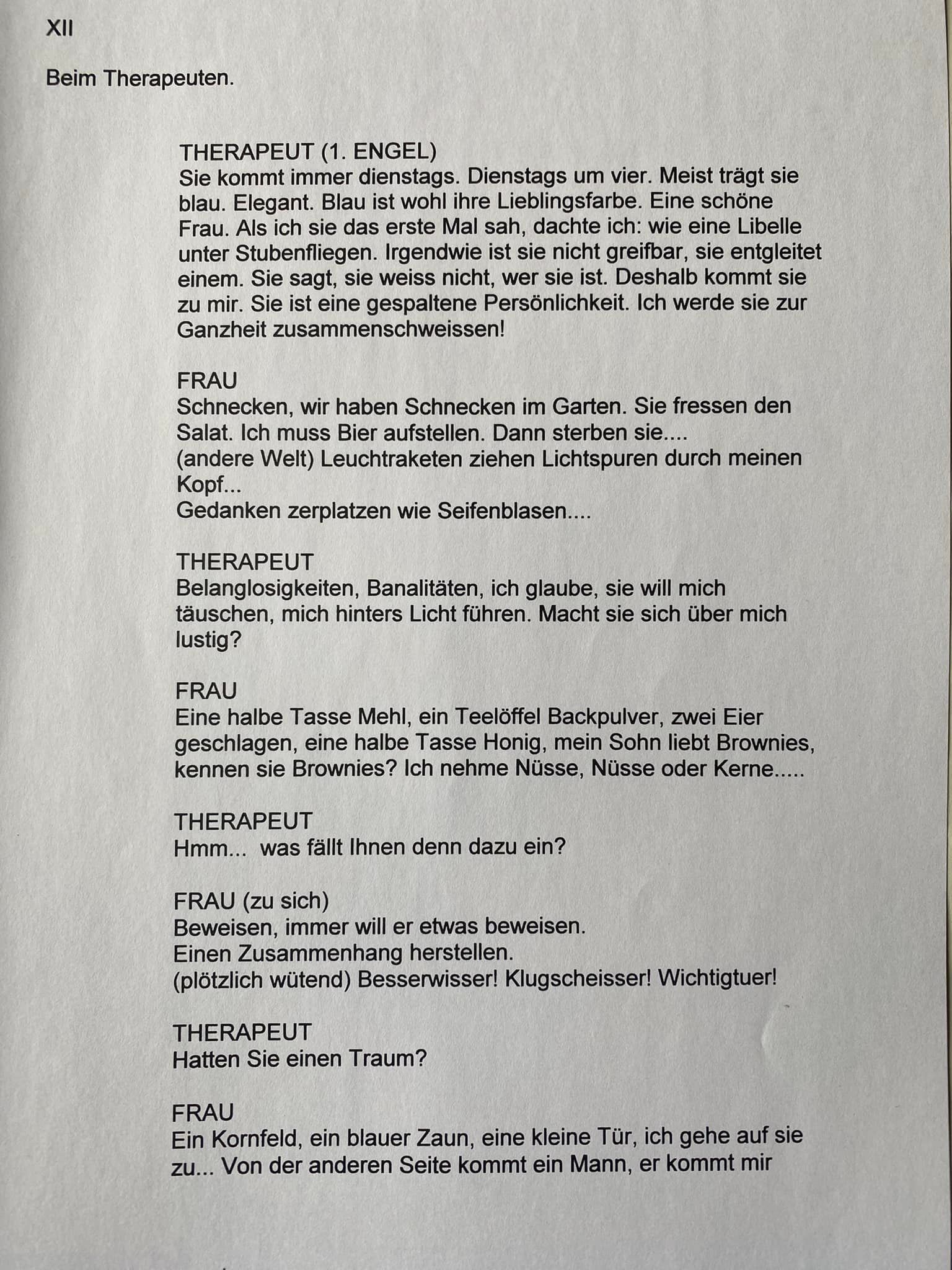

XII
The woman with her therapist (1. Angel)
THERAPIST
She comes every Tuesday. Tuesdays at Four. Usually she’s in blue. Elegant. Blue must be her favorite color. A pretty woman. When I first saw her,
I thought, like a damsel fly amongst house flies. Somehow she is not tangible. She eludes you. She says she doesn’t know who she is. That’s why she comes to me. She is a split personality. I shall weld her into wholeness.
WOMAN
Snails – so many snails in the garden
They eat my lettuce leaves
I pour beer in buckets to drown them all
(another world) Rocket flares flying in spirals around in my head
My thoughts rise and blow up like water bubbles
THERAPIST
Trivialities. Banalities. I think she wants to fool me. Keep me in the dark. Is she making fun of me?
WOMAN
Just a half a cup of flour, one teaspoon of baking salts, then beat up two egg whites, add a half a cup of honey
My son loves brownies, chocolate chip brownies
I put in walnuts, walnuts, maybe almonds
THERAPIST
Hmm…what does that remind you of?
WOMAN
Connections. He always wants to make connections. Prove something or another.
Pseudo-expert, Smarty-pants, Bullshit-artist!
THERAPIST
What did you dream of last night?
WOMAN
A cornfield, a purple fence with a tiny gate
I gingerly approach
At the opposite side I see a man
He’s coming right at me
He waves
But something is pulling me back like a drain I want to scream
My voice…I lost my voice!

Husband and lover. In the Woman’s memory, they are not the same man.
At the close of the previous section of Beyond (Jenseits), the “little night opera” I composed for my mother, the lullaby for her Son transitions to an introduction to the Woman’s Husband. (Catch up on all previous installments on the opera’s homepage.)
Section VIII combines the Woman’s childhood memories of vocal exercises and fantasies of kissing a frog to find her Prince Charming.
Then she sees herself as a ghost watching her husband at home, wondering when he will get the call about her accident. Musings on life’s impermanence are followed by unheard reminders about watering the roses and paying the cleaning woman.
Pulsing piano chords of a steady and stultifying nature are momentarily interrupted by slashing dissonances, but the shock quickly adjusts back to the steady routine.

In the end of Section VIII the Woman sings the fear motif, which transitions to the baroque melody of her rehearsal with the Conductor. Section IX.
This time the flirt between the two has progressed into a full blown affair.
Climaxing in a musical orgasm:
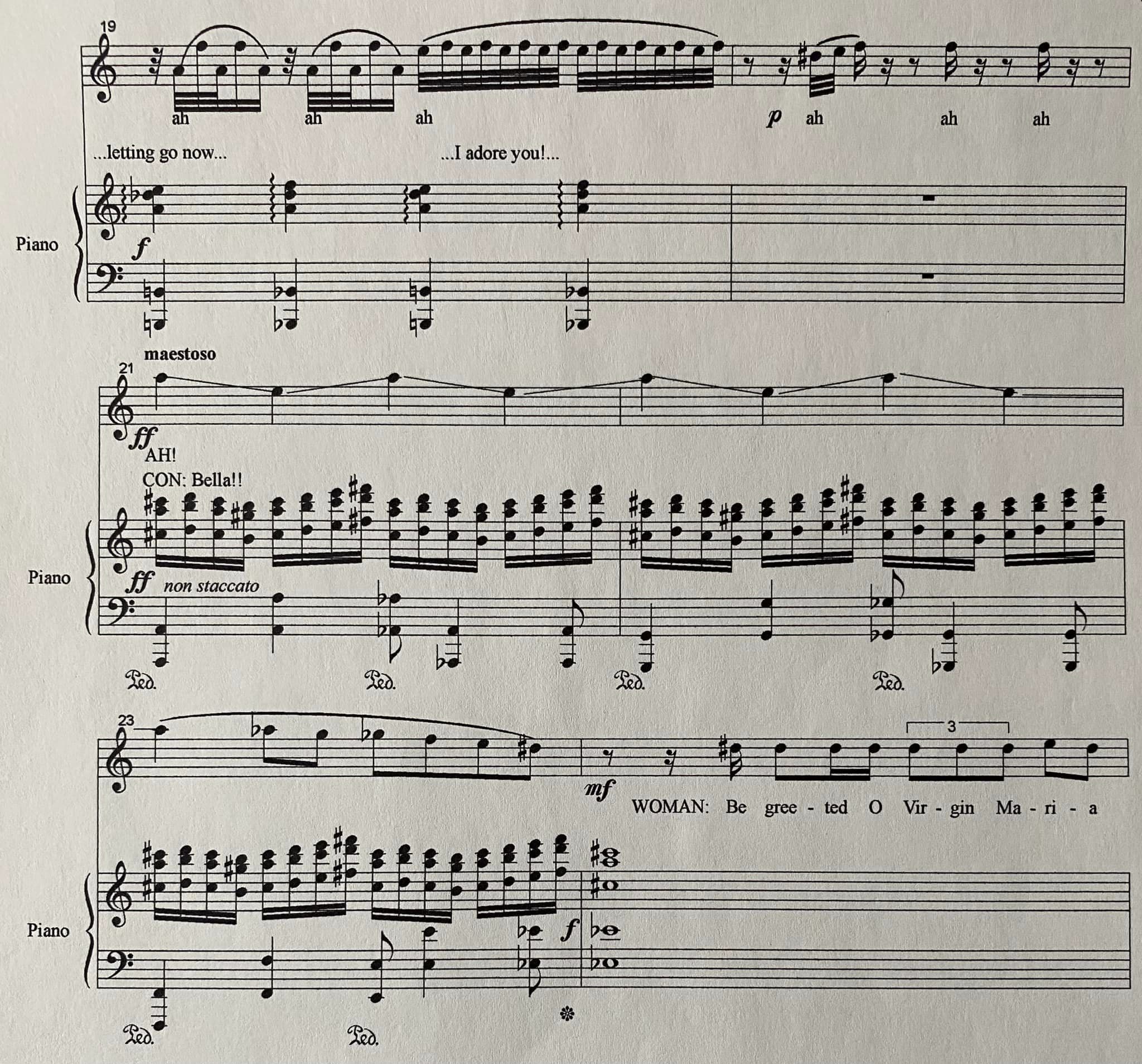
After which the Woman feels herself whisked back to the steady metronome of life with the Husband.
Whom we now hear quote passages from German jurisprudence (To properly translate these texts into English I went to Bryant Library to find New York State law books and look up equivilent passages in US jurisprudence). Apparently je is a lawyer. Whenever we hear him speak, he is quoting from the law.
Perhaps these quotes are a reflection of the Woman’s guilty conscience over the affair.

Section XI ties these competing scenarios together in an aria about longing: “Sehnsucht” in German, a beautiful word – literally “yearning addiction” – that is just so much more potent and resonating than English’s more simple “longing” or “yearning”.
All four of these sections flow together so closely that in the English language concert version they are all presented in one uninterrupted track.
The German studio recording keeps each section separate.
English Language Live Concert Recording
German Language Studio Recording
Continue reading
Aribert Reimann with my mother, Catherine Gayer, at rehearsal in 1971
Two Thursdays ago my mother called me from Berlin. Normally we talk on Sundays, so I was curious what occasioned this call.
“Aribert Reimann has died”, she told me, with shock in her voice. Aribert was a friend and colleague and contemporary, just a year older than Mom.
He was also one of the great composers of contemporary music. The New York Times obituary – which I will share below – refers to his many well received operas, specifically his widely produced setting of Shakespeare’s King Lear.
My Mom, Catherine Gayer (her maiden name being her stage name), worked countless times with Aribert Reimann. They performed many recitals together – he was also an accomplished pianist – and he composed many pieces for her to sing, including the lead in his second opera (also mentioned in the NYTimes obit) “Melusine”.
Performed in 1971, the Guardian at the time described the musical language of “Melusine” as neo-expresionist, with writing for voices in declamatory style and with demanding coloraturas.
Breezily executing demanding coloraturas was my mother’s bread and butter. Reimann was not the only contemporary composer who took advantage of her ability to sing difficult modern vocal writing with aplomb. But he composed more for her than all the others.

Mom, kneeling, as Melusine, with Martha Mödl behind her.
YouTube has the complete song cycle “6 Poems by Sylvia Plath” Reimann composed for Mom to sing. I’ll share the first piece here, but all 6 as well as both parts of “Nachtstücke” are accessible.
YouTube also has – in two parts – the recording of a recital Reimann and Mom performed in 1973. I’ll start you off with the first part here:
Although I saw my mother and Aribert Reimann work together again and again throughout my childhood, I didn’t have much of a relationship with him myself. The one anecdote I can think of is going with my parents to a party at his home, when I was around 14 years old. In 1981 or 1982.
He wasn’t the first of whom I knew at the time that he was homosexual, but I believe this was the first time I was knowingly in the home of a partnered homosexual. I was the only teenager there – my parents often took me along to parties and gatherings where everyone else was an adult – and I started wandering around the very large pre-war Berlin apartment.
I was particularly taken by some overtly homoerotic art or photography, and was seen staring at it by Aribert’s boyfriend. I felt caught as he looked the other way.
Not much of a story perhaps, but an indelible memory nonetheless.
Here is the obituary from the New York Times:
His works, which were radically individual, were among the most celebrated of the late 20th and early 21st century.
A.J. Goldmann is an American journalist who writes about European arts and culture. He is based in Munich.
Published March 19, 2024 – Updated March 22, 2024
“Aribert Reimann, whose powerful operas based on works by Shakespeare, Kafka, Lorca and others made him one of the most significant opera composers of the late 20th and early 21st centuries, died on Wednesday in Berlin. He was 88.
His publisher, Schott Music, announced the death.
Continue reading
In this fourth installment of the opera I wrote for my mother (you can find links to the first three installments on the JENSEITS / BEYOND home page), we are introduced to a new theme, a lullaby.
We have just transitioned out of the fear theme, hearing it transform at the end of Section VI into what becomes the lullaby theme at the beginning of section VII:

The lullaby theme is wordless, sung on the vowel sound oo (or uh for German vocal transliteration), sung a cappella, and repeating on a loop.
The first Angel soon adds his voice with a countermelody, also a simple lullaby, harmonizing with the Woman. Then the second Angel takes on the role of the Woman’s young Son, and as their scene starts, the piano takes over the Woman’s melody.
By the way, this repeating interplay between the two lullaby themes is something I would sometimes employ as a vocal exercise with my choral groups.
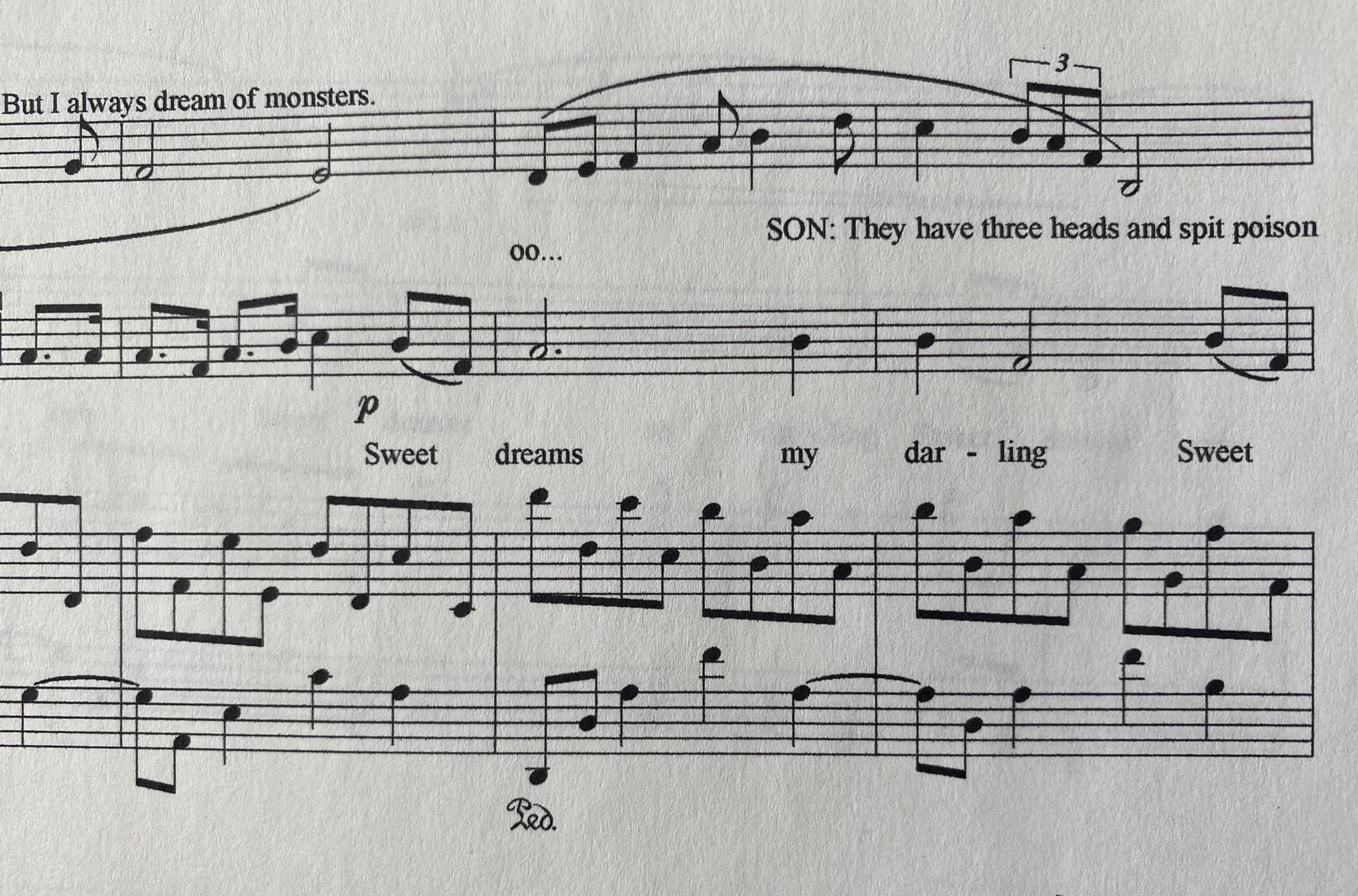
At the end of the scene both Angels harmonize their part in the lullaby, while the Woman expands upon hers, culminating in a celestial final harmony.
Which however at the very end just winds up being slightly, uncomfortably discordant.
And thus we are introduced to the husband…
German Language Studio Recording*
English Language Live Concert Recording
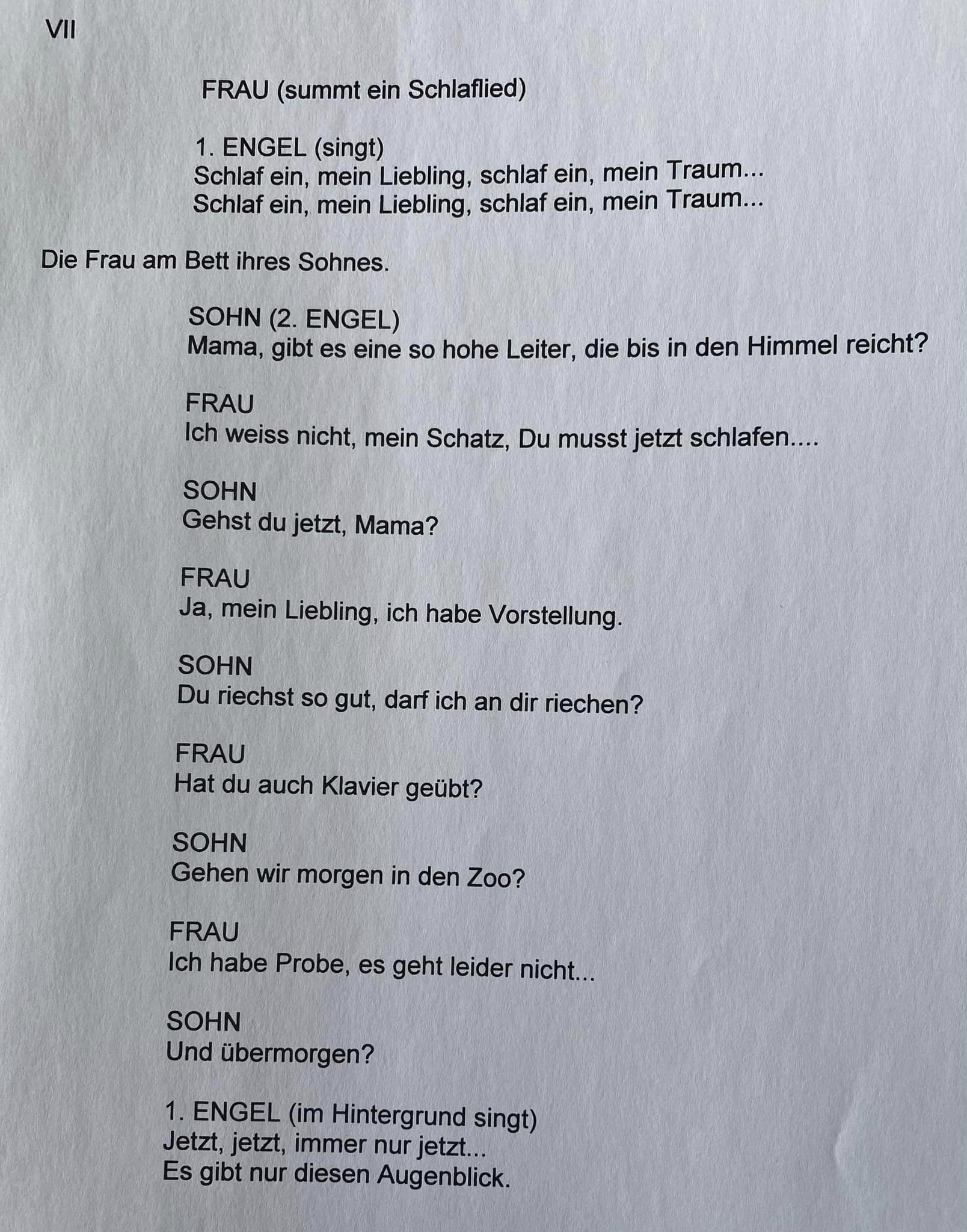
The woman, at her son’s bedside, sings a lullaby.
WOMAN
Oo… oo…
1. ANGEL
Sweet dreams my darling
Sweet dreams my love
Sweet dreams my darling
Sweet dreams my love
SON (2. ANGEL)
Mama, is there a ladder so high it reaches up to heaven?
WOMAN
I don’t know, Sweetie. Go to sleep now…
SON:
You leaving now, Mama?
WOMAN
Yes, my love, I have a performance.
SON
You smell so good. May I smell your perfume?
WOMAN
Did you practice your piano?
SON
Can we go to the zoo tomorrow?
WOMAN
I have rehearsal, there’s no time.
SON
And the day after?
1. ANGEL
(singing as accompaniment)
Now, now, evermore now
There only is this moment now
La la la la la la…
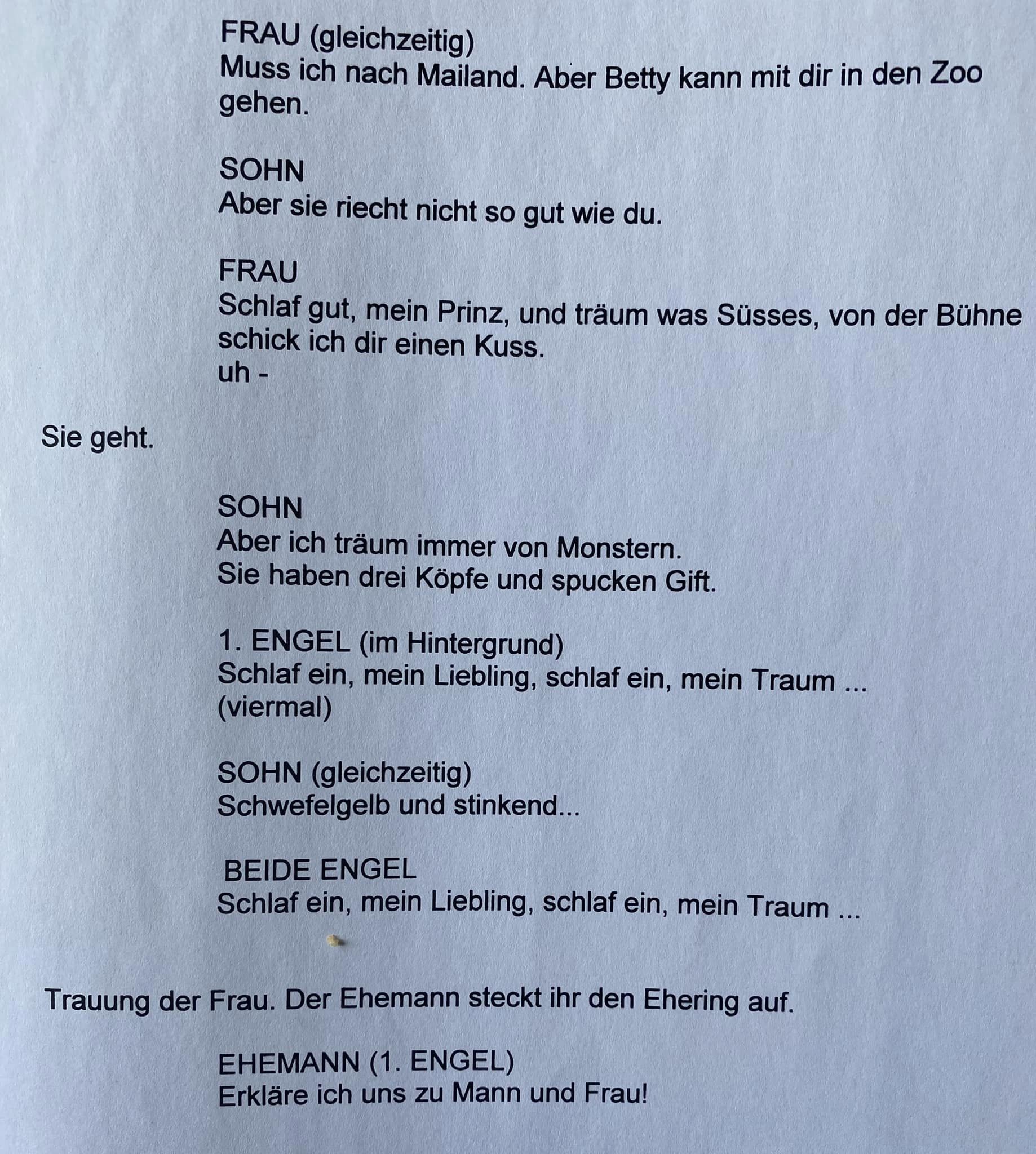
WOMAN
I have to go to Milan. But Betty can take you to the zoo.
SON
But she doesn’t smell as good as you.
WOMAN
Sleep tight, my prince, and sweet dreams. I’ll blow you a kiss from the stage.
oo… oo…
SON
But I always dream of monsters.
1. ANGEL
Sweet dreams my darling Sweet dreams my love
SON
They have three heads and spit poison. Sulfur-like and stinky
1. & 2. ANGEL
Sweet dreams my darling Sweet dreams my love
WOMAN Ah… ah…
1. & 2. ANGEL
Sweet dreams my darling Sweet dreams my love
Sweet dreams my darling Sweet dreams my love
Sweet dreams my darling Sweet dreams my love
HUSBAND (1. ANGEL)
I declare us husband and wife.
In the next installment we will spend time with the Husband, albeit interrupted by a lover’s tryst with the Conductor. Stay tuned.
*Yes, you heard right, that is me singing the 1. Angel part in the German studio recording; which means you can hear me perform as both Angels between that and the English concert recording in Section VII – although both times I stick to the upper harmony when singing with the other Angel.

Above is a picture of myself, my mother Catherine Gayer and family friend Helga Krauss after the New York stage premiere of Beyond, the little night opera Helga and I wrote for my mother.
This is Part 3 of sharing both the German and English versions of Jenseits/Beyond on Notes for a Composer. Part 1 can be found here, Part 2 is here, and eventually the whole libretto and score can be found on the designated Jenseits/Beyond page.
In Section V the woman’s journey in the Beyond has its first extended reenactment of a scene from the past. And for the first time one of the angels takes on the role of an important figure in the opera singer’s life, the conductor. (Yes, that is me hamming it up as the angel/conductor in the English language concert recording).
The woman is rehearsing a wordless baroque aria under the direction of the conductor – and if the long held note at the beginning of the aria followed by a circuitous melodic line vaguely reminds you of other famous baroque or baroque adjacent pieces of music, let me as the composer just state that that is absolutely intended.
The conductor is blurring the lines between musical direction and seduction, which the woman finds both thrilling and alarming. Her responses are reflected purely musically through modification of the baroque melody and wordless musical interjections.
This blast from the past troubles the woman greatly as she grapples with how she sees herself now in the Beyond in Section VI. She is filled with doubt and fear over what is real and what is happening with her. She sees no light, only darkness.

German Language Studio Recording
English Language Live Concert Recording
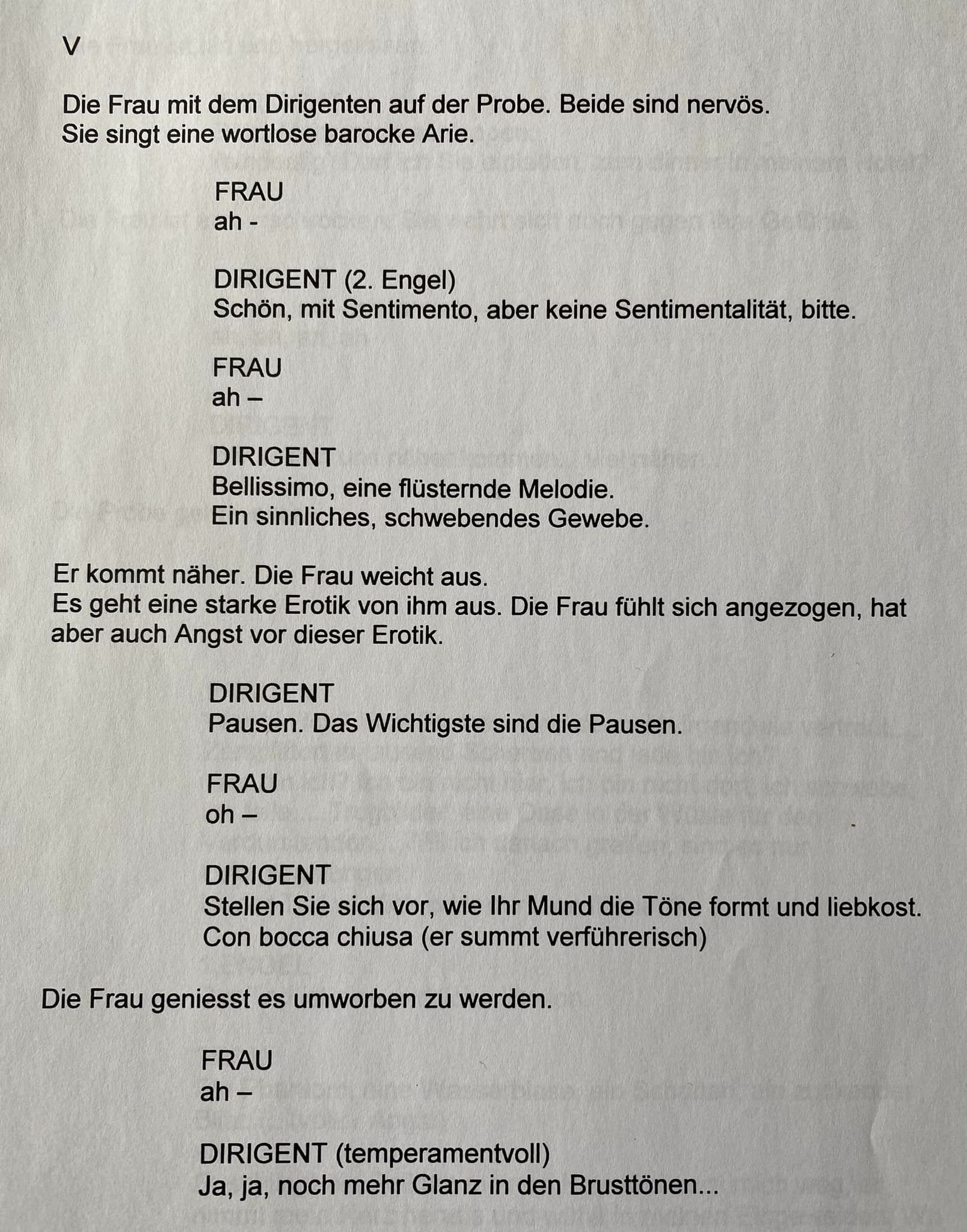
The Woman and the Conductor rehearsing. Both are nervous. She sings a wordless baroque aria.
WOMAN
Ah-
CONDUCTOR (2. ANGEL)
Lovely, with sentiment
WOMAN
Ah-
CONDUCTOR
But no sentimentality please
Bellissimo, a whispering melody
A sensual, hovering tapestry
He comes closer. She eludes him. He exudes a strong erotic energy. She feels drawn to him, but also fears this sensuality.
CONDUCTOR
Pauses….most important are the pauses.
WOMAN Oh-
CONDUCTOR
Imagine how your mouth forms the tones, caresses them. Con bocca chiusa. (He hums seductively)
WOMAN
AAH –
The woman is enjoying being wooed.
CONDUCTOR
Yes, yes, even more luster in your chest tones
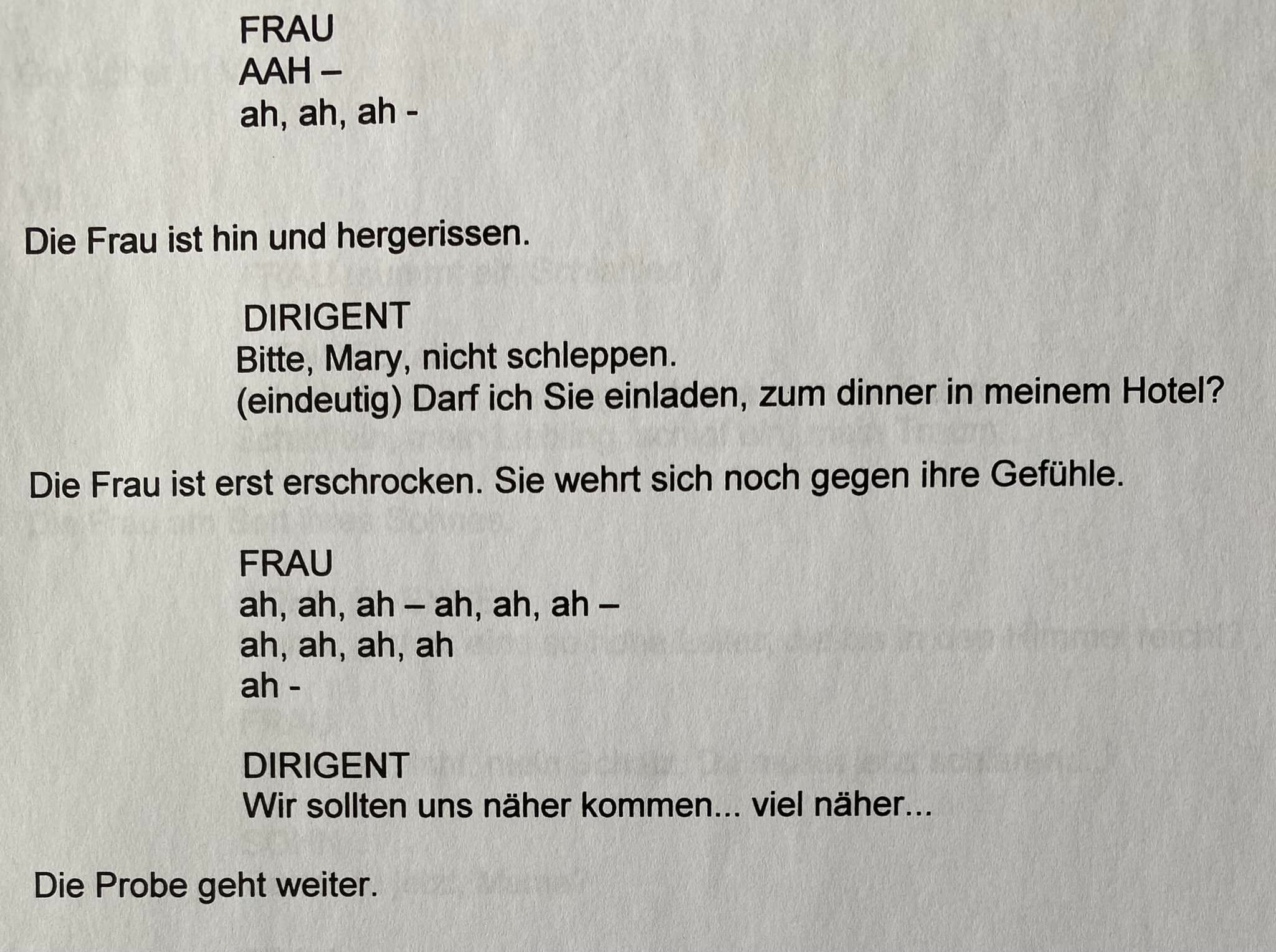
WOMAN
AAH – Ah, ah, ah –
CONDUCTOR
Please, Mary, don’t hold back.
(his intentions unmistakable)May I invite you, to dinner at my hotel?
WOMAN
Ah ah ah, ah ah ah
Uh uh, uh uh
Ah-
CONDUCTOR
We should get to know each other…much better…
The rehearsal continues.
WOMAN
Ah-
ah – ah- ah-


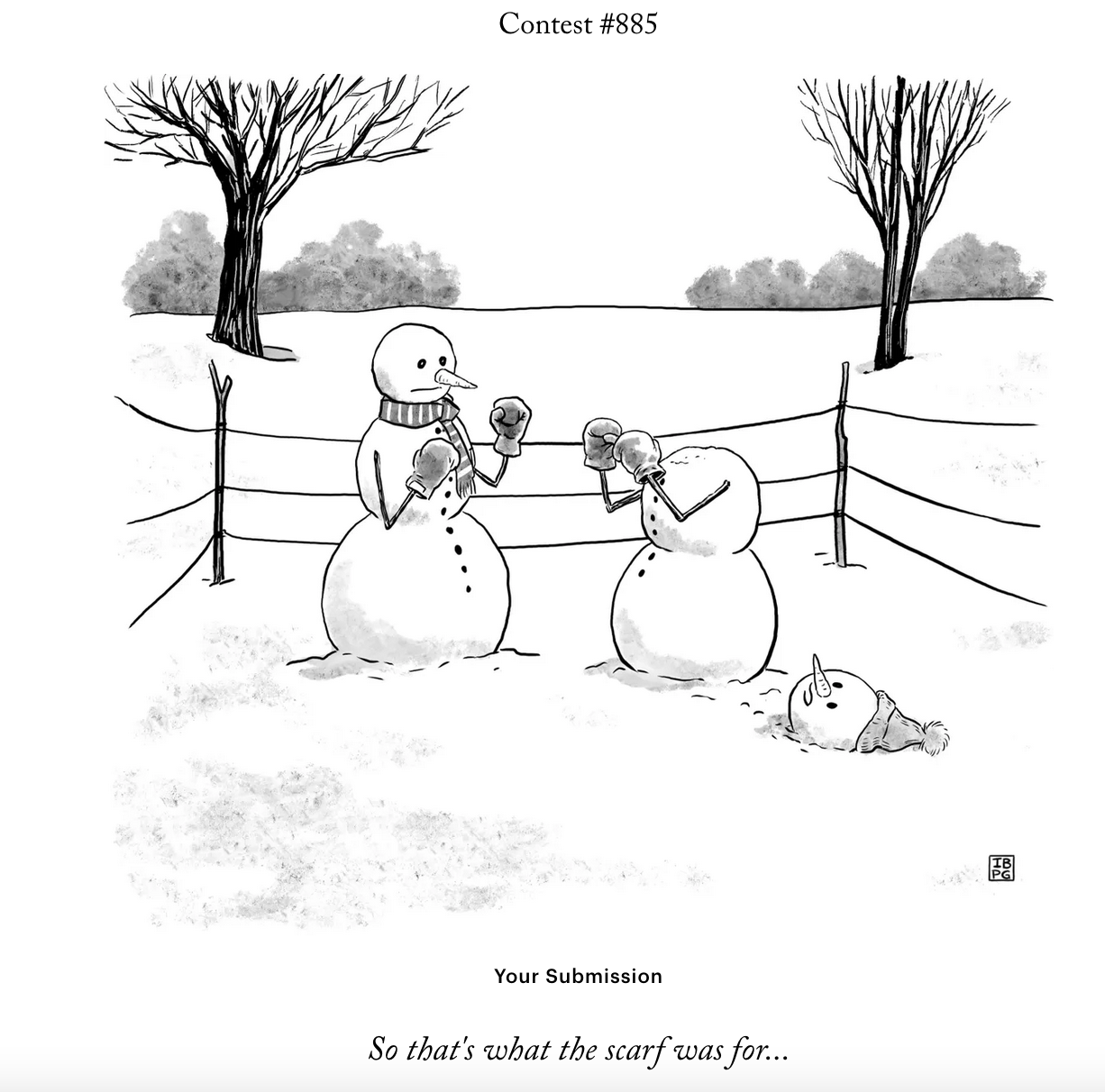
The 6th installment of my submissions to the New Yorker Magazine cartoon captioning contest.
My streak of not being chosen as a finalist continues unabated!
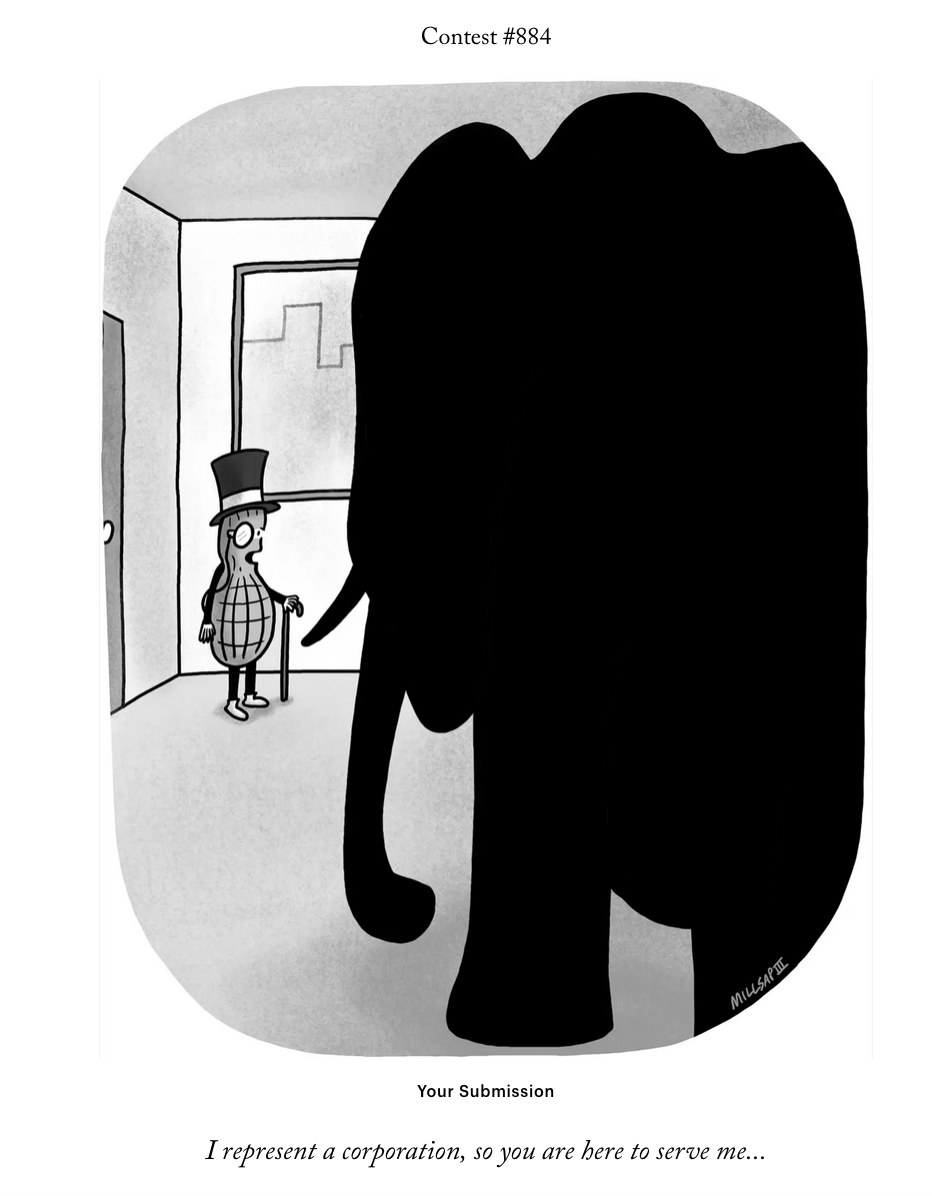
… got a little political with that one.

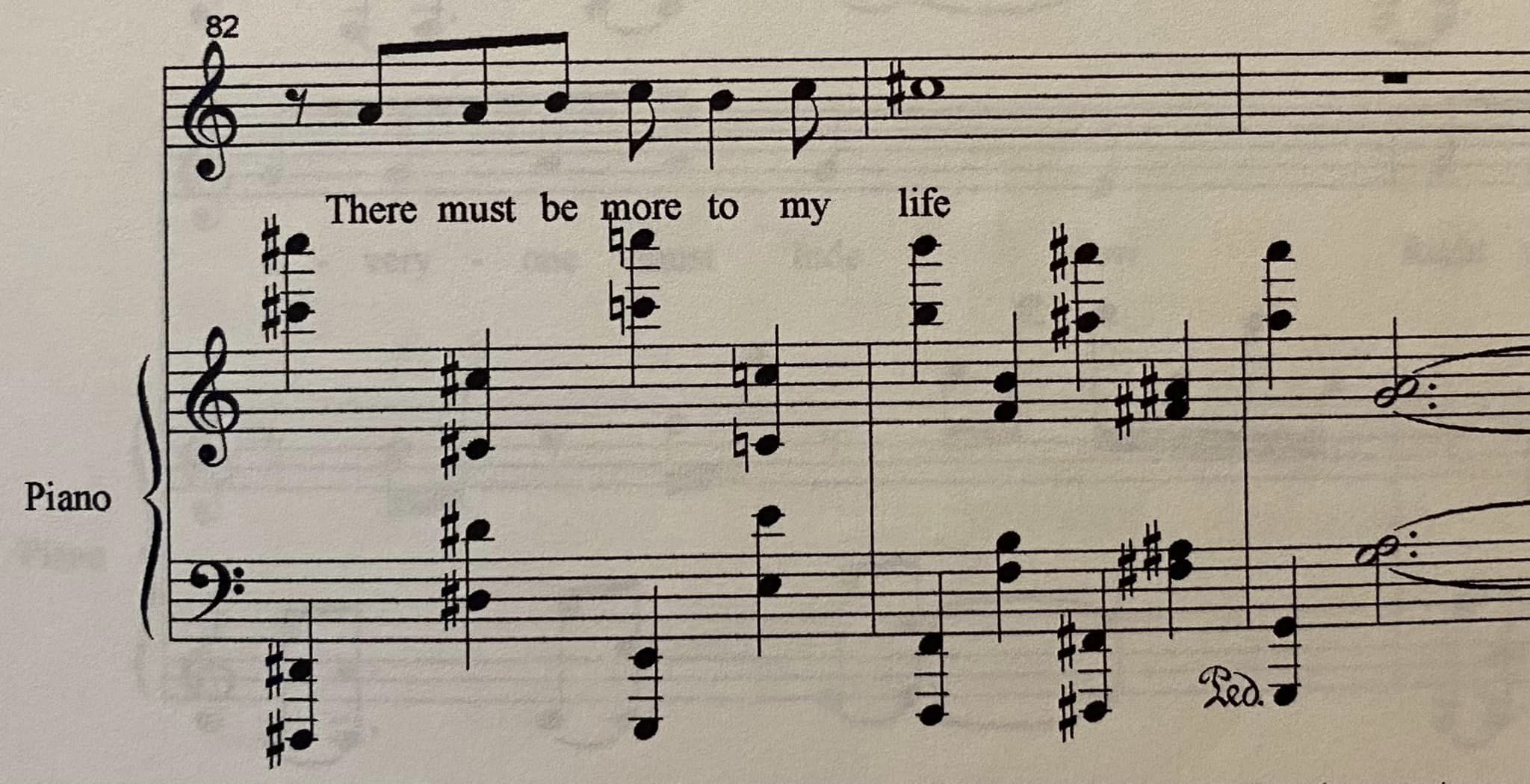
Welcome to the second post about the little night opera “Jenseits” AKA “Beyond” I composed for my mother, Catherine Gayer. Helga Krauss wrote the libretto, which I translated into English. Read and listen to the first post here, and follow the eventual posting of the complete opera on its designated page.
Today we look at/listen to sections III and IV. The woman, an opera singer who suffered a serious car crash, has found herself in a metaphysical waystation accompanied by two angels.
As she bargains for more life to live, she briefly looks back at three of the most important figures in her life (and who will figure prominently in sections to come): her son, her lover, and her husband. She laments all that has remained unsaid, uncried, unfulfilled.
Which is a cue for the angels to start a more comprehensive review of the diva’s life. Beginning with her childhood. We receive snippets of her girlhood concerns while she performs her vocal exercises, dreaming of becoming a famous opera singer.
By the way, the vocal exercises threaded into the score are all actual vocal exercises my mother learned from her mother and which she also taught her own vocal students, including me, who would in turn teach them to my students, as when I led school choirs or music directed first grade operas.
Those however are the only biographical details taken directly from my mother’s life and incorporated into the opera, along with roles the singer lists as her repertoire in section II. Everything else is Helga Krauss’ invention.

German Language Studio Recording
English Language Live Concert Recording
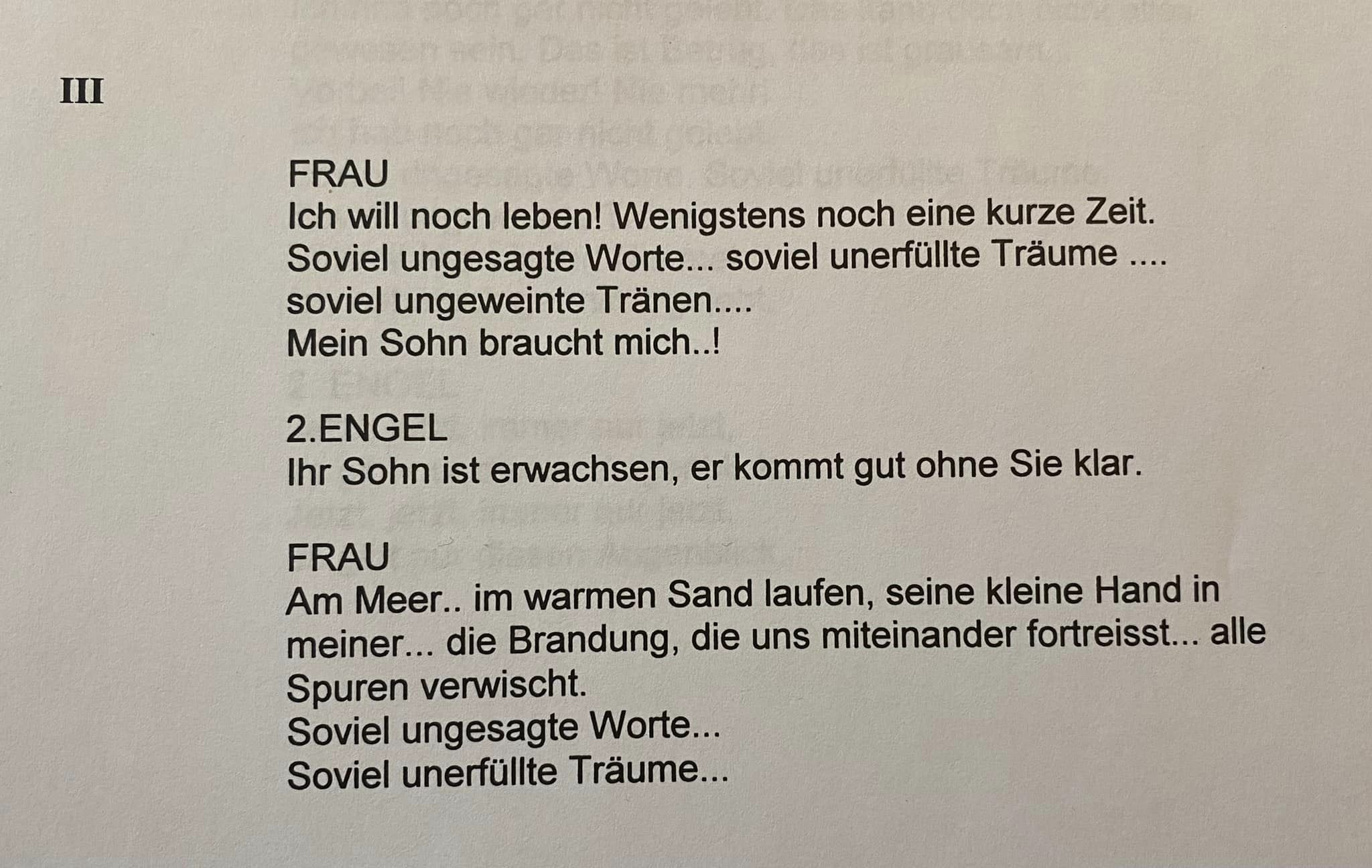
WOMAN
I want to live. At least a little bit longer.
All the words I have not spoken
All the dreams I have not followed
All the tears I have not cried out
My son needs me…!
2. ANGEL
Your son’s grown up. He can get by without you.
WOMAN
The shore
My little boy walking
With his tiny hand in my hand
The waves break pulling gently at our footsteps til our traces have gone
All the words I have not spoken
All the dreams I have not followed
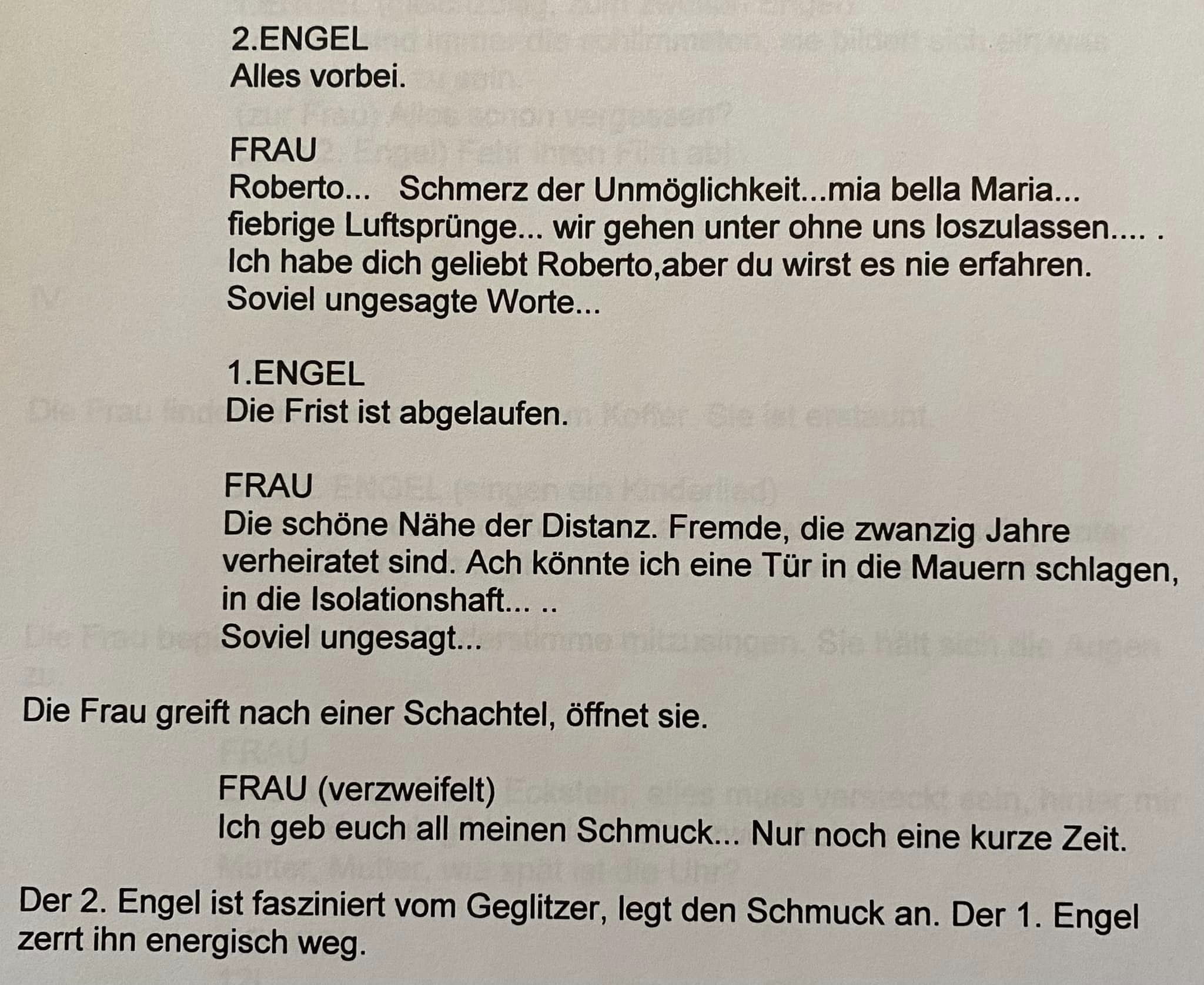
2. ANGEL All over
WOMAN
Roberto
Beloved impossible
Mia bella Maria
We take the lover’s leap
We cling together, sinking beneath the surface
I truly was in love, Roberto
But I made sure I never told you
All the words I have not spoken
1. ANGEL Your time is up.
WOMAN
Henry
The homey distance by your side
Strangers who have been married for thirty-three years
If I could break through the walls of our lonely jail cells
Of our private confinement
All the words I have
I’ll give you all my jewelry
Only a little bit longer
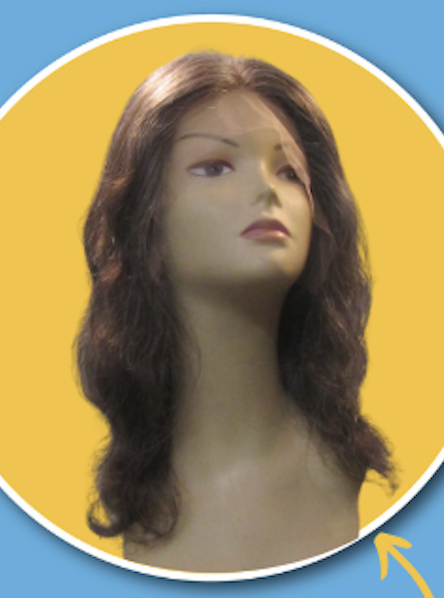
That is a picture of a wig that was made with my hair. Hair I donated. Multiple pony tails in zip lock baggies I shipped off to an organization called Hair We Care. Their mission statement is “to help maintain dignity, confidence and self-esteem to those affected by medical hair loss”.
As is turns out, Hair We Care required donations from four individuals to create the wig pictured above. This is the photo card they provided for me, crediting my contribution to this particular wig.

Here is a pic of me the day before the hair went bye-bye:

And here I am mere hours after it all got cut and shaved away:
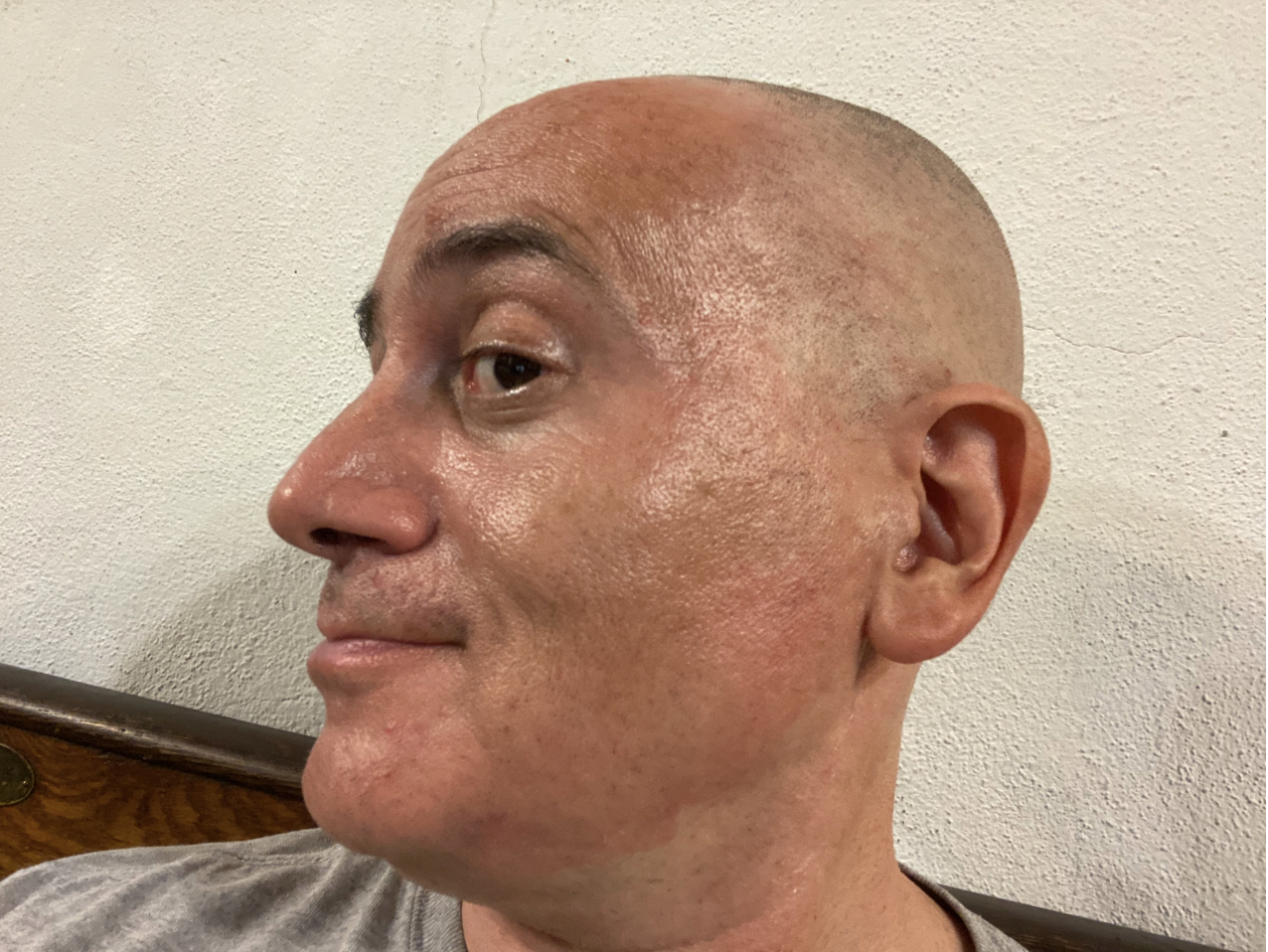
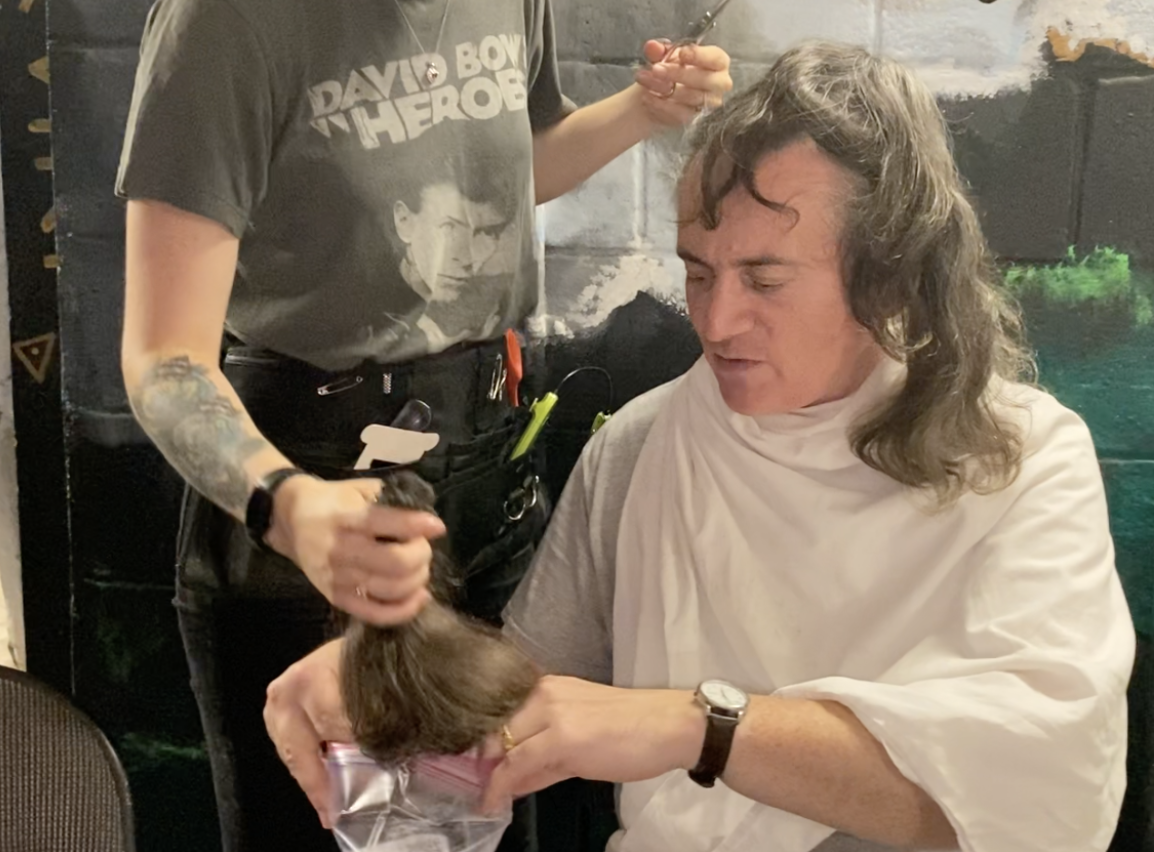
Regular readers – or those who clicked on the links above – will know my hair was that long and then shaved off in service of my second short film musical Edgar Allan Poe adaptation “The Pit and the Pendulum – a musicabre“.
This is the P&P On Set Diary blog post that documents in exhaustive hair-curling (or rather hair-removing) detail how my hair was cut and plastic baggied for shipping to Hair We Care.
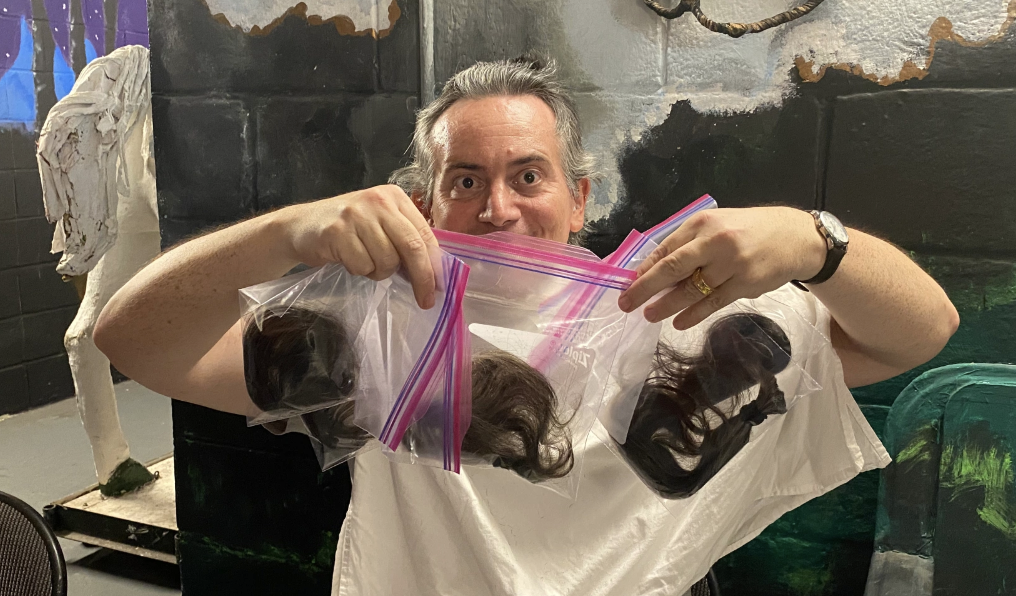
And below is the certificate I received from Hair We Care after they processed my donation.
They cautioned it would be a while before the wig would be made, and it took even longer due to back logs and pandemic induced delays. But now finally I have received the long-awaited photo of the wig that was made with my hair.
And that is really cool.


Twenty years ago family friend and screenwriter Helga Krauss and I created a one-act opera for my mother, Catherine Gayer (AKA Catherine Ashkenasi, her maiden name being her stage name). Helga wrote the libretto and I composed the music. It is the story of an opera singer who after a serious car crash is met by two angels who take her on a tour of her life and psyche to help determine whether she returns to life or passes on. The opera is called “Jenseits”. The English title – I was responsible for the English translation – is “Beyond”.
There is a studio recording of the complete German version, and a live concert recording of the complete English version. My mother sings both. The postcard at top is from the theatrical version my mother also performed at FringeNYC in 2005. The NYTimes review at the time said my music has “dimensionality and touches of poignancy”.
Starting today, and following up in regular installments, I will be sharing sections of Jenseits/Beyond in German and English, while simultaneously posting these on the opera’s designated Notes from a Composer Page. When the final blog post installment is posted, the full opera will be accessible in bilingual sound and text on the Jenseits/Beyond page.
We begin with Sections I and II. Two Angels, one seasoned, one new at the job, await their next assignment, an opera singer involved in a car crash…
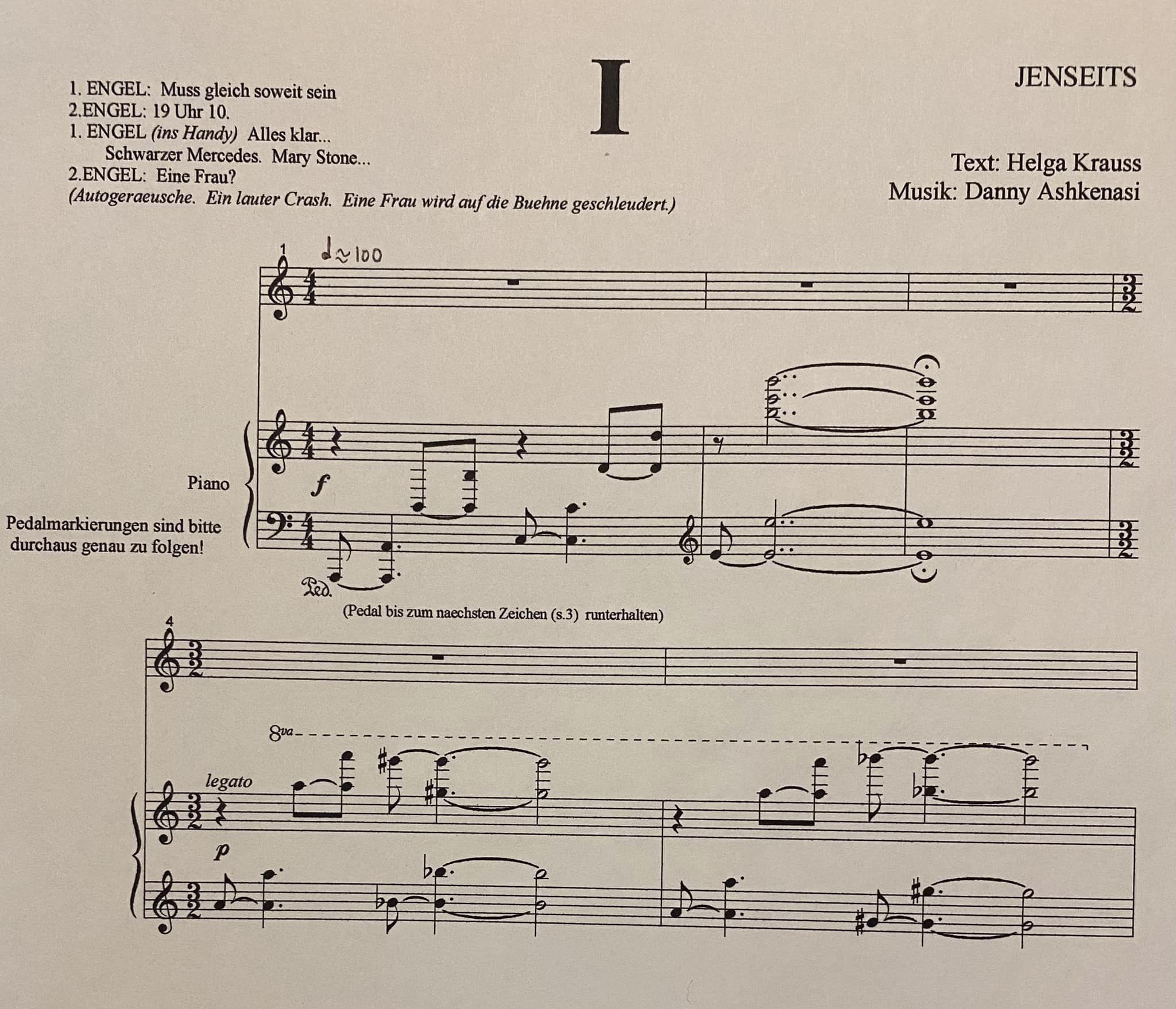




German Language Studio Recording
English Language Live Concert Recording
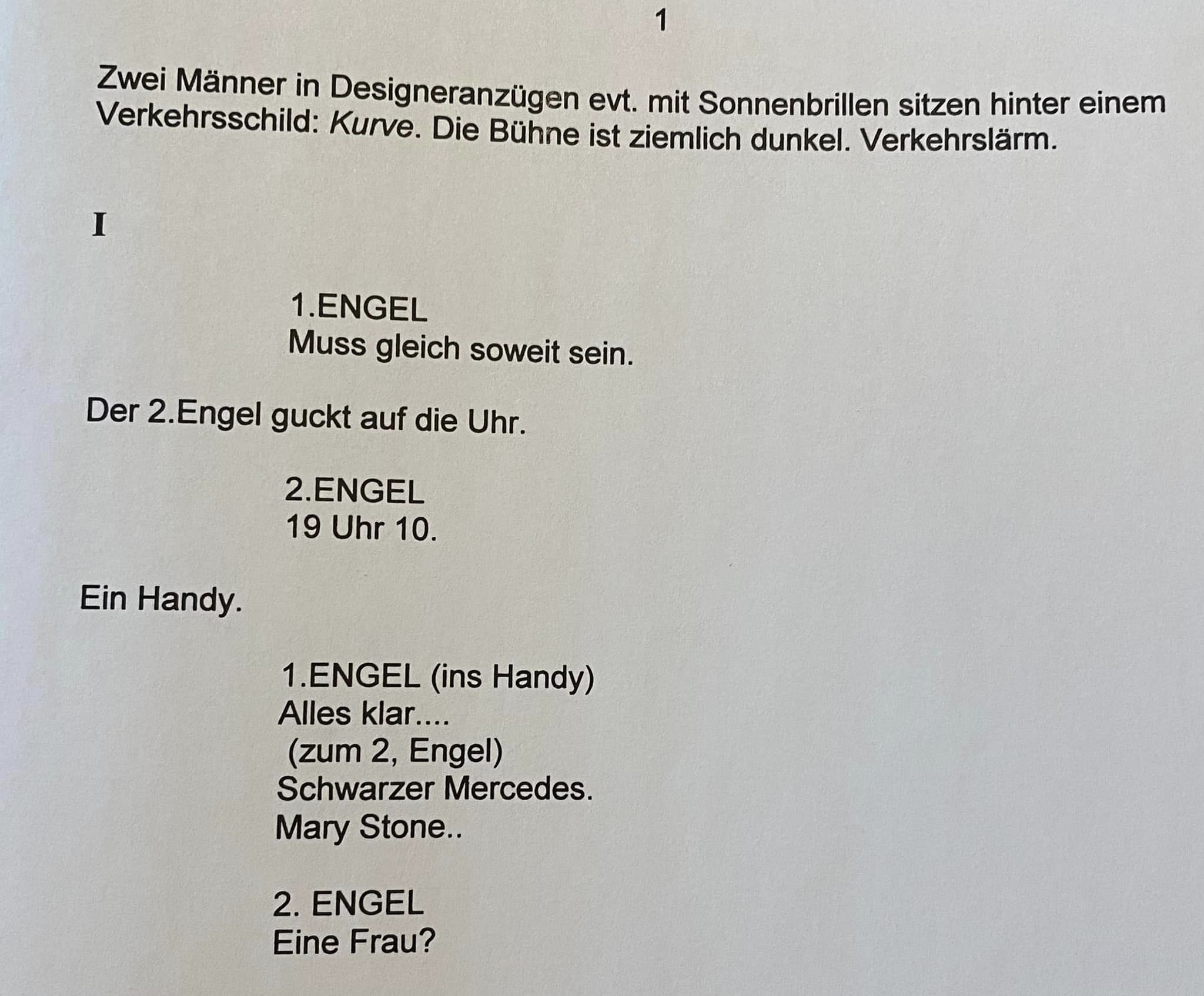
Two men in designer suits, possibly wearing sunglasses, sit behind a traffic sign: Curve. The stage is rather dark. Traffic noise.
1. ANGEL:
Must be about time.
The 2. Angel checks his watch
A cell phone
2. ANGEL
Nineteen hundred hours, ten minutes.
1. ANGEL Understood.
(to 2. Angel) Black Mercedes. Mary Stone 2. ANGEL
A woman?

Car sounds that come nearer. Then a loud crash, two cars have smashed into another. A woman is thrown onto the stage, together with a suitcase.
WOMAN
I’m falling…. I’m floating…
A waterfall, the roar of the ocean waves
The song of the sea shell’s breath
1. ANGEL
Are you ready?
WOMAN
A fluttering whirlpool of blinding white, blue tinted light
1. ANGEL
Please come along. You are expected.
WOMAN
No ending, no beginning
I am light, just like a feather
Fire truck siren.
Continue reading
My mother Catherine spent two weeks in New York with us in February. Her birthday was celebrated during her visit. And one birthday present was a puzzle of the New York Times front page of the day she was born.

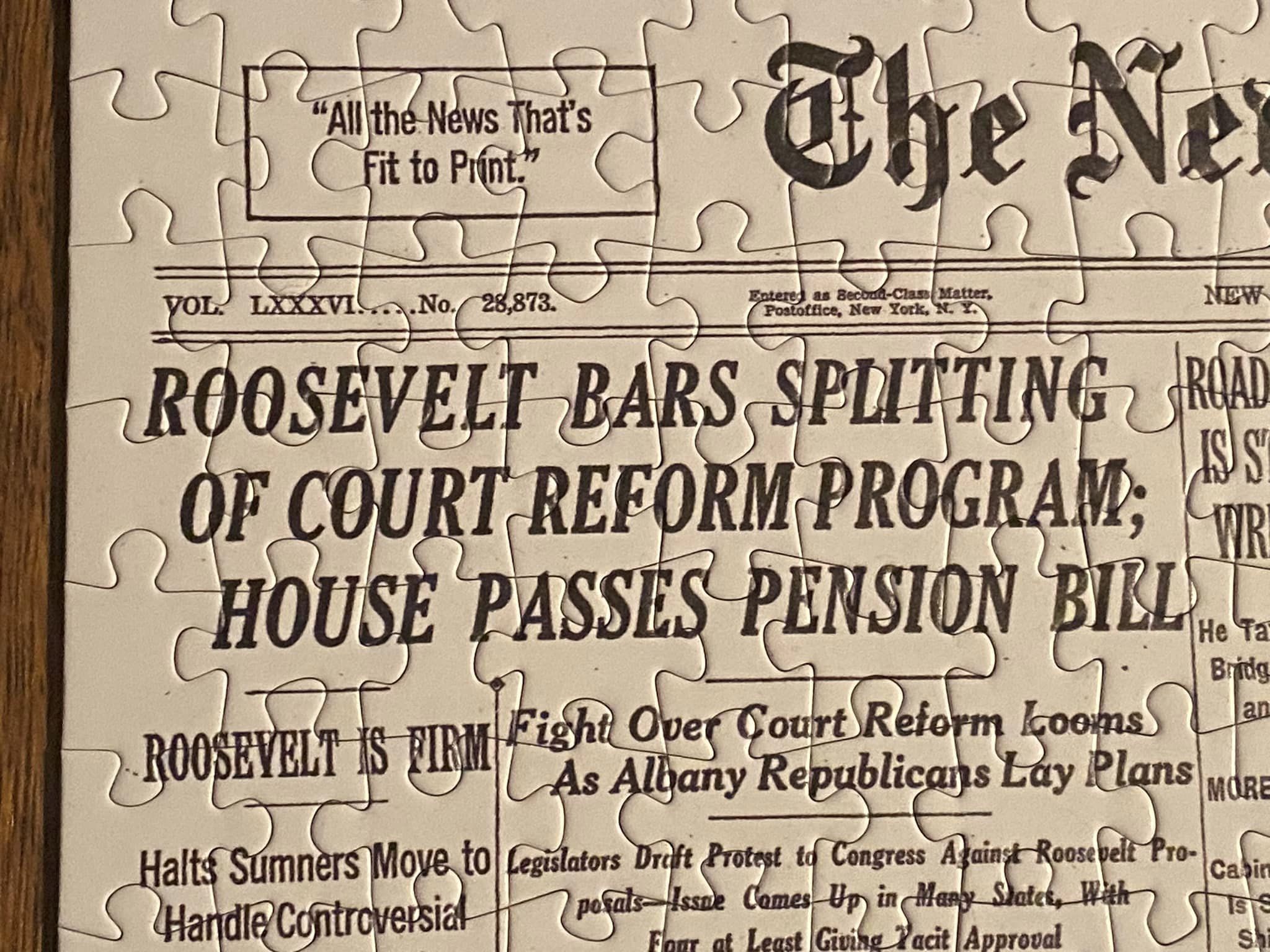
Let’s look even closer, here is the date at the top of the page. February 11, 1937.
My mother turned 87.

Here she is at the swanky restaurant overlooking Columbus Circle where we celebrated her birthday, blowing out the candle the waiter presented along with complimentary petit fours while singing “Happy Birthday”.
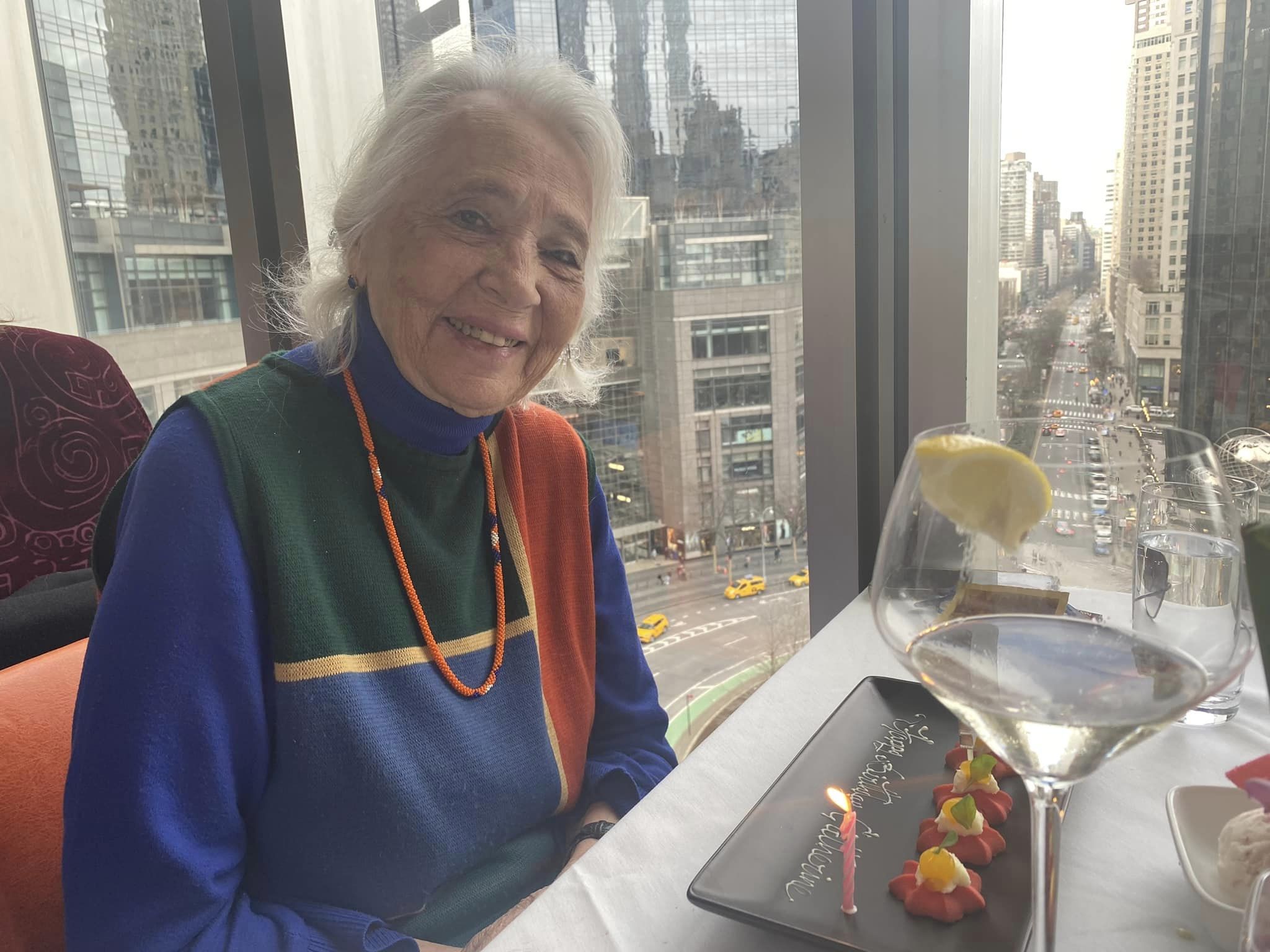
Next to Mom is her girlhood friend Sheila. They’ve known each other since elementary school. Sheila was the one who gave Mom the New York Times front page puzzle.

The 500 piece puzzle wasn’t necessarily easy to put together. But we managed to finish it before Mom’s visit concluded. Allowing us to sandwich it between two pieces of cardboard for safe travel in Mom’s suitcase to Berlin.
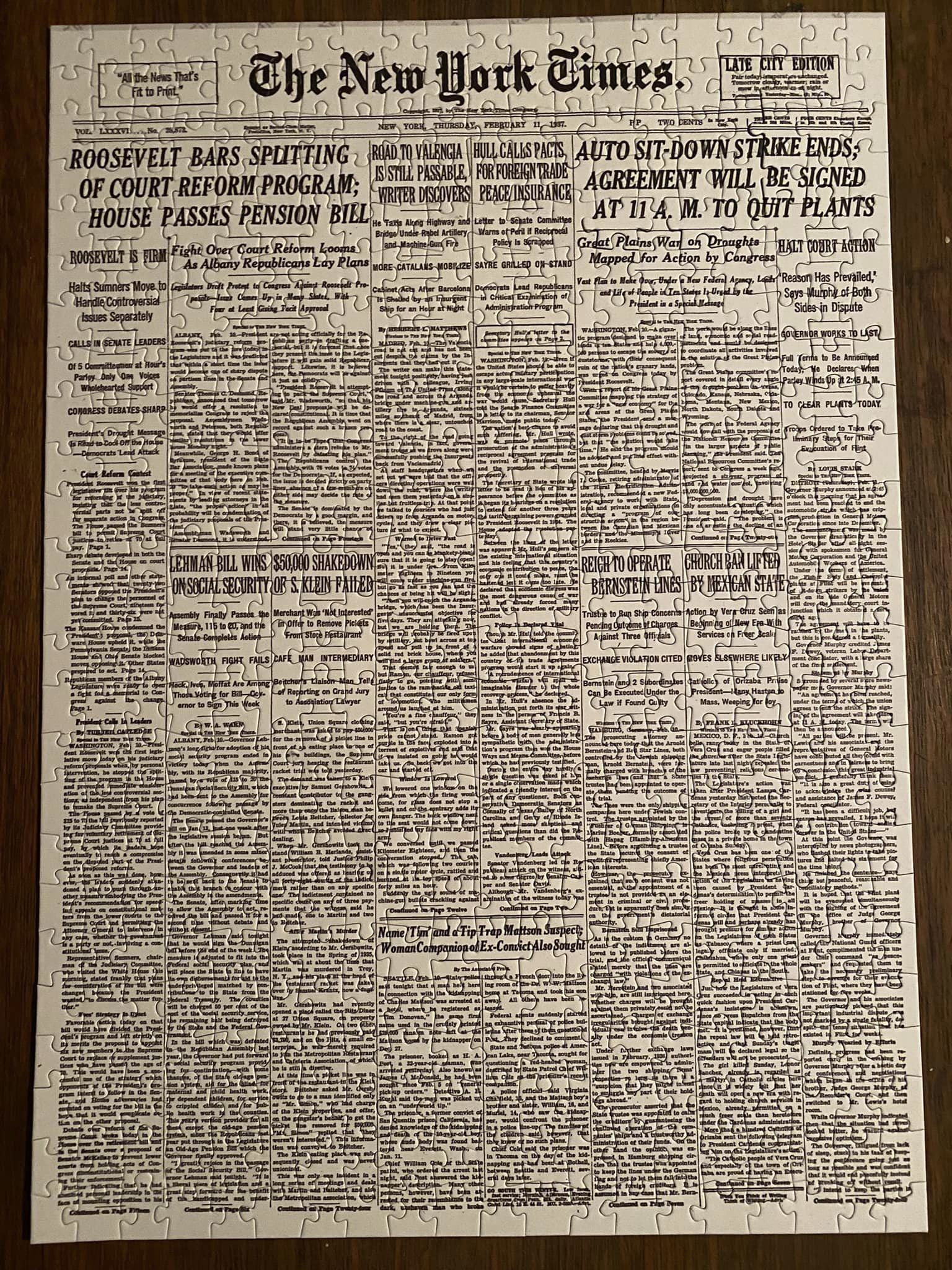
So what was the big news on February 11, 1937?
Well, some of the best known parts of 1930s history are referenced, like President Franklin Delano Roosevelt, The Spanish Civil War, the Dust Bowl and the Nazis.
The main headline and articles on the left side are all about FDR’s effort to reform the Supreme Court, nowadays often referred to as the court packing scheme. But even a passing glance at these articles suggests the whole court reform effort was more complicated than just the effort to add more justices to the court. This day’s paper has the president wrangling with Congress about whether to split different components of the reform effort into separate bills or not, while also discussing how various state legislatures are responding to the effort. Interestingly I found no use of the term “court packing” anywhere on the page.
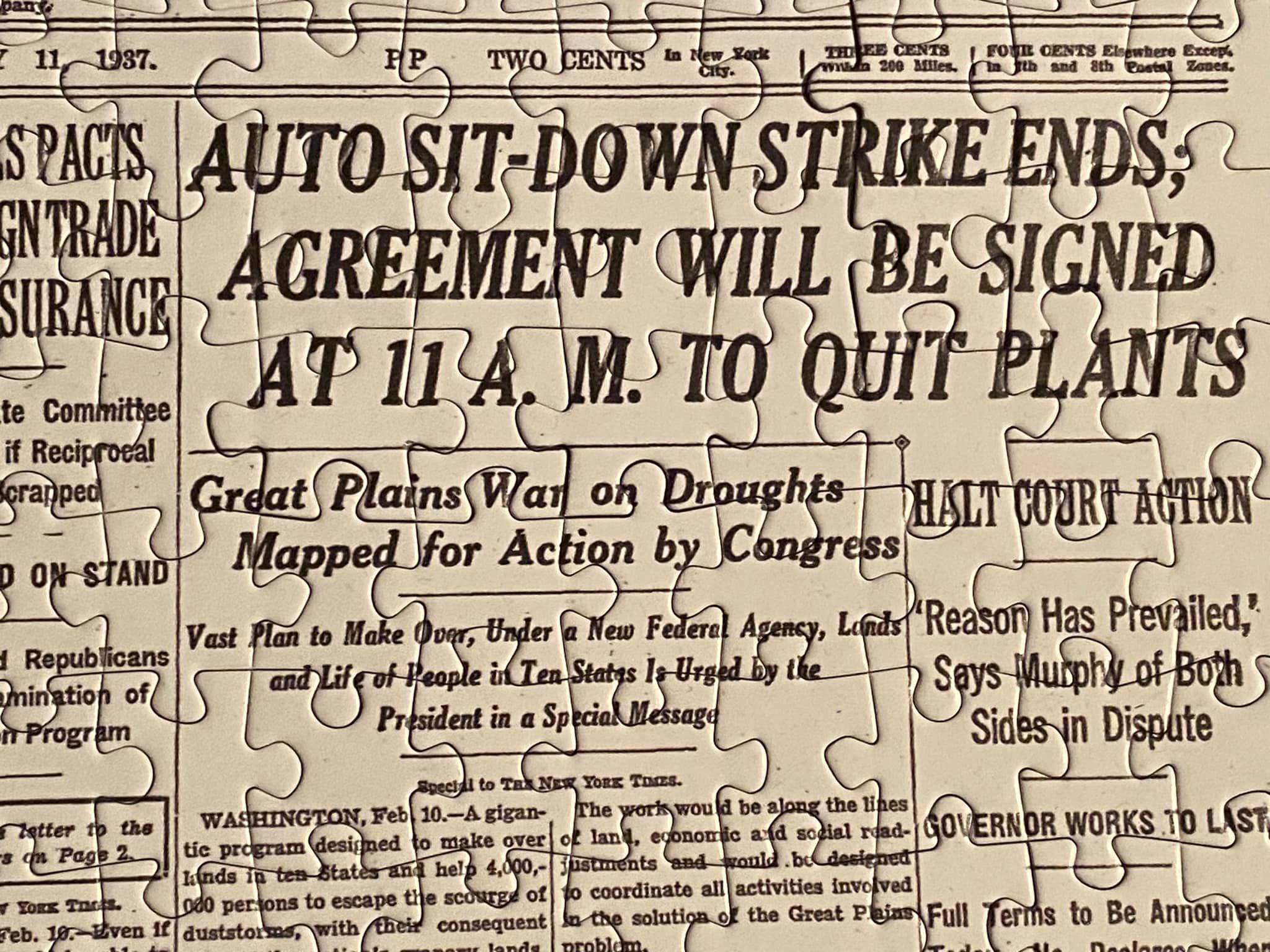
Meanwhile the secondary headlines on the right side both pertain to the Mid-West. An automobile-strike is averted in Detroit. The article emphasizes just how fatigued Michigan’s Governor Murphy was by the negotiations.
Below that bold face headline is an article regarding efforts to mitigate the devastation brought on by the massive droughts the Great Plains suffered in the 1930s, what we commonly now refer to the as the Dust Bowl.




It’s called Correfoc. It is a popular Catalan tradition consisting of “a parade of infernal characters that chase people with fireworks“. It was one of the wildest events we attended during Barcelona’s La Mercé festival.
Diables and Bestiari, adults and children dressed as devils or wearing monster contraptions, light firecrackers and sparklers and send shooting sparks careening into the parade watchers on Barcelona’s fashionable avenue, the Passeig de Gracia.
Teams of drummers accompany the semi-controlled mayhem.
In the evening all the devils and monsters go into the Porta de l’Infern, Hell’s Gate, erected in a northern corner of the Passeig. After a massive fireworks display, the devils come out of the Porta de l’Infern again and dance back south down the avenue, shooting swirling waves of bursting sparks along the way.


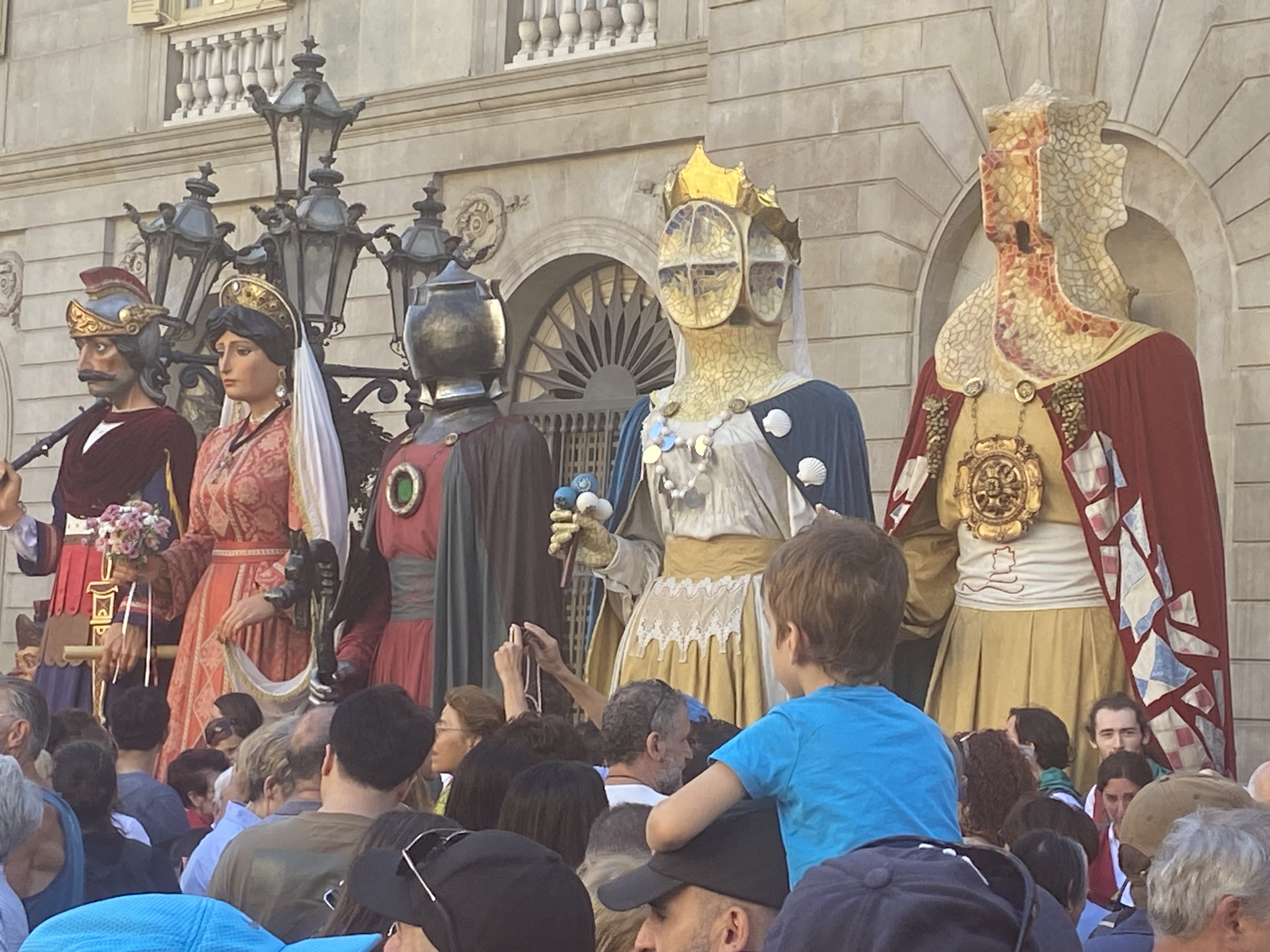
The day after the display of the Castells the La Mercé festival featured giant puppets dancing in Placa de Sant Jaume in Barcelona.
Huge puppets surrounded the plaza, then were marched by their handlers – balancing figures many multiples of their own height – into an open space in the middle of the plaza, where two to six of these giants, some of them depicting royalty, some regular folk or caricatures, some fantastical creations, danced elaborate choreography while a live band played traditional tunes.
Thereafter all the puppets marched and danced in a parade of the giants out of the plaza and through the city of Barcelona.



 | Ann Hilton Fisher on Ecclesiastes of my own persona… |
 | dannyashkenasi on A Dulcimer, A Fountain, and a… |
| Ann Hilton Fisher on A Dulcimer, A Fountain, and a… |
| Ann Hilton Fisher on I Take the Colbert Questi… |
| Ann Hilton Fisher on Happy Birthday, Ed – Evo… |
| dannyashkenasi on BRAZIL – Pernambuco… |
 | ebnesr9aabfafe63 on BRAZIL – Pernambuco… |
 | 1826sdf913 on Genesis of my own personal NEW… |
 | Weng on Speak Low, Phoenix, Speak… |
 | Tony Ananiadis on Speak Low, Phoenix, Speak… |
 | Brent on HOOVER DAM, MEMORIAL BRIDGE an… |
 | Steven on CANNES IMPRESSIONS Part 2 |
 | Rudi v on Catherine Gayer on the Ra… |
| Rudi on Catherine Gayer on the Ra… |
 | Erin Carere on Love and Hope in Barcelon… |





 Notes from a Composer