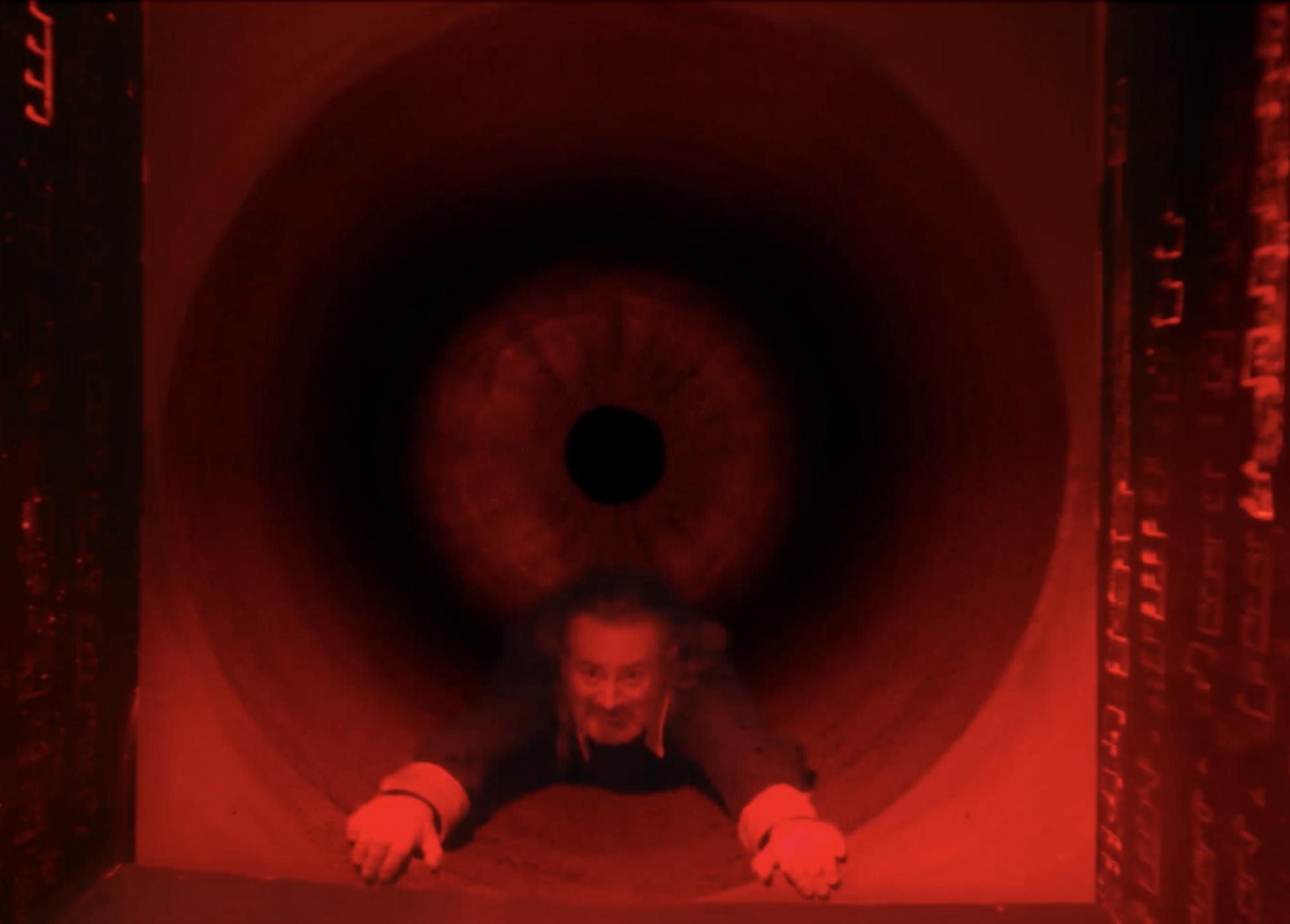
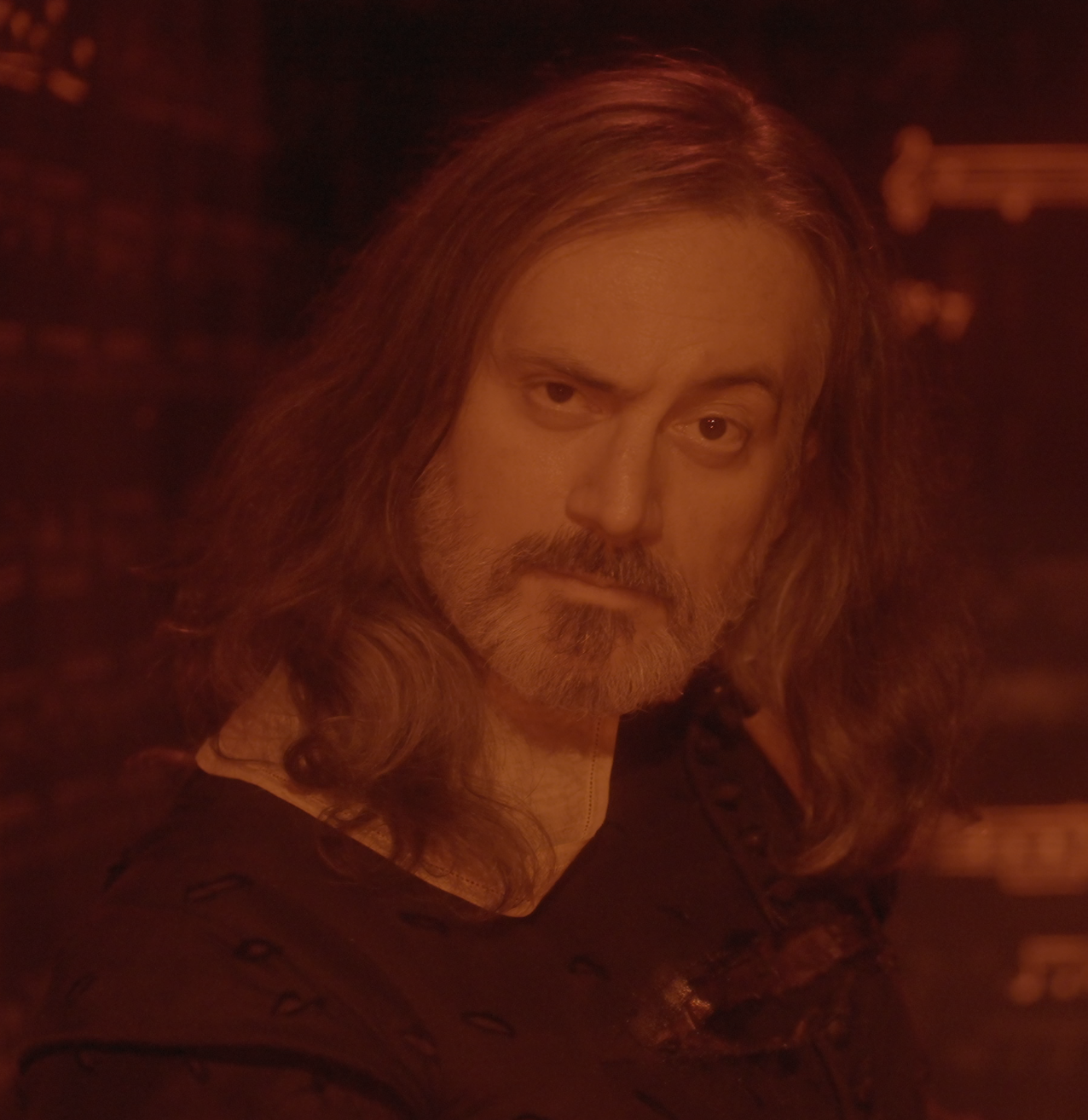
Even if you’ve only so far seen the poster(s) or trailer for “The Pit and the Pendulum – a musicabre“, my musical short film adaptation of the classic Edgar Allan Poe story, you’ve encountered the above image of the protagonist hanging from the edge of the pit, with a monstrous eye waiting below for its quarry.
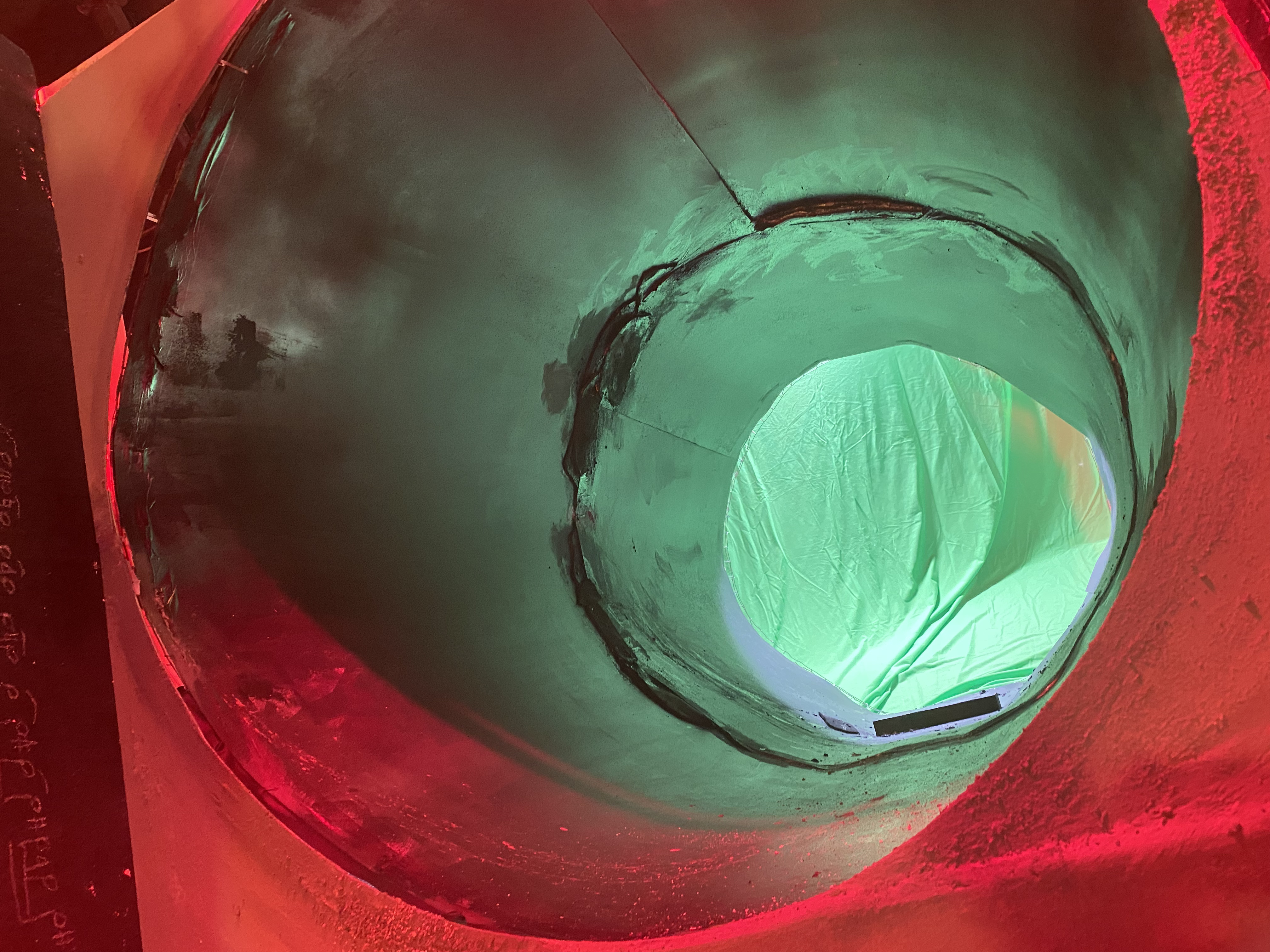
Day 8 of our shooting schedule is when we captured that shot – well, everything but the eye, photographed a previous day and added in post with VFX work. We would need an eight foot tube with the opening as wide (four feet) as the pit, in order to stretch out my body and arms within.
We wouldn’t be standing the pit tube upright for the shot. Usually in these “fake hanging from ledges” shots, the actor is lying on their stomach and the camera is placed level in the floor so that it looks like the shot is “looking down” at the character holding on for dear life.
In our case we decided we would tilt the pit tube about 45 degrees. In stead of a large fan, some gel and spray and styling would give my hair the right “downward” look. My acting would have to sell the rest. It felt a little like I was about to be shot out of a cannon.
For the whole film shoot we needed three separate versions of the pit. Most scenes required only the opening of the pit to be cut out of the floor of our set, raised just two inches above the studio floor. We placed a green screen or black cloth underneath (depending on the lighting). Both the inside of the pit shrouded in blackness and the reveal of the eye would be added in post with VFX.
Then we also needed to build a version of the pit that stood four feet off the ground, in order to allow shots from within the pit looking up, as well as shots of the protagonist as he is forced down into the pit by the encroaching, infernally hot walls.
For the shot of me actually hanging from the edge by my fingers we needed the big long tube. There was enough surface tension between me and the tilted tube that I wouldn’t slide down once lying down inside, but it was still very helpful that production designer Mariana Soares da Silva built a foot rest for me. Below the back entrance we at first placed green screen to aide Jimmy McCoy, our VFX guy, when he later adds the eye. But then we switched that out with black cloth to avoid the green light spill. The total darkness at the bottom of the tube caused by the black cloth was going to work better for Jimmy.
My first short film musical Poe adaptation “The Tell-Tale Heart – a musicabre” played the Romford Horror Independent Film Festival, an off shoot of the Romford Film Festival in 2021. So naturally I applied again this year with the companion musicabre. However the Romford Horror Independent Film Festival reached out to me, suggesting I switch my submission to the Romford Film Festival instead. I did, got accepted, and – upgrade! – here I am, playing in the bigger sandbox this time!
I look forward to being part of the festival. If you are in the London area, do come out Monday to see me and my musicabre.
The New Yorker magazine features a cartoon caption competition, where they print a captionless cartoon image and invite their readers to submit caption suggestions. Three submissions are then put up for a public vote to determine the final winner.
Every now and then I submit a suggestion. Not often, mind you, but to date I’ve screen shot six of my suggestions, which is enough for a blog post.
So far my suggestions have not been selected for the public vote, although the last one was only just submitted, so maybe… or maybe not.
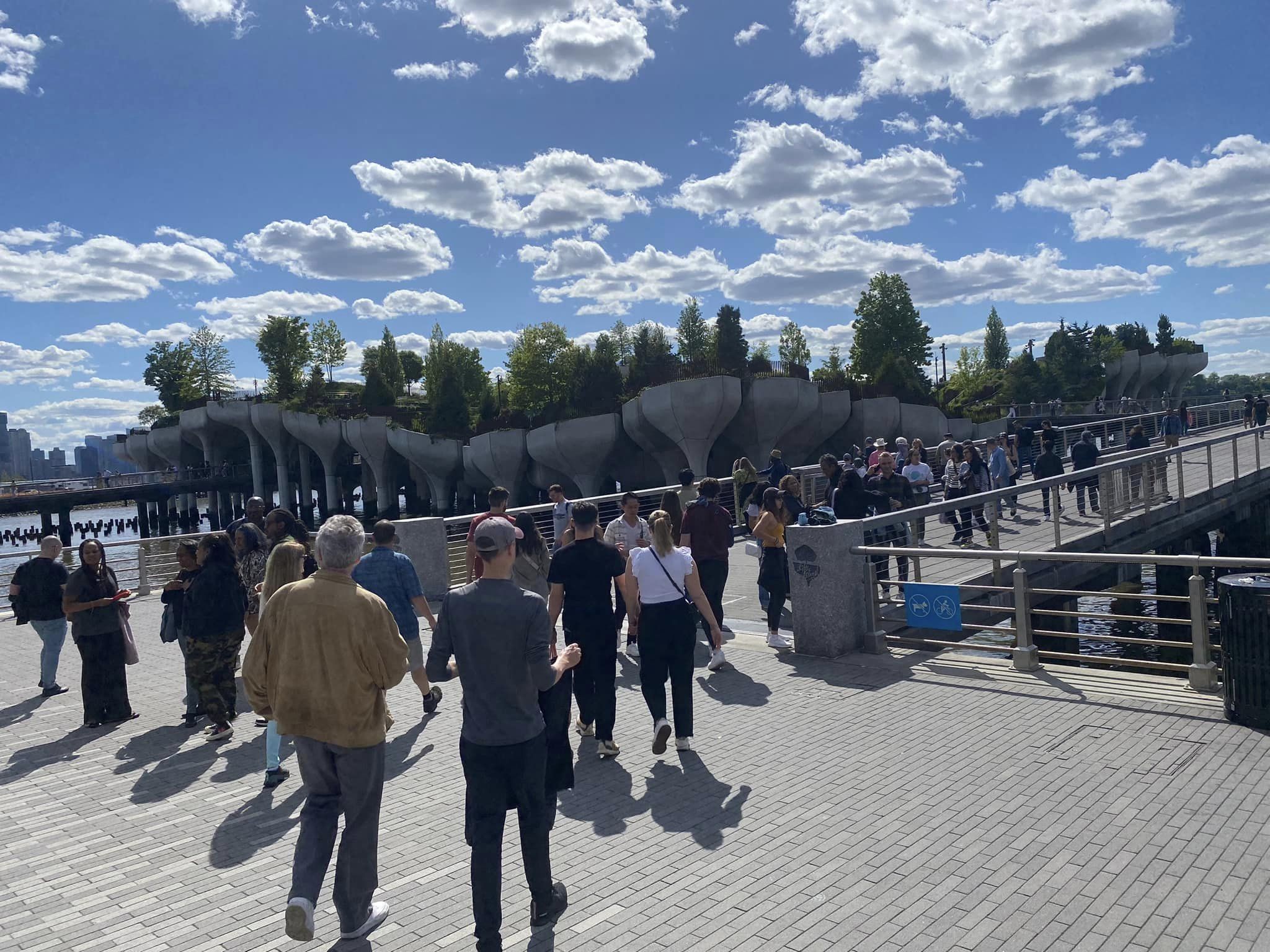
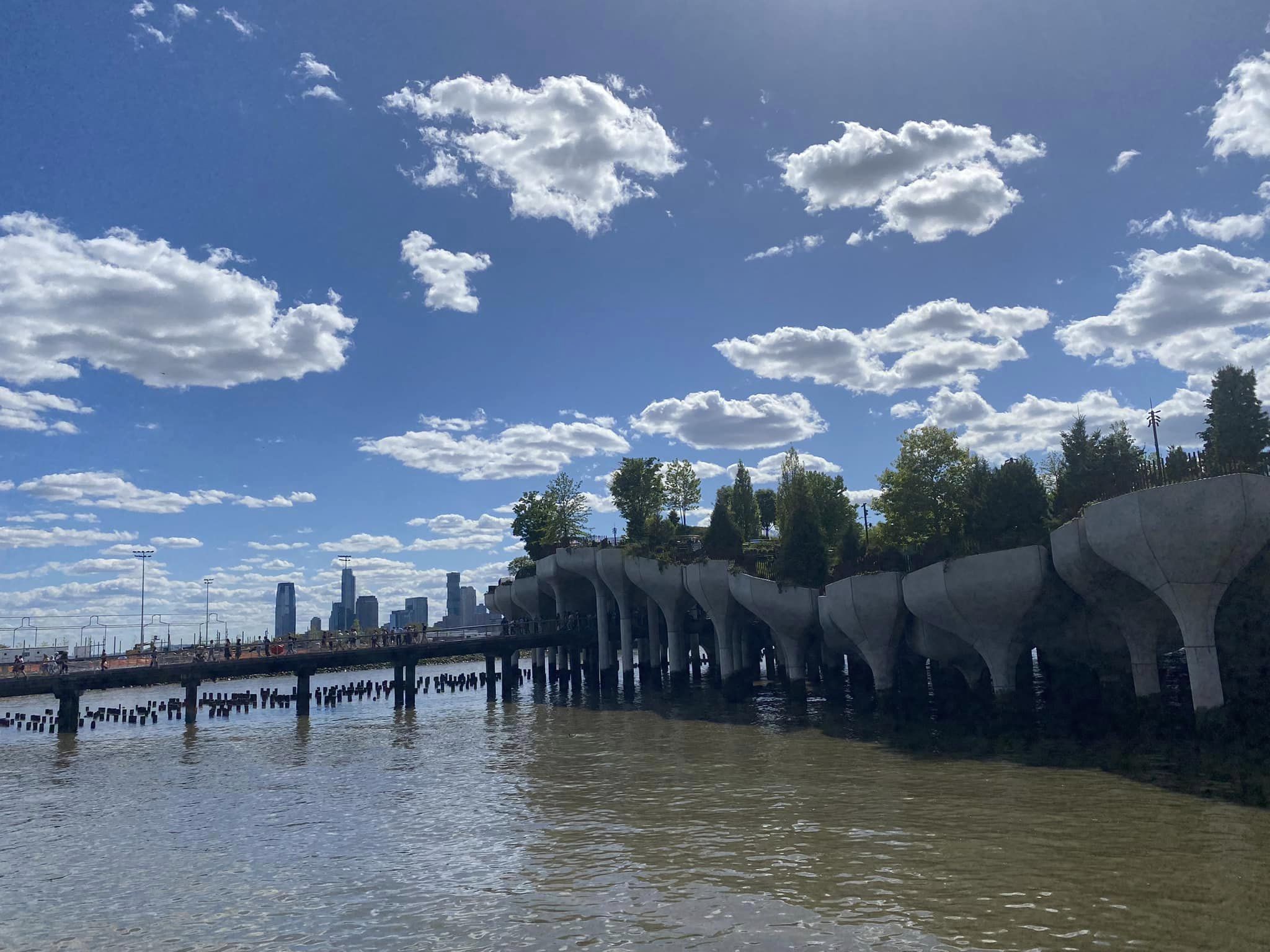
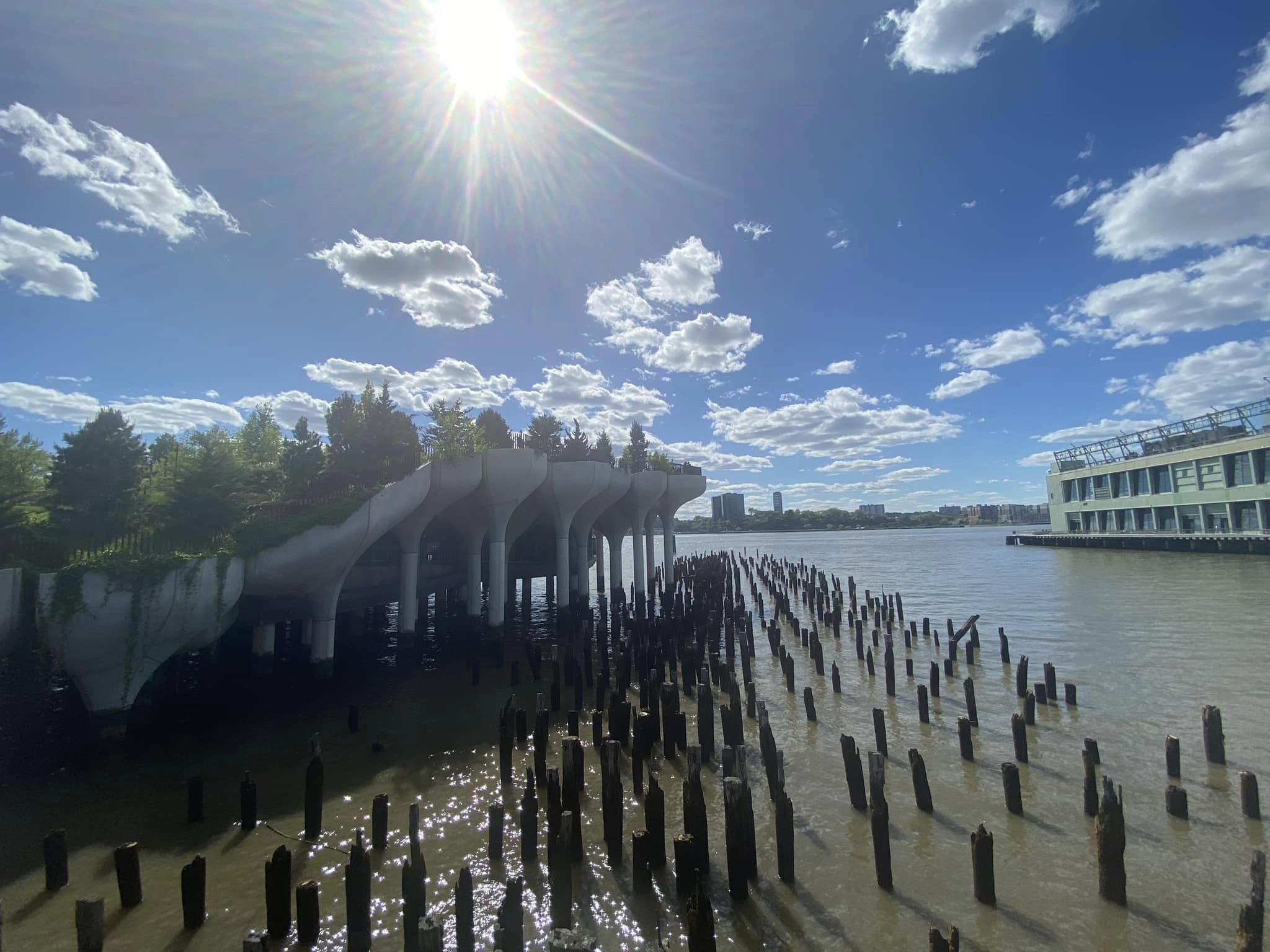
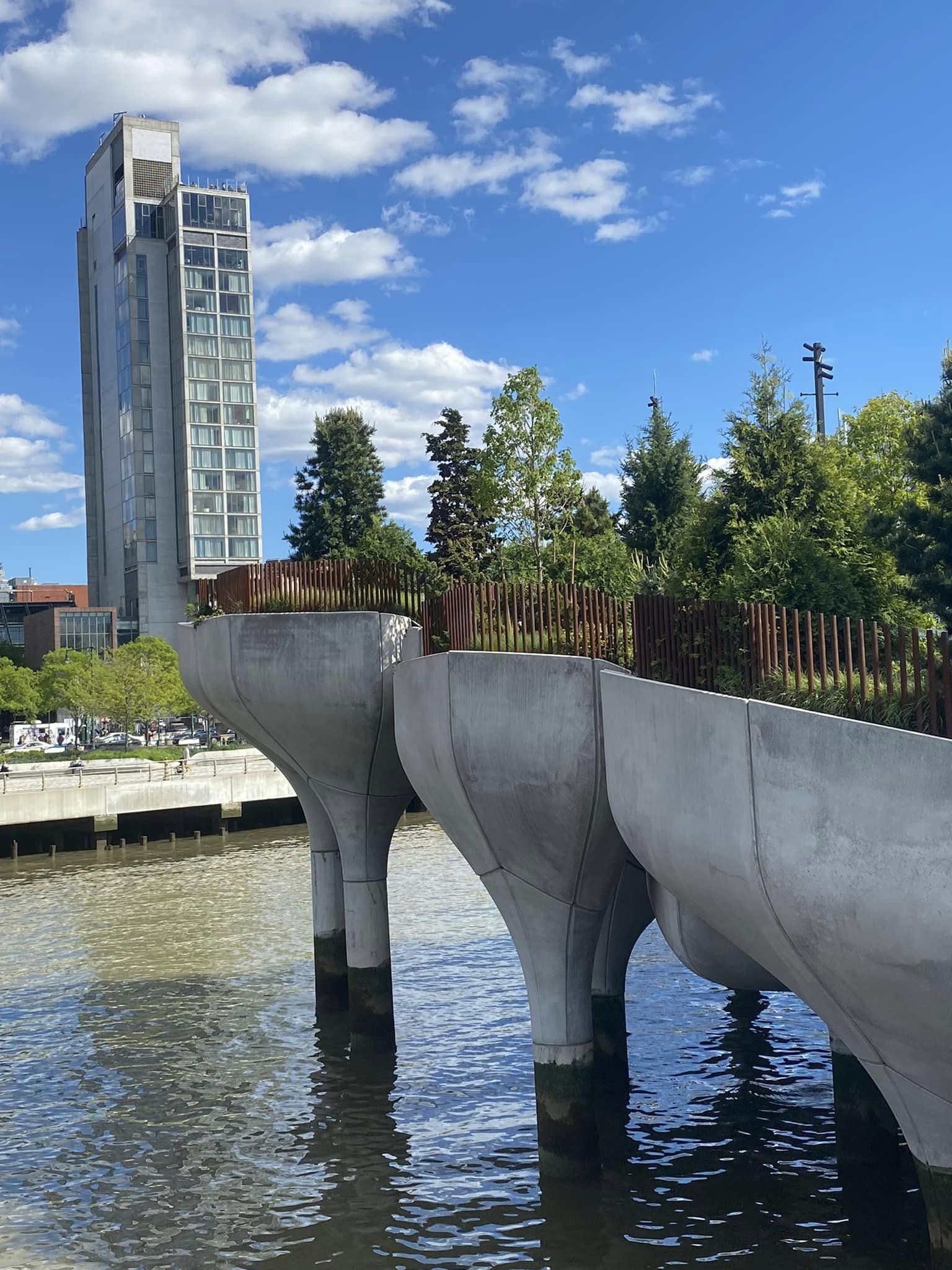
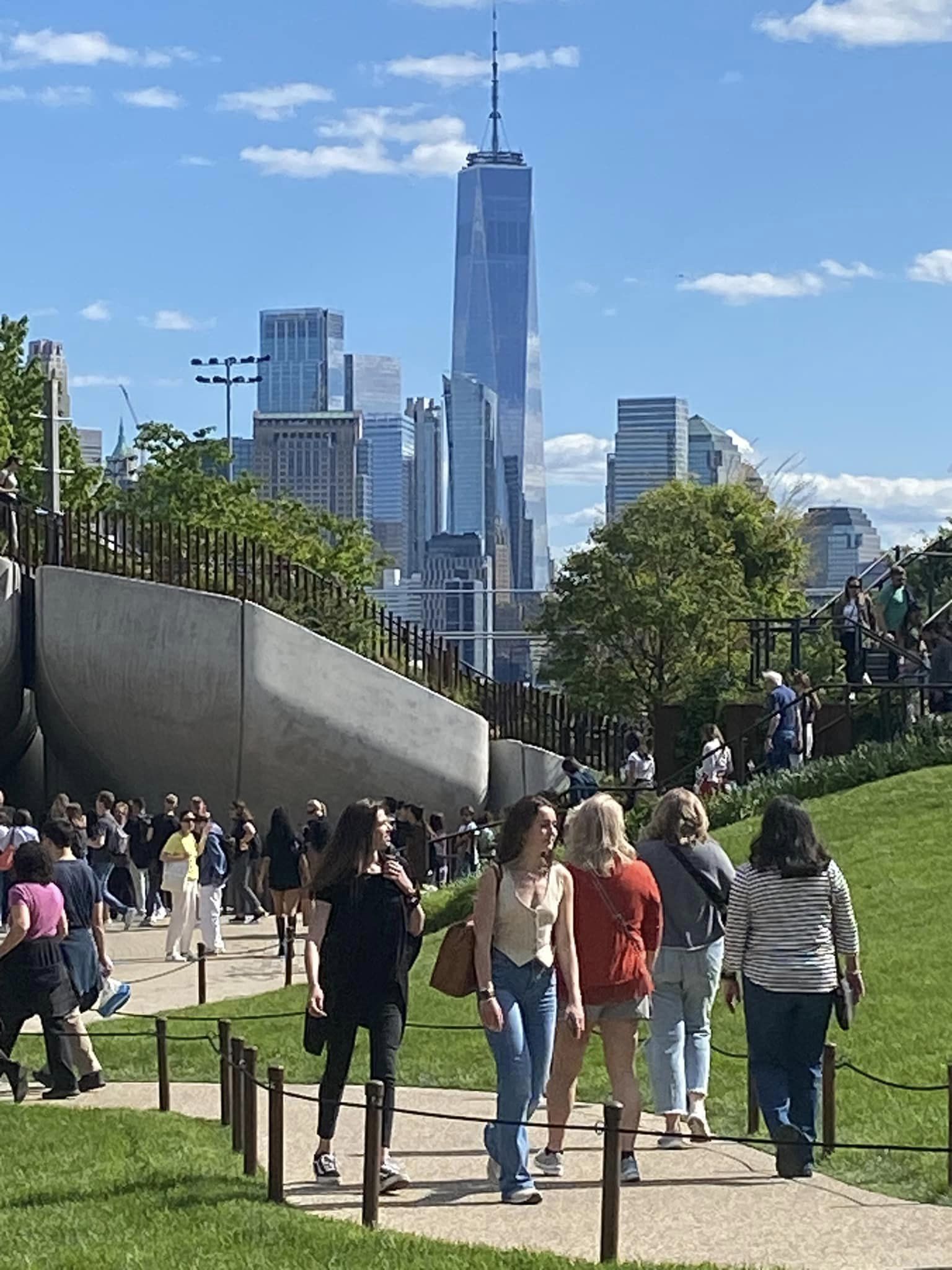
Rising from the waters of the Hudson River where Pier 54 used mark the western end of 14th Street, the man-made Little Island is Manhattan’s newest park attraction. From its website:
“Little Island opened on May 21, 2021 as an oasis for New Yorkers, with more than two acres of magnificent landscape, distinctive architecture, dazzling views and an abundance of free education programs and performances.”
On the first summery Saturday of the year, Little Island proved a popular destination. The wooden remnants of the old piers still stand in the waters below and beside the concrete platforms that form the island park.
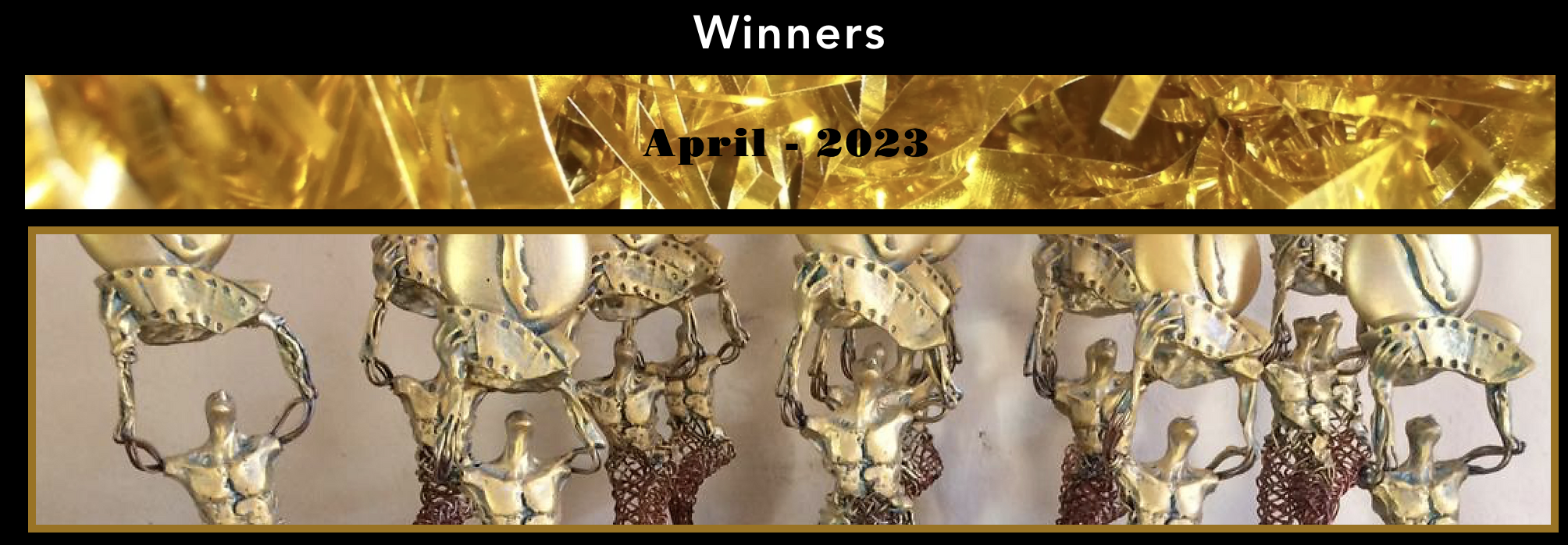
The Astoria Filmmaker’s Club on-line journal has published a short article by Kendall Mullenhour about me and my musical short film Edgar Allan Poe adaptation “The Pit and the Pendulum – a musicabre“, which the Triborough Film Festival (sponsored by the club) had recently awarded 3 trophies.
Ed and I returned home after a week in Naples, Italy (plenty photo posts on that forthcoming), and new Spring blossoms welcomed us back in our neighborhood and garden.
Robinson Film Award winners gathering on stage at the end of the festival
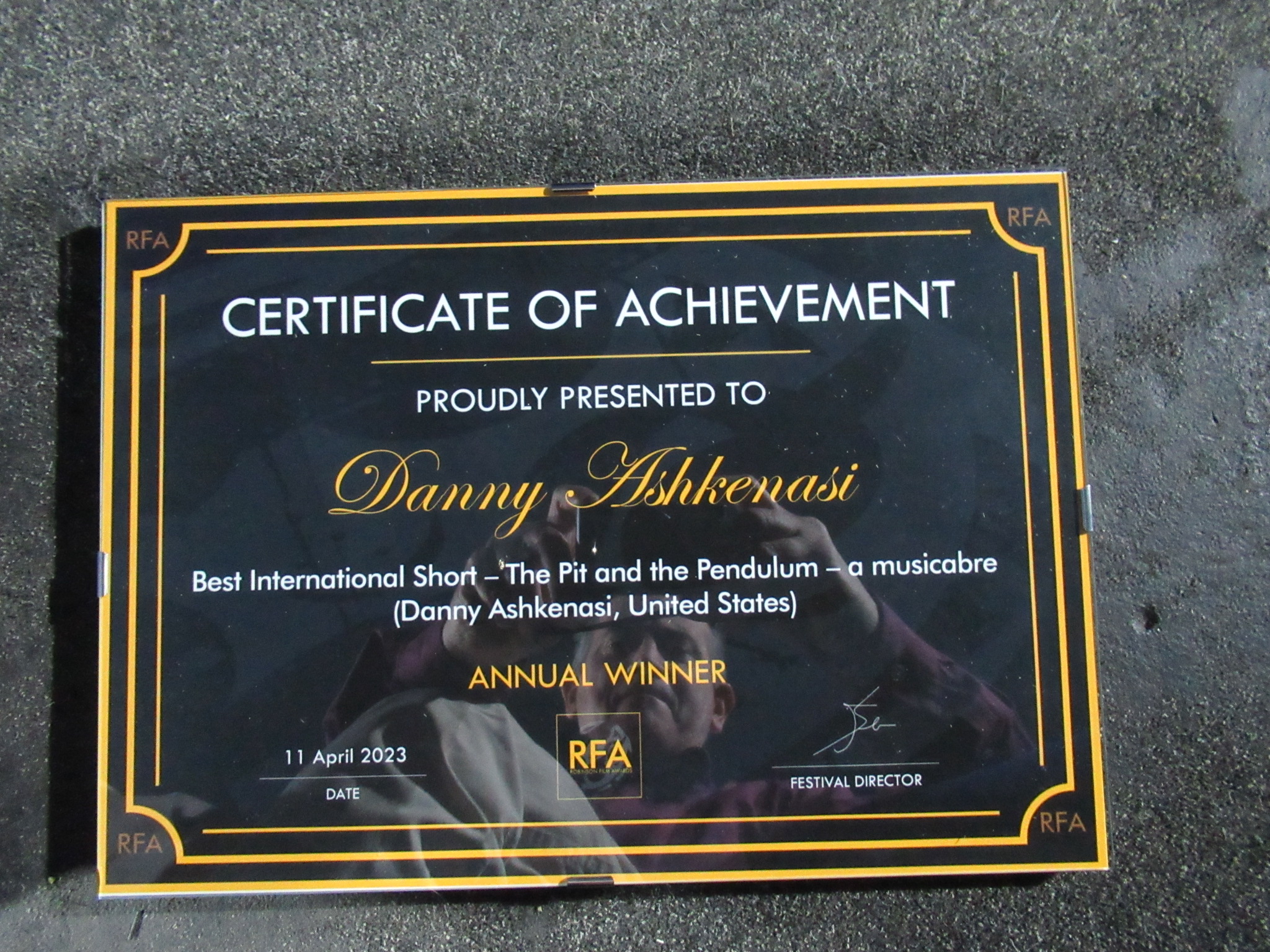
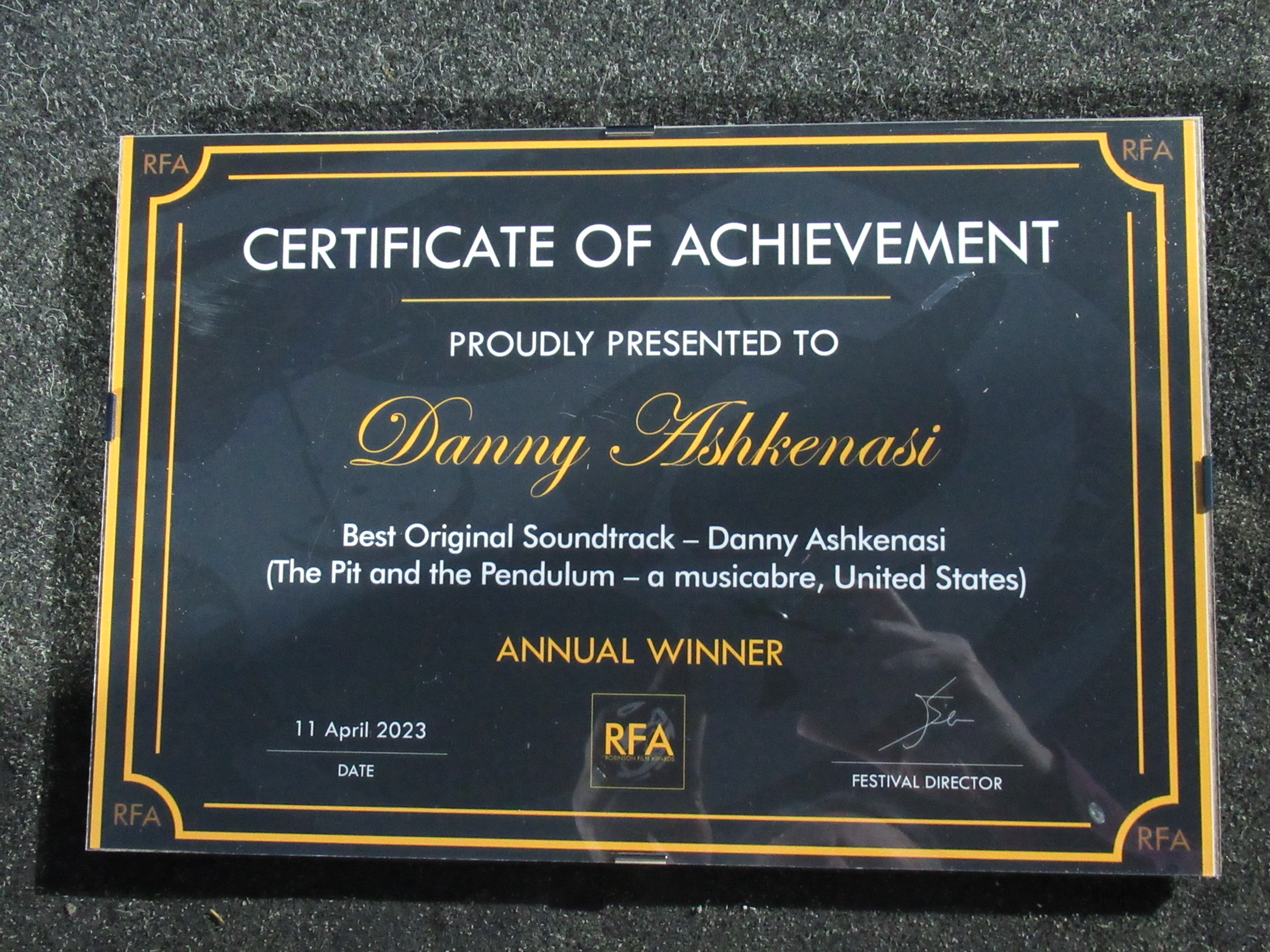
Tuesday, April 11 the Robinson Film Awards presented the best of their bimonthly awards season (“The Pit and the Pendulum – a musicabre“, my musical Edgar Allan Poe adaptation had won Best international Short and Best Experimental Short and Best Soundtrack during their December awards). Short films and feature length films were shown all day, interspersed with live performances.
“The Pit and the Pendulum – a musicabre” was scheduled for 14:00 (2pm).
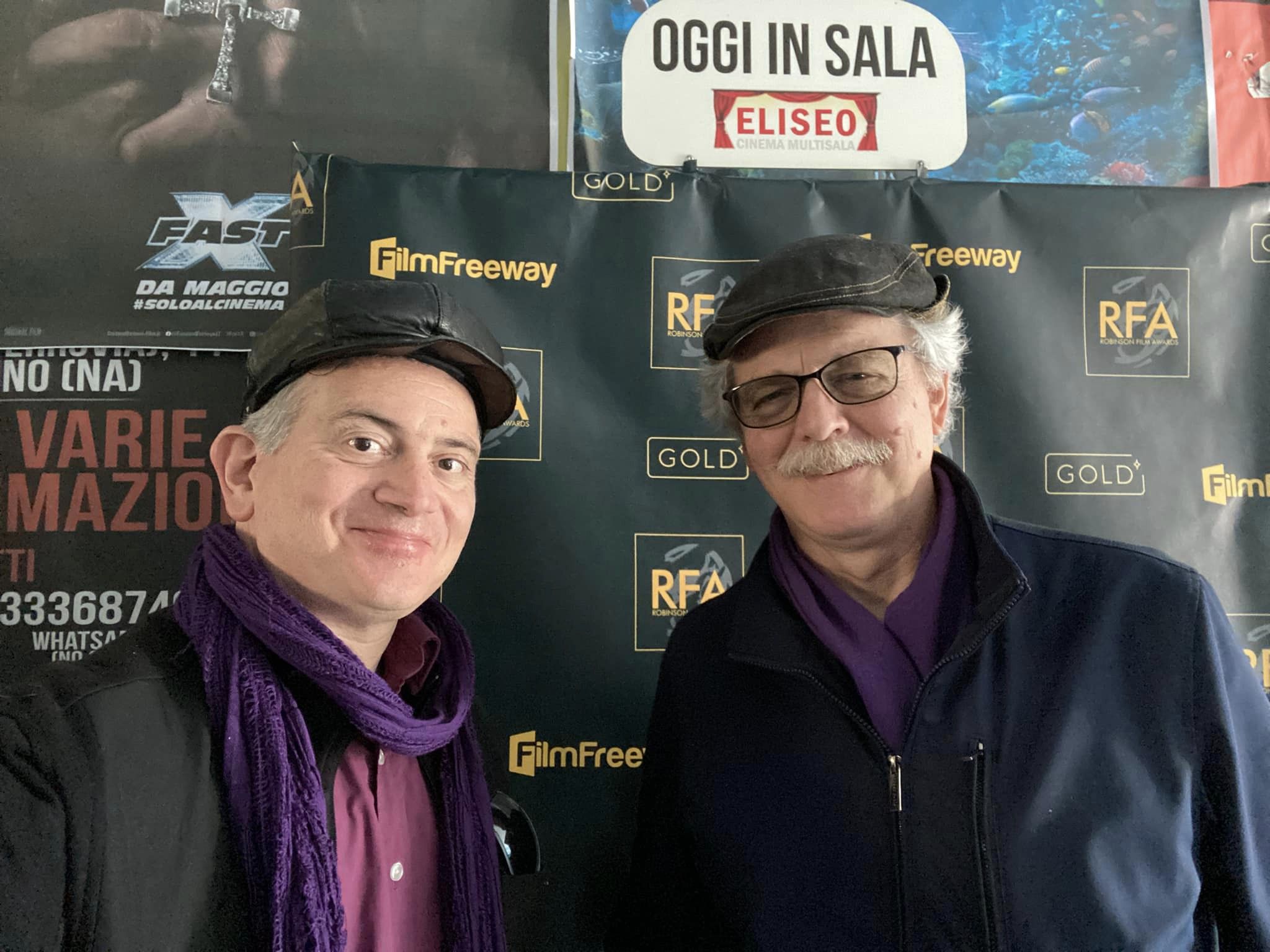
I attended with co-producer, co-actor (and husband) Edward Elder.
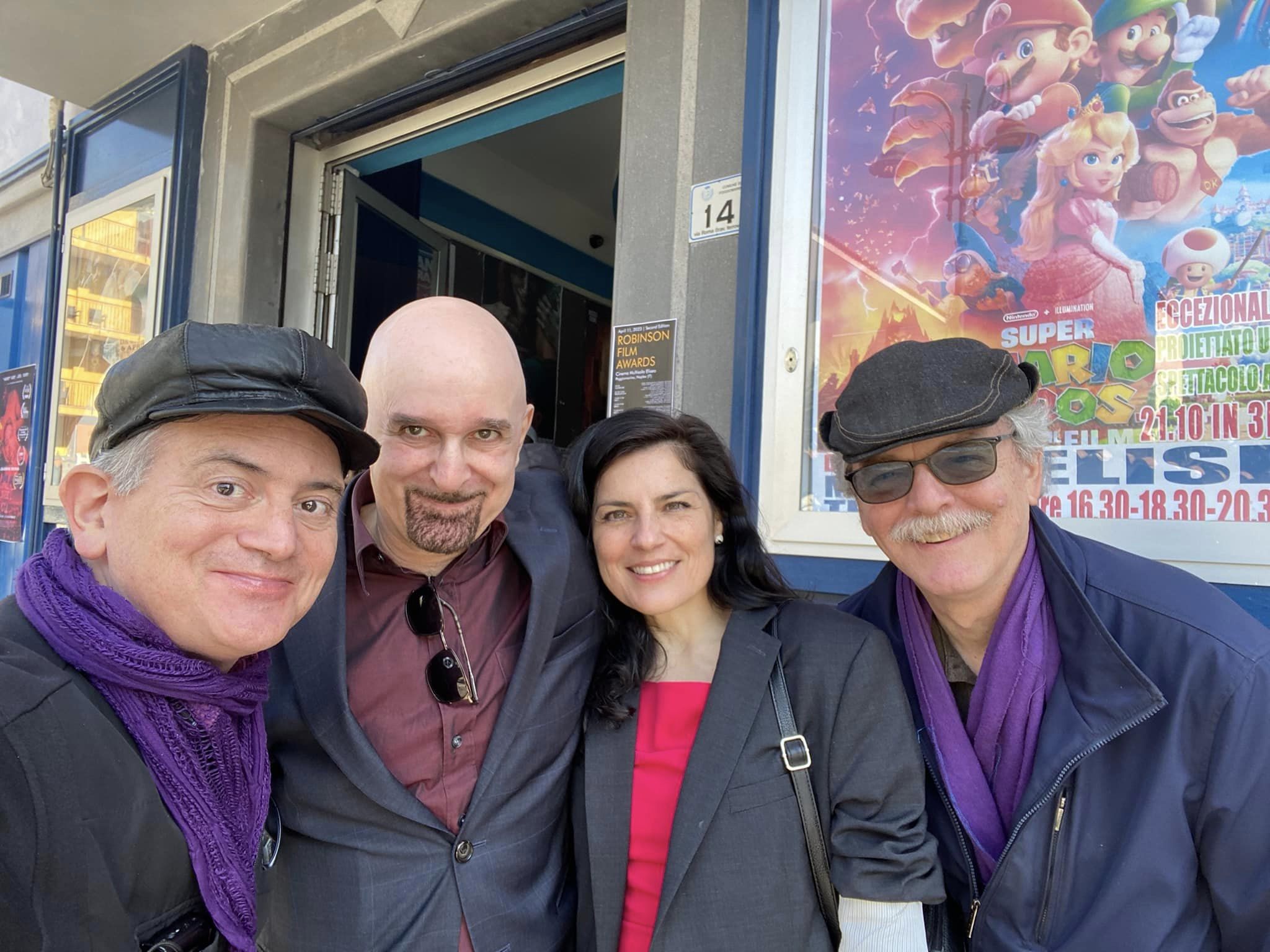
Here we are with John Vamvas and Olga Montes, who would later win Best Actor, Best Actress and Best Feature for their movie “Scarpedicemente”.
The festival commandeered one of the theaters in the Cinema Multisale Eliseo, which normally shows your typical movie fair. (I got a kick out of “Cocainorso”, the one word Italian translation of “Cocaine Bear”.)
Ed and I took our seats early. It would be an all day affair.
Last Tuesday I attended “Der Rosenkavalier” for the first time.
Or rather I attended all three acts of Richard Strauss’ opera “Der Rosenkavalier” for the first time. Family lore has it that I attended Act 2 and Act 3 when I was a small child of three or four, but I don’t remember that event, even if it is a story my mother has recounted often.
The first opera I remember attending was “Hansel and Gretel” at the age of five. Engelbert Humperdinck’s fairy tale adaptation is a far more appropriate first opera for a young child than “Der Rosenkavalier”. I remember the picture book gingerbread house and classically ugly witch, with extravagantly long and crooked nose and chin and hairy warts in ur-traditional Grimm fairy tale fashion. Although I knew even then it was all make believe, it was still daunting for a five year old to meet the singer playing the witch after the performance in the dressing rooms of the opera house and get a close up view of that grotesque make up. She was very sweet and attentive to me, but I looked up at that craggy visage dumbstruck and wary.
My mother was able to take me back stage because she too was a soloist at the Deutsche Oper Berlin, and thus had privileged access.
My mother, Catherine Gayer, was part of the Deutsche Oper ensemble for 41 years before retiring. And the reason I was taken to see “Der Rosenkavalier” at an even more tender age than five is because she was singing the soprano role of Sophie in the opera. Sophie doesn’t appear until Act 2, and so my mother didn’t need to arrive at the opera to get ready until the curtain was raised for Act 1. Act 1 of “Der Rosenkavalier” is too long for a young child, my parents reasoned, but they thought I could handle Act 2 and Act 3, especially with my mother’s character prominent in both.
I could, but not without difficulties, which were not because of stamina or attention span, but because I got a bit too engaged and emotionally invested, as the story goes.
In Act 2 young dashing Octavian – per an ancient Viennese custom wholly invented by librettist Hugo von Hofmannsthal – delivers a silver rose to sweet young Sophie to formalize her engagement to the odious Baron Ochs auf Lerchenau. Sophie and Octavian fall head over heals in love, even though he is secretly having an affair with The Marschallin (a powerful lady boss of Viennese High Society) and Sophie is, well, engaged to marry Baron Ochs. Then Ochs himself arrives and treats Sophie boorishly, manhandling her in physically demeaning and lascivious fashion, proving himself to be just thoroughly rotten and vile (he is basically a model for a certain imprisoned movie mogul and a certain eventually-to-be-imprisoned former never-popularly-elected president).
Quiet sniffles could be heard emanating from a little boy sitting in the orchestra seats while his mother was being awfully importuned on stage. My mother’s colleague, the bass singing Baron Ochs at that performance, heard my distress and went on to feel guilty about it for the rest of his life. It would be a story he too would tell again and again.
My mother, Catherine Gayer around the time I saw her as Sophie in Der Rosenkavalier
During the second intermission, my father took me to my mother’s dressing room. My mother saw my wan, sad-eyed expression and said “Danny, are you tired? You don’t have to sit through Act 3. Would you like to take a nap on my dressing room couch?” I shook my head. My father explained my distress at what I had witnessed. “Don’t worry”, my mother promised, “Baron Ochs will get his comeuppance in Act 3.”
And so he does. In Act 3 Baron Ochs is roundly exposed and embarrassed in near farcical Commedia dell’arte fashion, and forced to give up his claim on Sophie. The Marschallin proclaims his defeat and then graciously leaves young Octavian and Sophie to their mutual happy end.
After the performance my father took me back stage to my mother. I lifted my chin and declared: “Act 3 is much better!”
Cut to 50 plus years later, and I am attending Der Rosenkavalier at the Met, musing at the vocal and physical similarities between Erin Morley, who is singing Sophie, and my mother from all those years ago. When Baron Ochs starts mistreating poor Sophie I felt a burgeoning sense memory of my three or four year old self’s broiling outrage.
I was also musing at the incongruity of what is essentially a knock about bedroom farce being set to Strauss’ lush, densely ornate and time-stretching music. Imagine if instead of Gilbert and Sullivan it had been Gilbert and Wagner. Or if Some Like it Hot had been directed by Stanley Kubrick. Or Tarkovsky. Hofmannsthal’s text is very witty and immensely Viennese but perhaps could have used some pruning before Strauss lengthens time even further by gorgeously and patiently setting every single precious line. The performance ran longer and moreover felt longer than even Lohengrin, which I’d enjoyed at the Met a month earlier. That said, the fun of the farce was still to be had – albeit in a leisurely canter rather a gleeful gallop. And the music is masterful and the singers all fantastic (They wisely cast a true Austrian, Günther Groissböck, as Baron Ochs, whose text is the most over-the-top low-brow Viennese slang – and with a name like Groissböck – which either sounds like or actually is Austrian dialect for Big Goat – it seems like fate he would be the bass to sing Ochs and garner the biggest ovations that night).
Karl Kaefer from the Deviant Legion Network wrote the following on the blog website:
“Join us as we welcome NYC SF Film Festival Award Winner Danny Ashkenasi- director of the featurette “The Pit and the Pendulum”- a “musicabre” based on the Poe short story.
Having seen this film at the festival, I was totally unprepared and astounded by not only the visuals, but also with the music score- which was composed and orchestrated by Mr. Ashkenasi.
So please join us for this very special episode on Thursday, April 6 at 4pm EST.”
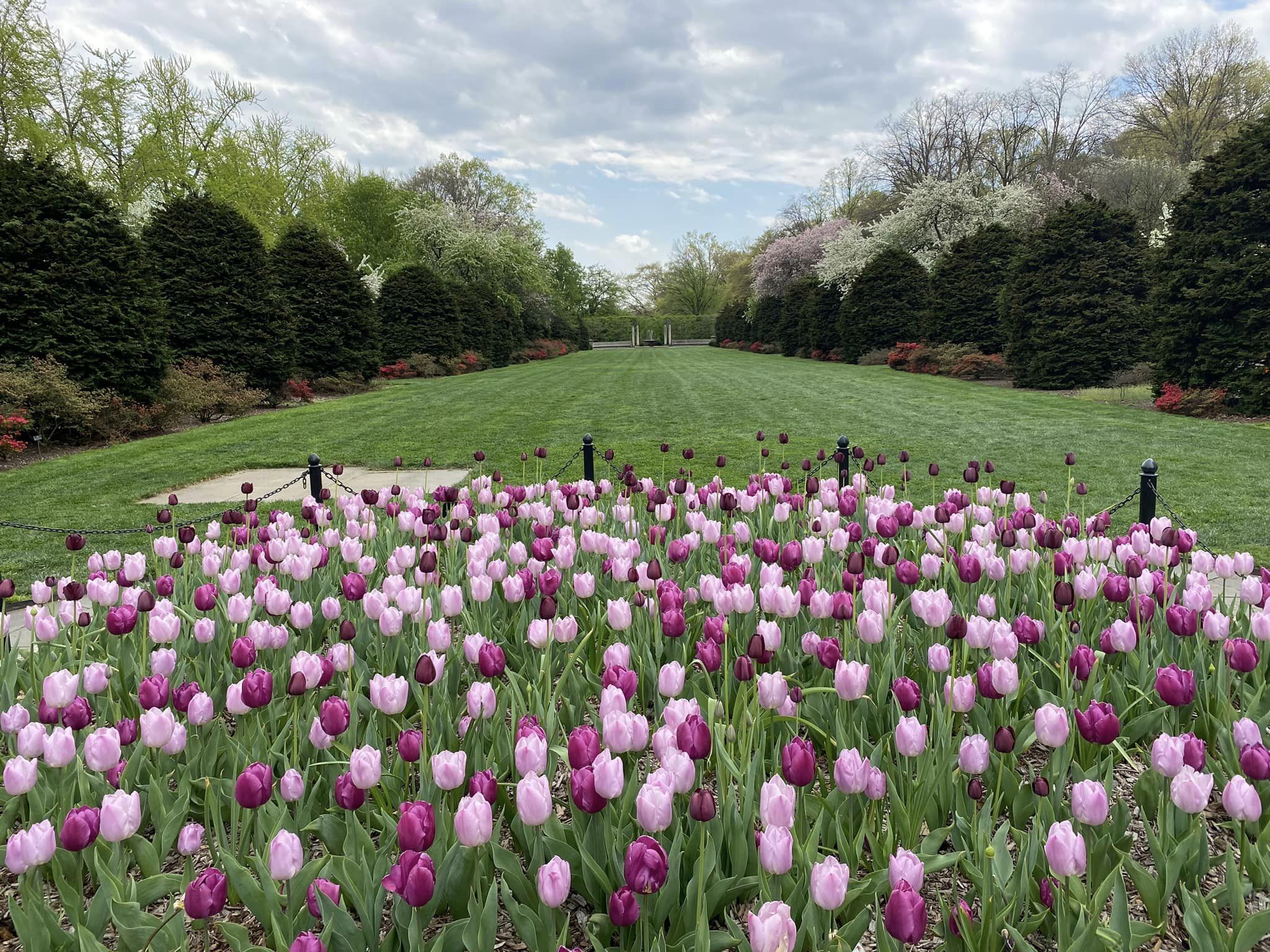
Last Sunday Ed and I enjoyed another jaunt at the Brooklyn Botanic Garden. While much is still in post winter slumber, here and there early spring blossoms – such as daffodils, early cherry, magnolias, and apricot – are writing the first act to a floral extravaganza for which the crocuses had been a mere prelude.
The BBG decided to restrict their daffodils not just to Daffodil Hill – which we will get to soon – but planted a welcoming brigade of them right by the Eastern Parkway entrance.
The main cherry trees at the Esplanade still have a month or so to go before they are in full bloom. (See some previous posts on that here and here.)
But some cherry tree variations at the outskirts of the Esplanade start blossoming before the majority.
I took the above selfie after the Q&A that followed the screening of my musical Poe adaptation “The Pit and the Pendulum – a musicabre” at the the New York Science Fiction Film Festival Saturday near Times Square.
And the screenshot below is from the on-line Q&A with Dan Abella, director of the NYSFFF, after the Sunday virtual screening of “The Pit and the Pendulum – a musicabre”.
Later that evening the award recipients of the festival were announced on Facebook Live. This clip is when “The Pit and the Pendulum – a musicabre” was awarded “Best Horror Featurette”.
Best Horror Featurette. Not bad… not bad at all ….
Group photo of some of the filmmakers represented by the NYSFFF Horror Shorts block:
From Left: Colin Francis Costello, director of STORAGE, Joe Leuben, director of FINGER, Kimberly David, director of CREEPERS, Arik Bariedl director of DILEMMA, and Lead Actor Elli Deja Bauriedl, Danny Ashkenasi director of THE PIT AND THE PENDULUM- A MUSICABRE, Dan Abella, director of The New York Sci-Fi Film Festival
On the first day of shooting “The Pit and the Pendulum – a musicabre”, we were not in the studio theater where sets were being built for the lion’s share of our 10 day shoot. On the first day we were in our own home, specifically shooting in our bathroom.
Most of that day required me sitting in the filled bathtub.
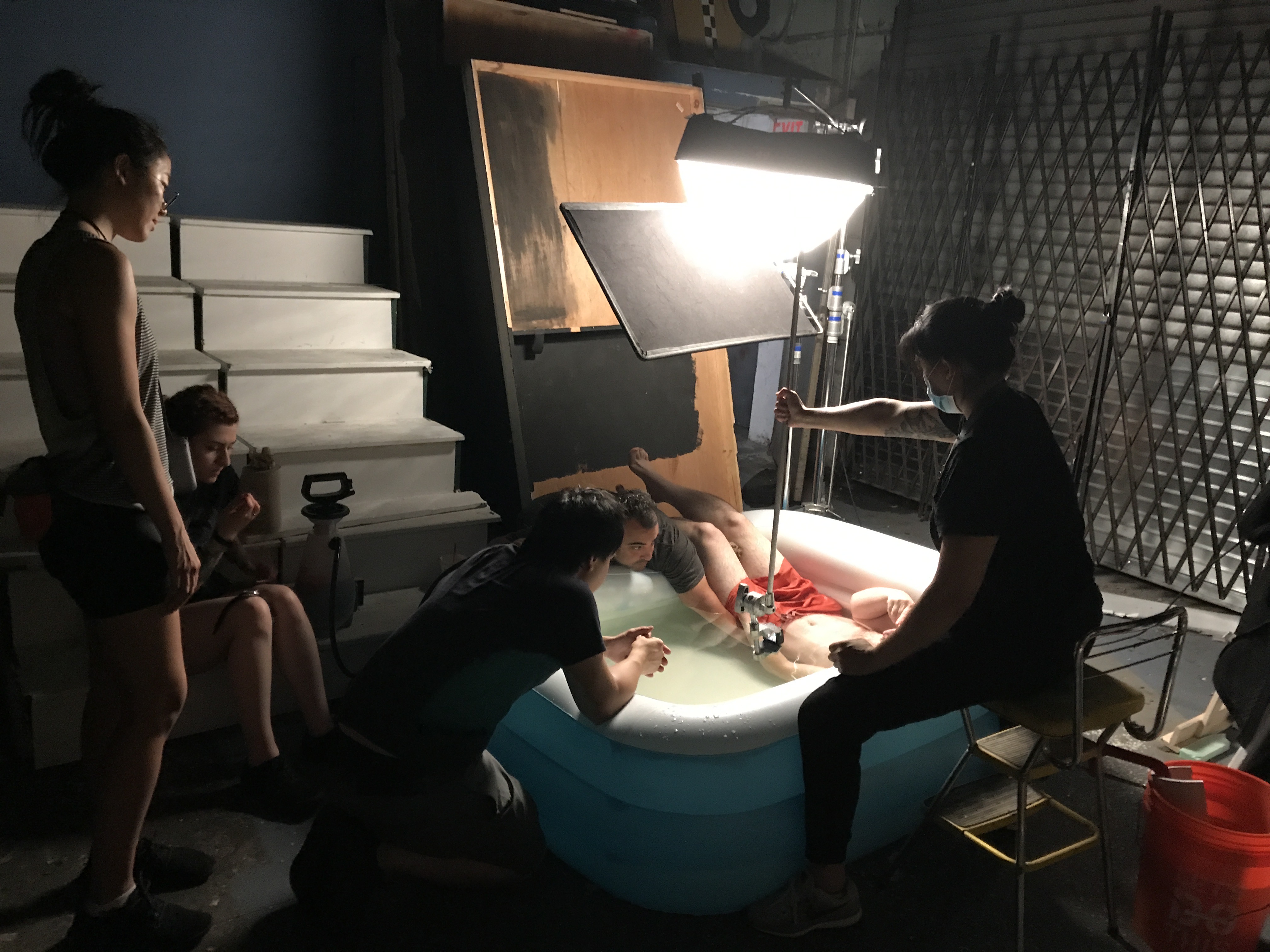
On the seventh day of shooting, late in the evening, we captured the underwater shots that were not possible in our own bathtub, mainly because it was just too narrow to get the camera underwater with enough distance to me to capture the shots we needed – like the one above.
So our production designer Mariana Soares da Silva ordered a kiddie pool and painted it white to approximate the underwater look of the bathtub.
And once again I had to peel off down to my swimming trunks for the art.
SPOILER ALERT!
Major spoilers for the end of “The Pit and the Pendulum – a musicabre” follow. You’ve been warned!
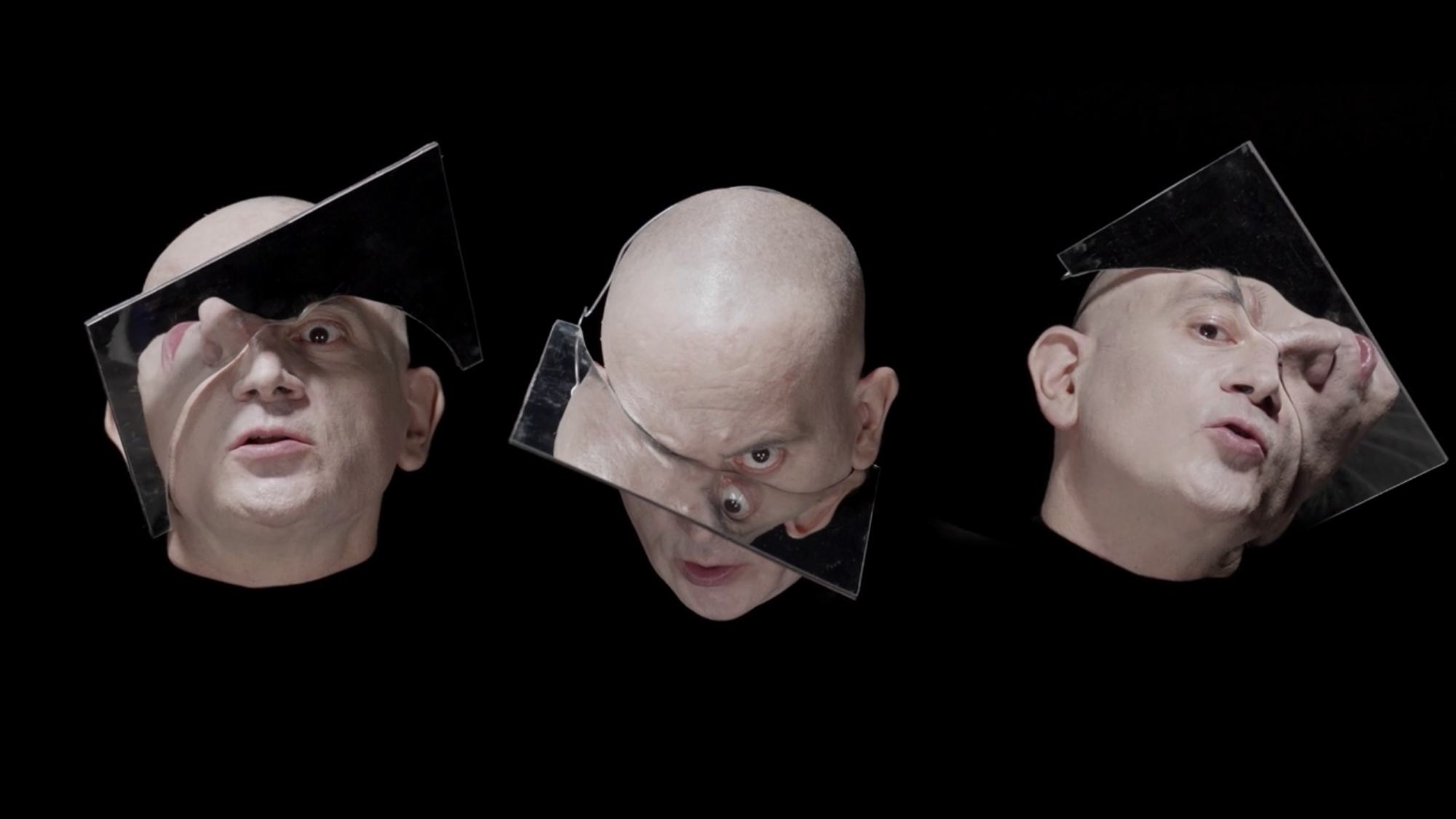
There are several shots of me underwater. But the main one, which required the use of a long rubber tube, is a close up shot of my left arm and torso as blood pours into the bathwater. You see, while the protagonist of “The Pit and the Pendulum – a musicabre” imagines himself the victim of Poe’s version of the Spanish Inquisition, he is slicing his wrists in a bathtub. During the fiery, surreal climax of Poe’s story in the film, quick cuts to the blood in the bathwater clue in the audience as to what is really happening in the here and now.




























































 Notes from a Composer